
 Host Marianne and Steve from www.ecoorganicgarden.com.au are talking about citrus and things to watch out for in Plant Doctor growing an Asian greens in Vegetable Heroes; holly leaves can be native in Plant of the Week plus which flowers are ethylene sensitive in Talking Flowers
PLANT DOCTOR
NEW Citrus Watch
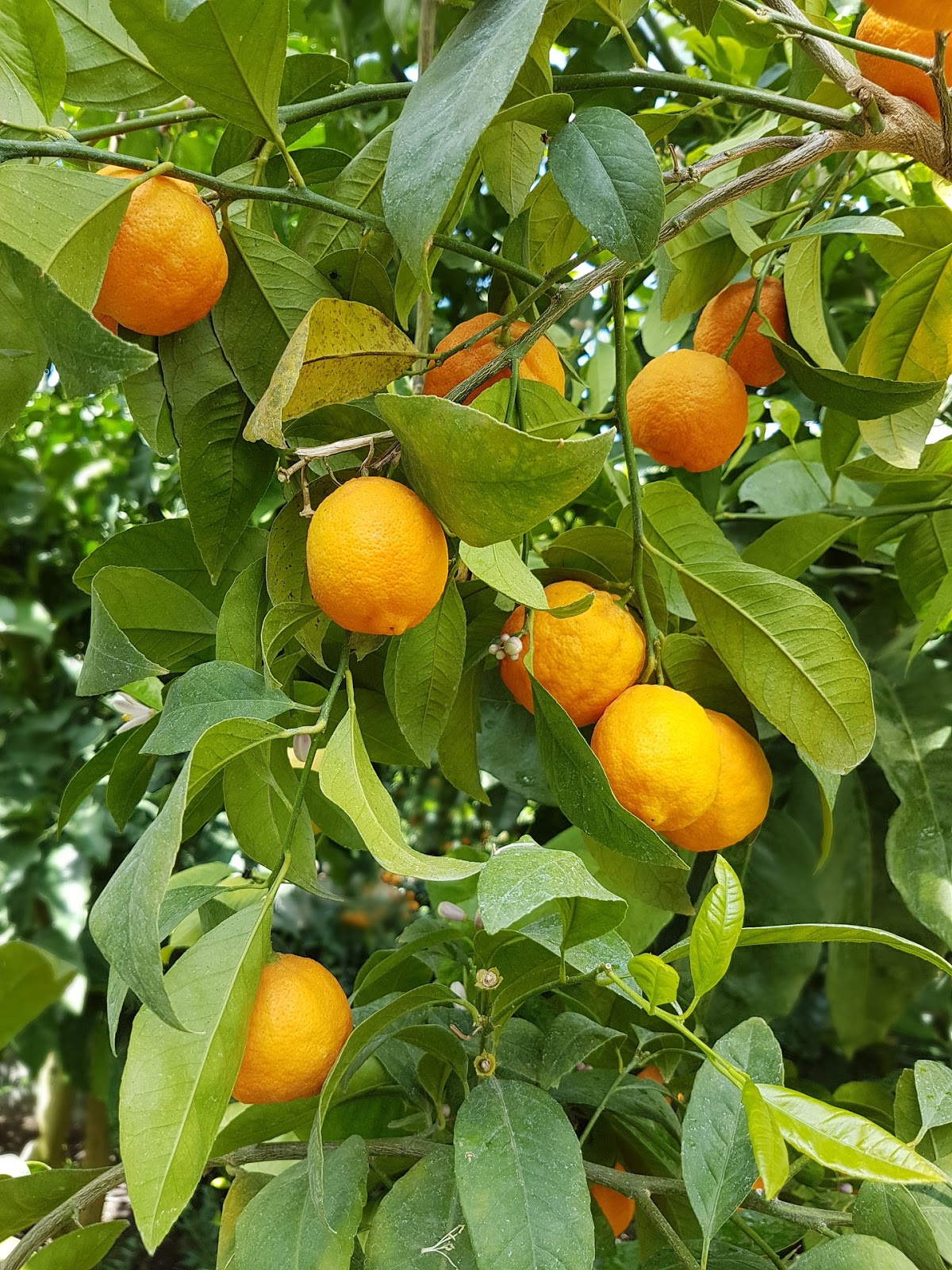
Citrus trees have their fair share of pests of diseases and control is better if it’s done proactively. Certain times of the year are crucial in beginning your control program, but don’t worry, it’s not too daunting.
Let’s find out what needs doing
I'm talking with Steve Falcioni of www.ecoorganicgarden.com.au
There are several types of pests
Sap Sucking Pests: control with botanical oils such as eco Oil
- mites,

Fruit flies sting the fruit leaving a telltale black spot on the outside. - aphids,
- scale,
- bronze orange bug- need to control at green nymph stage when the bugs measure only a few millimetres. Once they start to colour up, oils will not control them.
- neem oil is registered for control of bronze-orange bugs on ornamental citrus.

Chewing Pests; caterpillars: control with Dipel
Queensland fruitfly: control with pheremone lures, spinosad based pesticides and/or exclusion netting.
Mediterranean fruitfly (found in W.A.) control with spinosad based pesticide and/or exclusion netting.
Timing is the key for pests and diseases because they have a lifecycle which tells us when the pest is most vulnerable or when the diseases is most likely to strike.
This is a good indicator of when control is most effective.
After all, you don’t want to waste your time, energy and money using a product that won’t work as well as it should because it’s the wrong timing.
If you have any questions for me or for Steve, why not write in to Realworldgardener@gmail.com or write in to 2rrr, PO Box 644 Gladesville NSW 1675.
This is a good indicator of when control is most effective.
After all, you don’t want to waste your time, energy and money using a product that won’t work as well as it should because it’s the wrong timing.
If you have any questions for me or for Steve, why not write in to Realworldgardener@gmail.com or write in to 2rrr, PO Box 644 Gladesville NSW 1675.
VEGETABLE HEROES
Asian greens.
- Did you know that Asian greens are all a distant relative of Broccoli, Cabbage and Cauliflower?
- Asian Greens have been grown in China since the 5th century however, it wasn’t until the
- 18th century when Asian greens made their way into Europe after seeds were sent.
- As for Australia, wasn’t until Chinese migrants, who arrived during the 1850’s Gold Rush, brought their traditional vegetables with them.
- When the gold petered out, many Chinese became
market gardeners growing the pak choi family and other leafy green vegetables.Chinese market gardens still exist around the
capital cities today.

Tatsoi, Mustard Greens, Mizuna

Many Different Names for Asian Greens.
To some people because there are many different
types, have many names which may even have different spellings depending where
they come from. Names include Chinese White Cabbage, Chinese Chard, Chinese
Mustard Cabbage, bok choy, pak choy paak
tsoi, choy sum - as I said
Confucius...er... confusing!
- These are all non-heading forms of Chinese cabbage with thick white crisp leaf stalks and veins and shiny smooth broad or wide dark green leaves that create a loose cluster.
They all tend to have smooth edges to the
leaves.
There are also those cultivars that have pale
green stems instead of white, and the leaves are paler green in colour.
Pak choy and bok choy are basically the same
plant.
“Bok Choy has a white stem, and pak choy has a
green stem.
Choy sum, is also known as the Chinese
silverbeet.
Confusing names aside, when to grow them?
Asian greens-can be grown basically anywhere in
Australia.
The main commercial crops are Gympie, the
Sunshine Coast, Windsor in Sydney, and the Metropolitan area in Melbourne.
Sometimes Asian Greens go to seed too quickly.
- The right climate and timing is very important and this depends on where you are.
- If you are battling against your Asian greens-Pak Choi, Bok Choy bolting to seed the reason is plant bolts to seed early because they want to reproduce.
- If your soil is a bit too sandy, which has high silica content, then this will lead to early bolting.
- So keep topping up your organic matter in the soil and your harvest should be fine.
- This normally is a good indicator that the soil is out of balance, ie there needs to be more organic matter in the soil.

Bok Choy - For example in sub-tropical areas, Asian greens can be planted in most months of the year, but April, May and September to November are best.
- In temperate areas of Australia-remember temperate is from around Sydney down to Tasmania but only includes the coastal areas-here you can sow the seeds now and shouldn’t have the bolting to seed problem.
- Asian greens all love full sun, except in parts of Australia with very hot summers.In these hot spots, part shade is fine, so consider using some other plants, like beans and sweet corn, as ‘living shade’. Or erect a shade tent.
- How To Sow
- Before sowing seed work in a plenty of compost and blood and bone. You should also add some Potash because Asian greens like not only lots of Nitrogen but lots of Potassium.
- The seeds for Asian greens are very small so don’t bury them too deep. Just make a small impression in the soil about 5mm deep.
- Sprinkle them in the row and lightly cover them with soil.
- Asian greens also like lots of magnesium and because magnesium helps germination, put about half a teaspoon of Epsom salts, into two litres of water. Give it a good shake around and then water the seeds with that mixture.They will come up in about a week.
- In six weeks, you’ll be harvesting your Asian greens.

Harvesting
 |
| Choy Sum Stalks |
Pull them out of the ground then remove the
root ball and trim it with a knife. Wash them to remove the sand and the greens
are ready to cook.
Asian greens tend to attract insects, which
love to eat them. “Aphids, cluster grubs, diamond back moth.
Everything will have a chew on them but it
doesn’t matter because even if you’ve got a hole in the leaf, it makes no
difference to the cooking or flavour and once these leaves wilt down, you won’t
even see the hole.
Why are Asian Greens good for you?
In many Asian cultures, people believe that
food should be their medicine.
Bok choy would be a good choice as we’re an
excellent source of vitamin C
• Asian greens contain dietary fibre as well as
some iron, calcium and folate.
• Also a good source of beta carotene which
your body can make into vitamin A. Your eyes need vitamin A.
THAT WAS YOUR VEGETABLE HERO FOR TODAY
PLANT OF THE WEEK
Holly Leaved Fuchsia:Graptophyllum ilicifolium
There are those gardeners who think that native plants look straggly or messy and won’t plant them in the garden.
No mixing up of plants for them.Perhaps the holly leaved fuchsia will have them changing their minds because it looks more like something from the northern hemisphere.
A medium shrub 3-5m high found in fairly dry rainforest areas or along creek bank.
PLAY: Holly Leaved Fuchsia_9th October_2019
Graptophyllum ilicifolium, or holly leaved fuchsia is quite unusual, and may just suit your garden.
Leaves look like those of a holly bush so very useful for Christmas decorations perhaps?
The flowers are fuchsia like, but obviously this plant is tougher than your regular fuchsia because of the tougher leaves.
Actually occurring only in a small pocket west of Mackay in Queensland.
Moderately fast grower in warm climates, but slower in cool temperate areas.
WatchLet’s find out more. I'm talking with Adrian O’Malley, horticulturist and native plant expert.PLAY: Holly Leaved Fuchsia_9th October_2019
Graptophyllum ilicifolium, or holly leaved fuchsia is quite unusual, and may just suit your garden.
Leaves look like those of a holly bush so very useful for Christmas decorations perhaps?
The flowers are fuchsia like, but obviously this plant is tougher than your regular fuchsia because of the tougher leaves.
The flowers appear in spring and summer along the stems.
If you have any questions for me or for Adrian, please write in to realworldgardener@gmail.com
 |
| Graptophyllum ilicifolium: holly leaved fuchsia |

