Pages

Showing posts with label growing cucumbers. Show all posts

Saturday, 29 December 2018

Festive Flowers, Basil and Cucumbers

What’s on the show today?

Plenty tips about growing and cooking with Basil in the Spice It Up segment with herb and spice guru Ian Hemphill,; get those cucumbers growing in Vegetable Heroes; Festive red flowers but are they in Plant of the Week and which fence for your garden in Design Elements?

SPICE IT UP

Basil: Ocimum basilicum
At one stage the Greeks and Romans believed the most potent basil could only be grown if you sowed the seed while ranting and swearing.
Basil
Maybe that’s why the French say semer le baslic (sowing basil) means to rant.
Well I hope you don’t have to swear and rant to get your Basil seeds to germinate, just have your pencils at the ready if you want to know how to grow, use and store
I'm talking with Ian Hemphill from www.herbies.com.au

Herbs take on a different flavour when they're dried, because they lose their top notes.
Dried herbs are best added at the beginning of cooking so that they have time to infuse the dish with their flavour.
Fresh herbs on the other hand, need to be added at the very last minute so that their flavour doesn't disappear in cooking.

If you live in arid or sub-tropical regions you can sow Basil in late august in a mini greenhouse or indoors, but otherwise you can sow right through to December which is the best time to sow Basil seeds.
The seeds are best planted at soil temperatures between 18°C and 35°C
For something different when not try sowing cinnamon Basil or Lemon Basil or even Holy Basil, that is the true sacred basil that is grown in houses, home gardens and near temples all over India.…
If you have any questions about Basil either for me or Ian, why not email us realworldgardener@gmail.com or write in to 2RRR PO Box 644 Gladesville NSW 1675 

VEGETABLE HEROES

Cucumbers or Cucumis sativus..
Cucumbers just love the hot weather, so they’ll germinate and grow quickly at this time of the year.
Cucumbers are a member of the gourd or cucurbit family and have been grown for 4000 years!
Did cucumber start off in India?
No-one’s really sure.
Who Ate Cucumbers Throughout History?
Some pretty famous people have been known to be fans of cucumbers, even cucumber pickles.
  • Take, Julius Ceasar, he ate them everyday, Cleopatra, thought cucumber pickles helped her skin complexion, and other pickle lovers included George Washington and Queen Elizabeth 1.
  • Would you have thought that Cucumbers are one of the world’s favourite vegetables?
  • I would’ve said the tomato, but there you go.
  • When is the best time to grow some cucumbers?
  • Cucumber plants do best in all types of temperate and tropical areas and generally need temperatures between 15-33°C.
  • Cucumbers are happiest when the average temperatures are around 210C
  • For this reason, they are native to many regions of the world.
  • Sow the seeds of Cucumber in late Spring and early Summer for cool temperate districts, spring and summer for arid and temperate zones districts, from August until March in sub-tropical areas.
    Cucumber seedlings on the right
  • Only the cooler months for tropical areas-so April until August unless you’re inland.
And where can you grow these delicious cucumbers?
You need to pick a sunny, well-drained spot, because Cucumbers are a subtropical plant, that needs full sun.
Cucumbers also want a decent amount of growing space in your garden. If you’re short on space, try growing them up vertically on a trellis or even on some netting, perhaps a tomato trellis?
In fact, growing up a trellis would be a great way to avoid all the mildews and moulds that cucumbers are prone to in still humid weather.
There’s also a number of dwarf varieties if you’d like to grow your cucumbers in pots.
  • Try Mini White- one of the most popular. The 10 cm long fruit and is best picked when young. Gives you lots of fruit per plant and it’s burpless  
  • Or you could try Cucumber Mini Muncher as well.
  • You’ll need to go to a seed mail order place for those, or if you’re in Adelaide, go to the shop in the Botanic Gardens.
The best thing is that Cucumbers aren’t picky about soils.

However, do you find your Cucumber seeds sometimes don’t germinate?
They’re big seeds but if you’re raising them in punnets and the seed raising mix dries out, then the seed most like has dried up as well;
  • and if you keep it too wet, then the seed rots.
  • If this keeps happening, try using another type of seed raising mix, or even some good quality potting mix and try again.
  • What cucumbers like is soil that’s well-draining and has a pH of around 6.5.
  • Add in plenty of organic compost and fertilisers like chook poo or cow manure.
  • When your seeds have germinated, pick out the strongest couple and throw away the others so you don’t get overcrowding.
  • When your cucumber has gotten going, water it  regularly at the base of the plant, that way the leaves stay dry and you lessen the chances of the leaves getting the white powdery stuff growing on them, powdery mildew disease.
What is Powdery Mildew?
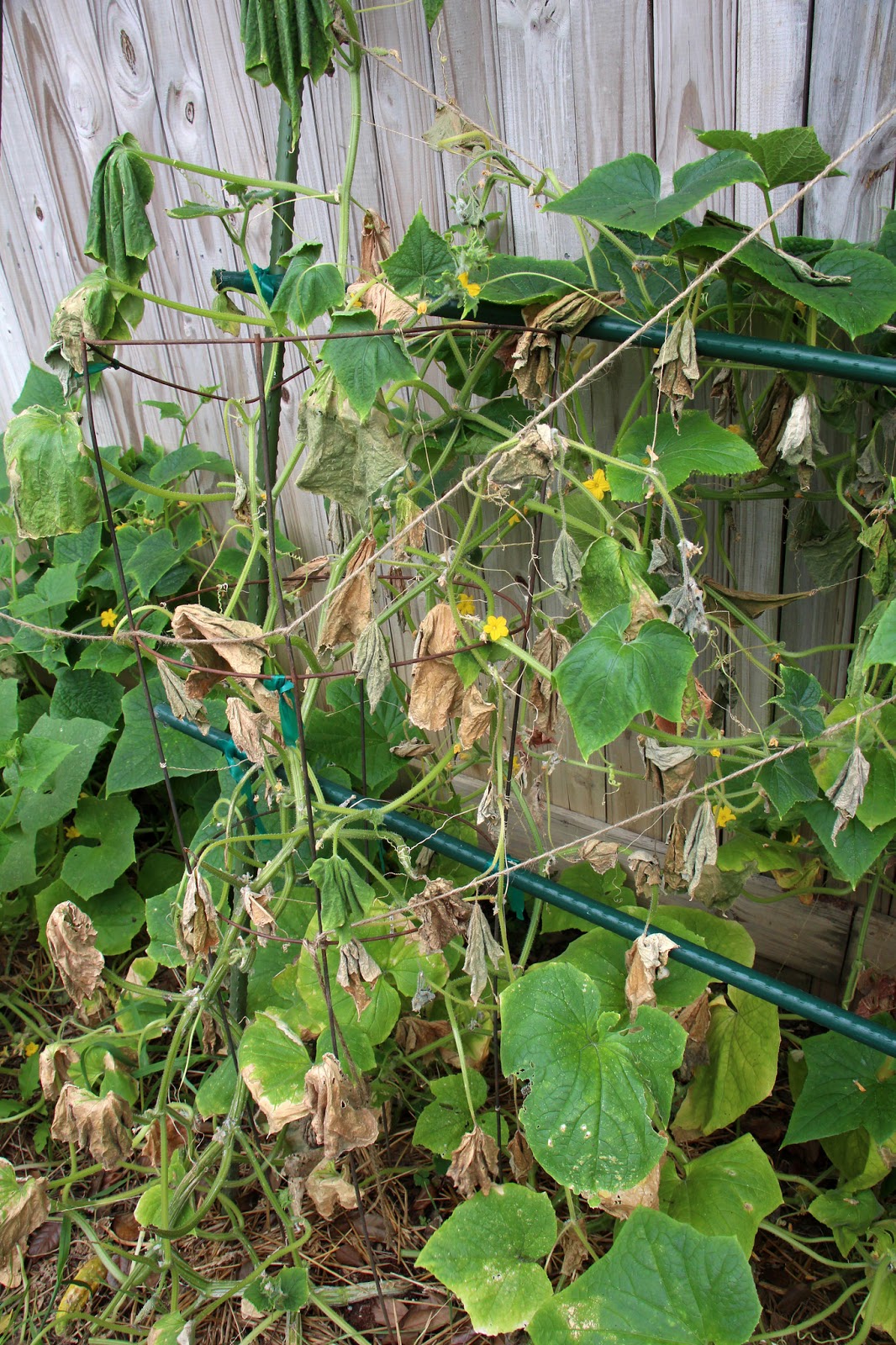
Advanced stages of disease.
  • Powdery mildew is a fungal disease that is spread by spores carried by the wind.
  • Look for white to grey fungal deposits on the leaves and stems of your cucumbers. As the mildew spreads, the leaves become brittle then start to die off.
  • There are some types of cucumbers that resist this disease for a time anyway.
  • You can also try a natural fungicide. 1 part whole milk to 10 parts water, and spray in the cool of the day.
  • Better still apply eco Fungicide from www.ecoorganicgarden.com.au 
Don’t forget to feed your cucumber plants every couple of weeks with a soluble plant food.
There’s so many now on the market, an some come with seaweed added into them as well.

Who out there hasn’t tried a cucumber that’s tasted bitter?

  • I’m sure some time in your life, that’s happened hasn’t it?
  • There’s seems to be a few theories for bitterness in cucumbers
  • One theory is that the bitterness is caused early in the plant’s development by terpenoid compounds that give a bitter flavour to the entire plant.
  • Usually the bitterness accumulates at the stem and below the surface of the skin of the cucumber.
    Cucumber Biet Alpha
  • According to this theory it’s a genetic problem.
  • Newer cucumber hybrids seem to have fewer problems with bitterness.
  • I’ve always thought it to be the result of Cucurbitacin.
  • Found in most cucumber plants, Cucurbitacin causes fruit to taste bitter.
  • Cucurbitacin levels increase when a plant is under stress, and can make the fruit taste really bitter.
  • The concentration of these compounds varies from plant to plant, fruit to fruit, and even within the individual fruit itself.
  • Did you know that the ability to taste detect bitterness or cucurbitacins also varies from person to person.
  • Even insects have varying preferences for cucurbitacins- the compounds attract cucumber beetles but repel other insects, such as aphids and spider mites.
  • Anyway, it proves that you shouldn’t stress out your cucumbers!
  • By the way, if you do get a bitter cucumber, peel it and cut of the ends by about 2.5cm, that’s where the bitterness concentrated.
Cucumber Flowers
Just like zucchinis, cucumbers have separate male and female flowers. 
Cucumber flowers
Male flowers come out at first, but don’t worry too much because the female flowers will arrive soon after. 
Cucumbers should be ready at about 50-60 days and picking fruit often stimulates more to start growing. 
When to Pick?
Some of you probably have realised that if you pick your cucumbers when they’re quite small, this is when they’re at their sweetest.
Twist the cucumbers off the plant or cut the stalk just above the cucumber tip.
They keep for 7-10 days in the fridge then the start to look like something that came from outer space…green and slimy
Why are they good for you?
Cucumbers have lots of Vitamins C but why you should eat them is because the silica in cucumber is an essential component of healthy connective tissue, you know, like muscles, tendons, ligaments, cartilage, and bone.
Cucumbers have some dietary fibre and Cucumber juice is often recommended as a source of silica to improve the complexion and health of the skin, plus cucumber's high water content makes it naturally hydrating—a must for glowing skin.
AND THAT WAS OUR VEGETABLE HERO SEGMENT FOR TODAY

PLANT OF THE WEEK

Poinsettia: Euphorbia pulcherrima
Poinsettia plant’s leaves were used by the Aztecs to make red dye and the plants’ milky white sap was also used to treat fevers.
Great for festive decorations and considered a must have at certain times of the year.
The bloke that this plant was named after also founded the Smithsonian Institute in America.
Let’s find out..

I'm talking with the plant panel :Karen Smith, editor of Hort Journal www.hortjournal.com.au and Jeremy Critchley, The Green Gallery wholesale nursery owner. www.thegreengallery.com.au

Unless you've purchased a "Princettia" Poinsettia which is a genuine dwarf cultivar, the others will grow much taller if planted out.
The species Poinsettia, will grow to over 3 metres tall in the garden.
Those that are sold at Christmas time have been sprayed with a dwarfing compound.
Princettia Poinsettia
Did you know that also that the American Congress honoured Joel Poinsett by declaring December 12th as National Poinsettia Day which commemorates the date of his death in 1851.
Poinsettias can be grown south of Brisbane right down to Coff's Harbour, and north of Brisbane they will grow as far as the land extends, although they can be difficult to grow in frost prone areas west of the coast.
They can also be grown in warm parts of South Australia and in Western Australia's coastal regions, particularly in the north.
If you have any questions about growing Poinsettias, why not write in to realworldgardener@gmail.com

DESIGN ELEMENTS

Which Fence Style For Your Home?
What type of fence have you got and does it need replacing?
Paling fences seem to be de rigour, but there’s no need to settle for that because you’ll be looking at it for a long time.
What are the things you should consider though before deciding on a fence?
Let’s find out.
I'm talking with Lesley Simpson garden designer.


Just goes to show that you don’t have to be limited with the type of fence that you can have for your garden?
If you’re stuck with a grey looking paling fence, you can always zhoosh it up with some bamboo screening.

Friday, 18 December 2015

Lanterns Light Up the Garden

PLANT DOCTOR

Scale of Citrus

Female scales don't need to mate to lay eggs, but they die straight after laying those eggs and crawlers that hatch can remain under the body for a few days.
White Wax Scale. Photo Courtesy Eco organic garden.
These pests are very tiny when they hatch, around 1mm in size, so undetectable to the naked eye.
As they get older they build a protecting coating where they are pretty much untouchable by anything that you want to throw at it.
Once crawlers have found a place that suits them as a feeding site, the insert their piercing mouthparts into the plant and begin to produce a waxy coating.
So the best time to treat your plants for scale is now when they’re unprotected.
Let’s find out about what the different scales look like and how to treat them.
I'm speaking with Steve Falcioni from www.ecoorganicgarden.com.au


Citrus Louse Scale
Did you know that there’s a ladybug that disguises itself as pest, almost looking like cottony cushion scale or mealybug but the difference between it and the pest that it resembles and eats, is that it’s relatively fast moving?
In fact this ladybug climbs up and down the twigs and branchlets looking for the mealybug dinner.
Mealybugs on the other hand, tend to hide in cracks and crevices of your plant and don’t really move much at all.
If you have any questions about scale pests or have some information you’d like to share, why not email realworldgardener@gmail.com or write in to 2RRR P.O. Box 644 Gladesville NSW 1675.

VEGETABLE HEROES

Cucumbers or Cucumis sativus..

Cucumbers just love the hot weather, so they’ll germinate and grow quickly at this time of the year.
Cucumbers are a member of the gourd or cucurbita family and have been grown for 4000 years!
Did you know that Cucumbers were widely eaten throughout Asia and Europe by the 6th and 7th centuries A.D?
Did cucumber start off in India? No-one’s really sure.
Some pretty famous people have been known to be fans of cucumbers, even cucumber pickles.
Take, Julius Ceasar, he ate them everyday, Cleopatra, thought cucumber pickles help her skin complexion, and other pickle lovers included George Washington and Queen Elizabeth 1.
Would you have thought that Cucumbers are one of the world’s favourite vegetables?
When is the best time to grow some cucumbers?
Cucumber plants do best in all types of temperate and tropical areas and generally need temperatures between 15-33°C.
Cucumbers are happiest when the average temperatures are around 210C
Sow the seeds of Cucumber in late Spring and early Summer for cool temperate districts, spring and summer for arid and temperate zones districts, from August until March in sub-tropical areas.
Only the cooler months for tropical areas-so April until August unless you’re inland.

And where can you grow these delicious cucumbers?
You need to pick a sunny, well-drained spot, because Cucumbers are a subtropical plant, that needs full sun.
Cucumbers also want a decent amount of growing space in your garden. If you’re short on space, try growing them up vertically on a trellis or even on some netting, perhaps a tomato trellis?
growing cucumbers commercially
In fact, growing up a trellis would be a great way to avoid all the mildews and moulds that cucumbers are prone to in still humid weather.
There’s also a number of dwarf varieties if you’d like to grow your cucumbers in pots.
Try Mini White- one of the most popular.
The 10cm long fruit and is best picked when young.
Gives you lots of fruit per plant and it’s burpless
Or you could try Cucumber Mini Muncher as well.
Available from www.diggers.com.au
The best thing is that Cucumbers aren’t picky about soils.

However, do you find your Cucumber seeds sometimes don’t germinate?
They’re big seeds but if you’re raising them in punnets and the seed raising mix dries out, then the seed most like has dried up as well;and if you keep it too wet, then the seed rots.
If this keeps happening, try using another type of seed raising mix, or even some good quality potting mix and try again.
What cucumbers like is soil that’s well-draining and has a pH of around 6.5.
Add in plenty of organic compost and fertilisers like chook poo or cow manure.

When your cucumber has gotten going, water it regularly at the base of the plant, that way the leaves stay dry and you lessen the chances of the leaves getting the white powdery stuff growing on them, powdery mildew disease.
Flowers of Cucumbers
Powdery mildew is a fungal disease that is spread by spores carried by the wind.
Look for white to grey fungal deposits on the leaves and stems of your cucumbers. As the mildew spreads, the leaves become brittle then start to die off.
There are some types of cucumbers that resist this disease for a time anyway.
You can also try a natural fungicide. 1 part whole milk to 10 parts water, and spray in the cool of the day.
Don’t forget to feed your cucumber plants every couple of weeks with a soluble plant food.
There’s so many now on the market, and some come with seaweed added into them as well.

Who out there hasn’t tried a cucumber that’s tasted bitter?
I’m sure some time in your life, that’s happened hasn’t it?
There’s seems to be a few theories for bitterness in cucumbers
One theory is that the bitterness is caused early in the plant’s development by terpenoid compounds that give a bitter flavour to the entire plant.
Usually the bitterness accumulates at the stem and below the surface of the skin of the cucumber.
According to this theory it’s a genetic problem.
Newer cucumber hybrids seem to have fewer problems with bitterness.
I’ve always thought it to be the result of Cucurbitacin.
Found in most cucumber plants, Cucurbitacin causes fruit to taste bitter.
Cucurbitacin levels increase when a plant is under stress, and can make the fruit taste really bitter.
The concentration of these compounds varies from plant to plant, fruit to fruit, and even within the individual fruit itself.
Did you know that the ability to taste detect bitterness or cucurbitacins also varies from person to person.
Even insects have varying preferences for cucurbitacins- the compounds attract cucumber beetles but repel other insects, such as aphids and spider mites.
Anyway, it proves that you shouldn’t stress out your cucumbers!
By the way, if you do get a bitter cucumber, peel it and cut of the ends by about 2.5cm, that’s where the bitterness concentrated.
Just like zucchinis, cucumbers have separate male and female flowers. Male flowers come out at first, but don’t worry too much because the female flowers will arrive soon after. Cucumbers should be ready at about 50-60 days and picking fruit often stimulates more to start growing.
Twist the cucumbers off the plant or cut the stalk just above the cucumber tip.

They keep for 7-10 days in the fridge then the start to look like something that came from outer space…green and slimy.
Why are they good for you?
Cucumbers have lots of Vitamins C but why you should eat them is because the silica in cucumber is an essential component of healthy connective tissue, you know, like muscles, tendons, ligaments, cartilage, and bone.
Cucumbers have some dietary fibre and Cucumber juice is often recommended as a source of silica to improve the complexion and health of the skin, plus cucumber's high water content makes it naturally hydrating—a must for glowing skin.
So eat them quick in sandwiches, salads or juice them for healthy glowing skin!
 AND THAT WAS OUR VEGETABLE HERO SEGMENT FOR TODAY

TOOL TIME

Do you wear garden gloves when you’re doing jobs in the garden?
Garden gloves come in all shapes, colours, materials.
Some last really well, others don’t and you probably won’t buy them again.
Garden glove selection; leather gauntlets are good for rose pruning.
But why wear garden gloves?
Let’s find out if wearing gardening gloves is really that important. I'm talking the Tony Mattson, General Manager of www.cutabovetools.com.au
  From spider bites, to ingrained dirt, gardening gloves protect your hands but not all gloves will work for all the situations in your garden.
That means you might have to have several different types on hand in the gardening cupboard, or under the sink in the laundry.
Leather gloves for rose pruning or pruning prickly plants, waterproof gloves when digging around in wet soil or potting mix, and all round gloves for general jobs.

Rubber gloves are good for wet work and thermal gloves are great for cold days.

If even you’re just picking up leaves, gardening gloves protect from unexpected nasties lurking amongst them.

Important: Try the gloves before you buy them.
They need to fit like a ahem, glove. That means there is no space at the top of your fingers and no gap in between the fingers of the gloves.
All gloves are made to a price point. You can buy them for as little as $5 or as much as $50 dollars


PLANT OF THE WEEK

Abutilon x hybrida Bella, Chinese Lantern
The common name for this plant reflects what the flower does.Hanging down like a lantern but until now, the bush grew quite big, around 2 - 4 metres tall and almost as wide.
In comes these relatively new introductions that are really dwarf plants, but with the same size flowers so they can be squeezed in anywhere. Who can resist?
Let’s find out about them. I'm talking with Karen Smith editor of www.hortjournal.com.au and Jeremy Critchley owner of www.thegreengallery.com.au


PLAY: Chinese Lantern_16th December 2015
The really dwarf varieties of Chinese Lanterns are the Abutilon Bella series.


Bella Pink

Bella series lanterns grow to 30cm tall and slightly wider.


They really can be squeezed into any spot in the garden if you have a semi-shaded spot or because they only grow small, potted Chinese Lanterns would be great as well.


Chinese Lanterns grow well in most parts of Australia, except for the very cold mountain zones.

In inland areas be sure to water well and keep protected with mulch.

In hot inland climates Abutilons appreciate some light shade.

Chinese lanterns flower for such a long time, from Spring right through to Autumn so if you do have room for some more plants, even a small bit or room, I recommend growing several.
Pruning is not required.

If you have any questions about growing Chinese Lanterns or have some information you’d like to share why not write in to realworldgardener@gmail.com


Sunday, 4 January 2015

Leaping Grasshoppers and Gloxinias

PLANT DOCTOR

Has anyone experienced grasshoppers eating the lot in their garden?
Long Horned Grasshopper in Bromeliad photo M Cannon
They are tiny little eating machines!!
Some gardeners have discovered that the best chemical-free method for getting rid of grasshoppers is to simply take off their thongs and smack the little blighters.
If you were to follow this plan of attack you’d be at it 24/7 and would end up demolishing every plant in your garden and you’d have to be fast!
Is there a way to get rid of them without nasty chemicals?
Let’s find out ….I'm talking with General Manager Steve Falcioni from www.ecoorganicgarden.com.au

The eggs pupate in bare patches of soil, sometime for years, then hatch out when the rain and warm weather arrives.
So many grasshoppers eating tomato leaves and flowers and indeed most plants' every morning-even your orchids!
You can let your chickens into the veggie patch to try and curb the infestation, but grasshoppers can jump very high, either into or out of that same patch.
But there’s no need to go out on a killing spree because the grasshoppers will beat you every time.
Go for that neem oil.
If you have any questions about your grasshoppers or a photo, send it in to realworldgardener@gmail.com or write in to 2RRR P.O. Box 644 Gladesville NSW 1675.


VEGETABLE HEROES

Today’s vegetable hero is cucumber or Cucumis sativus

Cucumbers just love the hot weather, so they’ll germinate and grow quickly at this time of the year.
Did you know that cucumbers are a member of the gourd or cucurbita family and have been grown for 4000 years?

Did cucumber start off in India? No-one’s really sure.
Some pretty famous people have been known to be fans of cucumbers, even cucumber pickles.
Take, Julius Ceasar, he ate them everyday, - and Cleopatra, thought cucumber pickles helped her skin complexion, and other pickle lovers included George Washington and Queen Elizabeth 1.

Would you have thought that Cucumbers are one of the world’s favourite vegetables?
I would’ve said the tomato, but there you go.

When is the best time to grow some cucumbers?

Cucumber plants do best in all types of temperate and tropical areas and generally need temperatures between 15-33°C. Cucumbers are happiest when the average temperatures are around 210C

For this reason, they are native to many regions of the world.
Sow the seeds of Cucumber in late Spring and early Summer for cool temperate districts, spring and summer for arid and temperate zones districts, from August until March in sub-tropical areas.

Only the cooler months for tropical areas-so April until August unless you’re inland.

Lunch box sized cucumbers. photo M Cannon
And where can you grow these delicious cucumbers?

You need to pick a sunny, well-drained spot, because Cucumbers are a subtropical plant, that needs full sun.

What do cucumber plants love?
Cucumber’s can be a bit fussy about position.
In cool zones, they are best in full sun.
For areas with hot summers, shade is better for your cucumbers.
TIP:Did you know that you can actually grow cucumbers in about 30% – 50 % shade in places where the air is warm?
A simple shade covering, temporary or something more permanent will protect the plants from the harsh sun as well as lessening the  risk of scarring the fruit, (it might have the added benefit of protecting your plants from pests too).

Cucumber vine photo M Cannon
Cucumbers are mostly vines that need to climb.
Pick a position that provides them with the right amount of sun and also gives them a bit of support.
Fences and trellis do fine as do wire supports.
In fact, growing up a trellis would be a great way to avoid all the mildews and moulds that cucumbers are prone to in still humid weather.
If you like to grow sweet corn then plant your cucumbers amongst them so they can climb up the corn stalks- a good way to make the most of the space in your veggie bed.
Cucumber flowers. photo M Cannon

Just like zucchinis, cucumbers have separate male and female flowers. Male flowers come out at first, but don’t worry too much because the female flowers will arrive soon after.

Cucumbers in Pots
There’s also a number of dwarf varieties if you’d like to grow your cucumbers in pots.
Try Mini White- one of the most popular. Grow it for yourself and see why. The 10cm long fruit and is best picked when young. Gives you lots of fruit per plant and it’s burpless  
Or you could try Cucumber Mini Muncher as well.
You’ll need to go to www.diggers.com.au , or if you’re in Adelaide, go to the shop in the Botanic Gardens.

The best thing is that Cucumbers aren’t picky about soils.
As long as your soil is well-draining and has a pH of around 6.5.
Add in plenty of organic compost and fertilisers like chook poo or cow manure.
I’ve seen an idea where you make mini mounds, wet the soil first and then drop in 4 -5 seeds into the top of each mound.
Mulch the mounds so they don’t dry out but not too much or you’ll be wondering why nothing is germinating, that’s because the seed has rotted away.

When your seeds have germinated, pick out the strongest couple and throw away the others so you don’t get overcrowding.
Water regularly at the base of each plant – keeping leaves dry or you risk powdery mildew disease – and feed every couple of weeks with a soluble plant food.

IMPORTANT:

Cucumbers, like many vines, are prone to fungal infections.

Powdery mildew is a fungal disease that is spread by spores carried by the wind.
Look for white to grey fungal deposits on the leaves and stems of your cucumbers. As the mildew spreads, the leaves become brittle then start to die off.
There are some types of cucumbers that resist this disease for a time anyway.
You can also try a natural fungicide. 1 part whole milk to 10 parts water, and spray in the cool of the day.

Prevention is much better than cure so; use a clean soft mulch like sugar-cane or straw, drip irrigation instead of overhead watering preferably early in the morning, not crowding plants to get good air movement, and a trellis or support.

TIP: When picking your cucumbers don’t pull them off the vine.
Twist the cucumbers off the plant or cut the stalk just above the cucumber tip or cut the cucumbers off with a scissors or secateurs, making sure you leave a bit of stem attached to the fruit.

 Bitter Cucumbers?
Who out there hasn’t tried a cucumber that’s tasted bitter?
I’m sure some time in your life, that’s happened hasn’t it?
There’s seems to be a few theories for bitterness in cucumbers
One theory is that the bitterness is caused early in the plant’s development by terpenoid compounds that give a bitter flavour to the entire plant.
Usually the bitterness accumulates at the stem and below the surface of the skin of the cucumber.
According to this theory it’s a genetic problem.

I’ve always thought it to be the result of Cucurbitacin.
Found in most cucumber plants, Cucurbitacin causes fruit to taste bitter.
Cucurbitacin levels increase when a plant is under stress, and can make the fruit taste really bitter.

Anyway, it proves that you shouldn’t stress out your cucumbers!
By the way, if you do get a bitter cucumber, peel it and cut of the ends by about 2.5cm, that’s where the bitterness concentrated.

Cucumbers should be ready at about 2 to 2 1/2 months and picking fruit sometimes encourages more to start growing.
They keep for 7-10 days in the fridge then the start to look like something that came from outer space…green and slimy

Why are they good for you?
Cucumbers have lots of Vitamins C but why you should eat them is because the silica in cucumber is an essential component of healthy connective tissue, you know, like muscles, tendons, ligaments, cartilage, and bone.

Cucumbers have some dietary fibre and Cucumber juice is often recommended as a source of silica to improve the complexion and health of the skin, plus cucumber's high water content makes it naturally hydrating—a must for glowing skin.
So eat them quick in sandwiches  salads or juice them for healthy glowing skin!

AND THAT WAS OUR VEGETABLE HERO SEGMENT FOR TODAY!

DESIGN ELEMENTS

 with garden designer Lesley Simpson
Create a Potager Garden
photo M Cannon

The French term potager refers to a home kitchen garden that grows a mixture of annual and perennial fruit, vegetables and culinary herbs.

Potager gardens are meant to supply a household with food.

Let’s find out about create one of these gardens.

PLAY: Create a potager garden_31st  December _2014
Organic gardeners tend to replace ordered rows (still seen in many European kitchen gardens) with more informal plantings.
English potager garden photo M. Cannon
By underplanting, interplanting and companion planting not only adds interest to the garden but that this mix improves growing conditions by offering plants shade and protection from hot sun or strong wind.
It also may just discourage or confuse attacking insects while encouraging beneficial insects into the garden.

PLANT OF THE WEEK

Gloxinia speciosa or Gloxinia
This next plant is the type you buy after seeing it in a florists display because it looks so exotic with it’s rich velvety petals.
You think to yourself, “ I’ll get that” as a reward for something you’ve done like finishing a horticulture, gardening or floristry course or a difficult task. Perhaps even after losing some weight.
If you find the right location, they last for years and years.

The plants commonly known as Gloxinias, or perhaps florist Gloxinias, are mostly varieties of one species, Sinningia speciosa, which come from Brazil.
Gloxinia photo M Cannon


The name Gloxinia was given in honour of Benjamin Peter Gloxin, a French botanical writer working at the end of the eighteenth century.

Wilhelm Sinning, head gardener at the University of Bonn in the mid-nineteenth century was associated with the hybridization and selection work which has given us the flower we know today.


These modern hybrids have brilliantly coloured trumpet-shaped velvety flowers and very beautiful, large, flat, velvety mid-green leaves. 
The flowers vary in colour from rich crimson, deep red, violet and white to various combinations of  colours.

The biggest difference between growing Gloxinia and growing African violets or Streptocarpus is that Gloxinia require a period of dormancy or “winter rest” in order to flower again.
Your plant will start to wind down, usually around April or May with flowers fading more quickly and fewer or no new buds being formed.
When that happens, your plant is telling you it’s time to rest.
Reduce watering to about half the usual amount and remove dead flower stems.

The really great news is that once you have a mature gloxinia plant, it can live for years. There’s the belief that if you can successfully grow African violets, you can probably grow gloxinias. They both are members of the Gesneriaceae family. The care of the two species is similar, other than the gloxinia's required periods of dormancy.
Funnily enough I can grow my Gloxinia outdoors under a peach tree in a pot, but can’t do that with my African violets.