Pages

Saturday, 26 December 2015

Basil, Beans and Bridal Wreaths


SPICE IT UP

Basil Ocimum basilicum


At one stage Greeks and Romans believed the most potent basil could only be grown if you sowed the seed while ranting and swearing. This custom is mirrored in the French language where semer le baslic (sowing basil) means to rant.
Well I hope you don’t have to swear and rant to get your Basil seeds to germinate, just have your pencils at the ready if you want to know how to grow, use and store Basil in the next segment.
I'm talking with Ian Hemphill from www.herbies.com.au

If you live in arid or sub-tropical regions you can sow Basil in late august in a mini greenhouse or indoors, but otherwise everywhere else, for everyone else, October, right through to January is the best time to sow Basil seeds. Best planted at soil temperatures between 18°C and 35°C
For something different when not try sowing cinnamon Basil or Lemon Basil or even Holy Basil, that is the true sacred basil that is grown in houses, home gardens and near temples all over India.
To dry Basil the air needs to be as humid free as possible. If you're able to grow Basil in cooler weather:Spring or Autumn, you have a better change of drying your Basil without it going black first.
Another method is to layer the leaves in a jar filled with olive oil. The oil excludes air getting to the leaves and turning them black.

If you have any questions about growing Basil or have some information you’d like to share, why not email realworldgardener@gmail.com or write in to 2RRR P.O. Box 644 Gladesville NSW 1675.

VEGETABLE HEROES

This week’s Vegetable Hero is the BEAN or Phaseolus vulgaris which is latin for the Common Bean.
Do you love your beans?
Did you know that beans have been an important part of the human diet for thousands of years?
Beans have been eaten by people for so long that they have worked their way in to everyday expressions.
Have you said "He’s full of beans when you’re describing somebody with a lot of energy? "
Perhaps you wanted someone to "spill the beans" –tell you a secret or the truth?
Bean pods can be green, yellow, purple, or speckled with red; they can be flat, round and a yard long.
Beans are what’s called a legume in the Faboidea or the pea family.
Growing beans is pretty easy and I would say essential in a veggie garden because beans, as well as other legumes, have nitrogen fixing nodules on their roots.
Yep, that’s right, the roots make nitrogen out of the air and deposit it into the soil.
Lightning storms are even better for that reason because they convert nitrogen into ammonium ions.
Would you believe that beans are supposed to have been grown in ancient Peru from around 500 B.C?
French beans appeared about 8,000 years ago with its origin from Latin American, Mexico, Peru and Colombia.

Green beans

Bean varieties such as green beans, French bean and long bean have been planted for their fruits or pods for vegetables in many regions in the world since 6,000 years ago
Spanish explorers took the green bean back to Europe in the 16th century and introduced it there.
From there were spread to many other parts of the world by Spanish and Portuguese traders.
Beans, either climbing or Dwarf Beans, are sometimes called Green beans are also called string beans and snap beans.

When to grow your beans
To grow beans you need up to four months of warm weather.
In subtropical climates beans can be grown almost all year.
For temperate and arid zones, mid-spring through to late summer are the best times to plant.
In colder districts, beans, don’t like the cold at all and they certainly don’t like frost. You have until the end of summer, certainly you wouldn’t be expecting any cold snaps now.
Tropical districts, once again, need to wait until the winter months to sow beans.
How to grow your beans
Beans are best planted at soil temperatures between 16°C and 30°C so planting them from now on is ideal. Beans are easy to grow, and each year I teach hundreds of schoolchildren to sow bean seeds.
Schoolkids just love to see those bean seeds grow so it’s a great way to get your kids or grankids started in the vegetable garden.
Sow your bean seeds about 2.5cm deep or depending on the size of the bean I guess.
Sow your beans, either climbing or dwarf beans either in rows or just scatter so the seed are 5-10cm apart (don't worry about the odd ones which are closer).
Cover with soil, potting mix, or compost and firm down with the back of a spade or rake.
Grown this way the beans will mostly shade out competing weeds and 'self-mulch'.
An important fact about growing beans is that they need well-drained soils with a pH between 6.5 and 7.0 and are sensitive to deficiencies or high levels of minerals in the soil-especially climbing beans.
So make sure you spread some chook poo or cow manure before sowing your bean seeds.
When growing green beans, keep the soil moist.
A good rule of thumb is to put a finger in the dirt and if the dirt is dry up to the first knuckle, then it needs about an inch of water.
Keep your beans watered and watch for vegetable bugs and green caterpillars
Pods won’t set at temperatures above 27 C.
Did you know that if you pick the beans as soon as they’re ready, you’ll get new flowers?
If you neglect your bean plants and let your beans get large and stringy, flowering will slow right down and you probably won’t get any more beans from your plants.
Tip: To have beans all summer long, plant more seed as soon as the previous planting starts to flower.

Beans do poorly in very wet or humid tropical climates because they get bacterial and fungal diseases.
Go easy on the fertiliser or you’ll get lots of leaves and no beans.
When picking your beans, pick times when your plants are dry.
Working with beans when the leaves are wet tends to spread any diseases.
When are beans ready pick I hear you ask?
Usually in about 10-12 weeks.
Pick them when they are about as thick as a pencil, smaller if you want a better, tender taste.

Beans

Why are they good for you?
Green Beans are a good source of vitamin C and also contain calcium, magnesium, zinc and Vitamin A. But, the most important nutritional fact for beans is that they provide a major source of soluble fibre, which, when passing through the digestive tract grabs and traps bile that contains cholesterol, removing it from the body before it's absorbed.
Also is a source of folate .
Some varieties of the dwarf beans are
Brown Beauty-flat pods Dwarf Snake Beans-ready in 11 weeks.
Windsor Delight has long pods of about 15cm.
Blue Lake Climbing, long pods again but they’re round this time.
That was your vegetable hero segment for today.

DESIGN ELEMENTS:

Colour schemes for gardeners.

Bodnant Garden. photo M. Cannon
Introducing a new series on Colour schemes in the garden over the next 4 weeks.
Colour is pretty much the most prominent factor in a garden design and often the first one considered.
Colour is what most gardeners are drawn to and for a lot of gardeners, the have distinct preferences for a certain colour.
Using Colour in the garden and making it look good desn’t necessarily mean it’s going to be easy or work the first time for you.
Good garden design involves knowing how to combine colours so that the final product will be one we like.
Let’s kick of the series, I'm talking with garden designer Lesley Simpson.
We know what we like when we see it.
Only practice and experimentation will develop your eye for colour and allow you to see the differences between colours.
 I hope the next four weeks of my Design Elements will help you with the colour palette in your garden.

PLANT OF THE WEEK

Stephanotis floribunda, Bridal Wreath.

Stephanotis floribunda
Do you like fragrance in the garden?
 Have you a lot of plants with fragrance?
Along with fragrance in the garden, but for many years, the flowers have been used in bridal bouquets because they’re so lovely. Even though it prefers warmer climates gardeners in Europe love it so much that it’s sold as an indoor pot plant, even though it prefers to climb.
In fact it’s available there from florists climbing attractively over small frames in pots.
Also known as the Hawaiian Wedding Plant, this plant’s a must for the fragrant garden.
Let’s find out more about this plant.
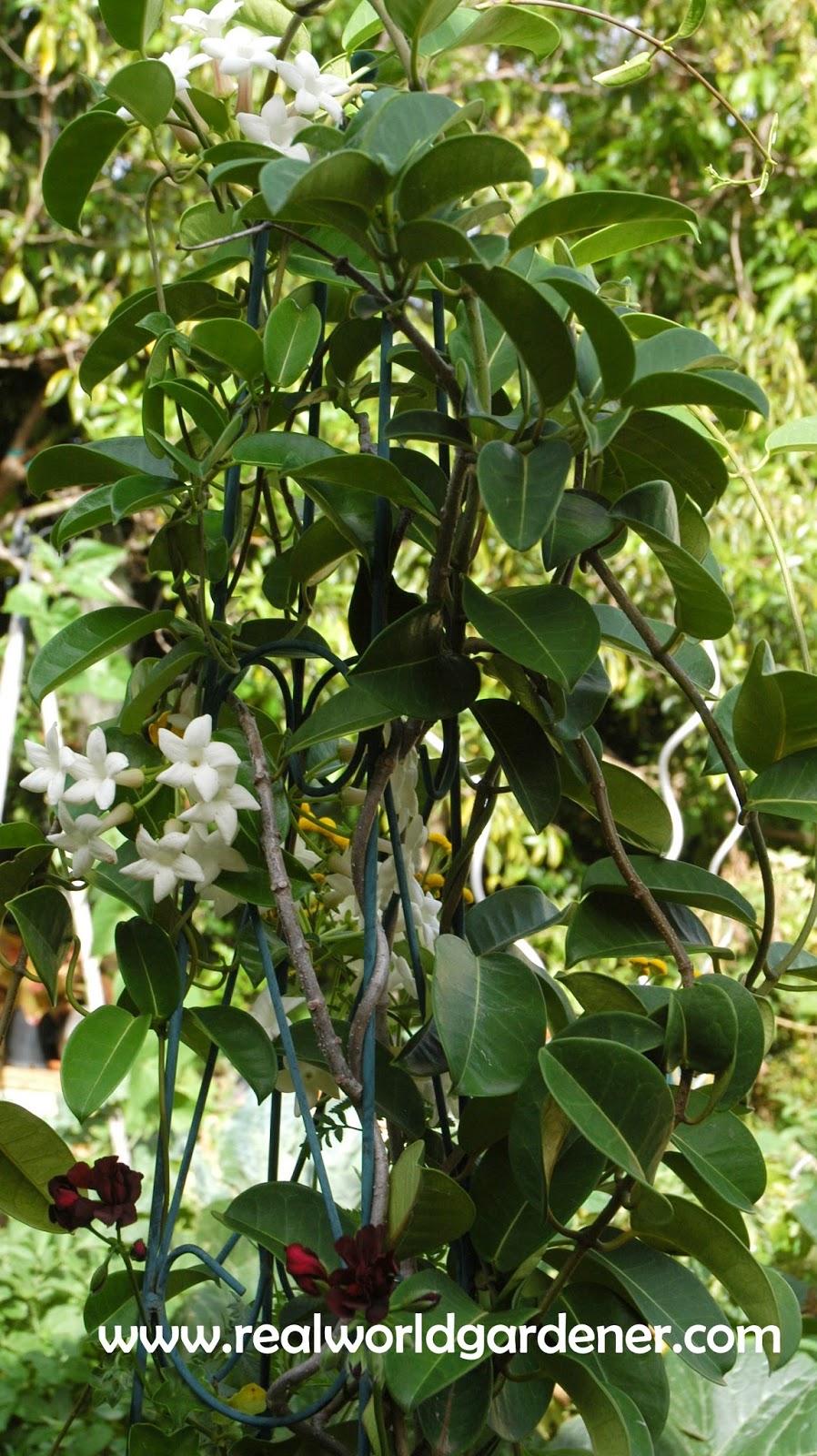

Stephanotis looks lovely all year round and flowers more than once.
Did you know that the genus name-Stephanotis comes from the Greek words stephanos (crown) and otos (ear), supposedly because the flower tube looks like an ear canal surrounded by a crown of five ear-like lobes.
Stephanotis is in the dogbane and milkweed family whereas true jasmine (Jasminium officinale) is in the olive family.

If you have any questions about growing Stephanotis, or have some information to share why not write in to realworldgardener@gmail.com 


Friday, 18 December 2015

Lanterns Light Up the Garden

PLANT DOCTOR

Scale of Citrus

Female scales don't need to mate to lay eggs, but they die straight after laying those eggs and crawlers that hatch can remain under the body for a few days.
White Wax Scale. Photo Courtesy Eco organic garden.
These pests are very tiny when they hatch, around 1mm in size, so undetectable to the naked eye.
As they get older they build a protecting coating where they are pretty much untouchable by anything that you want to throw at it.
Once crawlers have found a place that suits them as a feeding site, the insert their piercing mouthparts into the plant and begin to produce a waxy coating.
So the best time to treat your plants for scale is now when they’re unprotected.
Let’s find out about what the different scales look like and how to treat them.
I'm speaking with Steve Falcioni from www.ecoorganicgarden.com.au


Citrus Louse Scale
Did you know that there’s a ladybug that disguises itself as pest, almost looking like cottony cushion scale or mealybug but the difference between it and the pest that it resembles and eats, is that it’s relatively fast moving?
In fact this ladybug climbs up and down the twigs and branchlets looking for the mealybug dinner.
Mealybugs on the other hand, tend to hide in cracks and crevices of your plant and don’t really move much at all.
If you have any questions about scale pests or have some information you’d like to share, why not email realworldgardener@gmail.com or write in to 2RRR P.O. Box 644 Gladesville NSW 1675.

VEGETABLE HEROES

Cucumbers or Cucumis sativus..

Cucumbers just love the hot weather, so they’ll germinate and grow quickly at this time of the year.
Cucumbers are a member of the gourd or cucurbita family and have been grown for 4000 years!
Did you know that Cucumbers were widely eaten throughout Asia and Europe by the 6th and 7th centuries A.D?
Did cucumber start off in India? No-one’s really sure.
Some pretty famous people have been known to be fans of cucumbers, even cucumber pickles.
Take, Julius Ceasar, he ate them everyday, Cleopatra, thought cucumber pickles help her skin complexion, and other pickle lovers included George Washington and Queen Elizabeth 1.
Would you have thought that Cucumbers are one of the world’s favourite vegetables?
When is the best time to grow some cucumbers?
Cucumber plants do best in all types of temperate and tropical areas and generally need temperatures between 15-33°C.
Cucumbers are happiest when the average temperatures are around 210C
Sow the seeds of Cucumber in late Spring and early Summer for cool temperate districts, spring and summer for arid and temperate zones districts, from August until March in sub-tropical areas.
Only the cooler months for tropical areas-so April until August unless you’re inland.

And where can you grow these delicious cucumbers?
You need to pick a sunny, well-drained spot, because Cucumbers are a subtropical plant, that needs full sun.
Cucumbers also want a decent amount of growing space in your garden. If you’re short on space, try growing them up vertically on a trellis or even on some netting, perhaps a tomato trellis?
growing cucumbers commercially
In fact, growing up a trellis would be a great way to avoid all the mildews and moulds that cucumbers are prone to in still humid weather.
There’s also a number of dwarf varieties if you’d like to grow your cucumbers in pots.
Try Mini White- one of the most popular.
The 10cm long fruit and is best picked when young.
Gives you lots of fruit per plant and it’s burpless
Or you could try Cucumber Mini Muncher as well.
Available from www.diggers.com.au
The best thing is that Cucumbers aren’t picky about soils.

However, do you find your Cucumber seeds sometimes don’t germinate?
They’re big seeds but if you’re raising them in punnets and the seed raising mix dries out, then the seed most like has dried up as well;and if you keep it too wet, then the seed rots.
If this keeps happening, try using another type of seed raising mix, or even some good quality potting mix and try again.
What cucumbers like is soil that’s well-draining and has a pH of around 6.5.
Add in plenty of organic compost and fertilisers like chook poo or cow manure.

When your cucumber has gotten going, water it regularly at the base of the plant, that way the leaves stay dry and you lessen the chances of the leaves getting the white powdery stuff growing on them, powdery mildew disease.
Flowers of Cucumbers
Powdery mildew is a fungal disease that is spread by spores carried by the wind.
Look for white to grey fungal deposits on the leaves and stems of your cucumbers. As the mildew spreads, the leaves become brittle then start to die off.
There are some types of cucumbers that resist this disease for a time anyway.
You can also try a natural fungicide. 1 part whole milk to 10 parts water, and spray in the cool of the day.
Don’t forget to feed your cucumber plants every couple of weeks with a soluble plant food.
There’s so many now on the market, and some come with seaweed added into them as well.

Who out there hasn’t tried a cucumber that’s tasted bitter?
I’m sure some time in your life, that’s happened hasn’t it?
There’s seems to be a few theories for bitterness in cucumbers
One theory is that the bitterness is caused early in the plant’s development by terpenoid compounds that give a bitter flavour to the entire plant.
Usually the bitterness accumulates at the stem and below the surface of the skin of the cucumber.
According to this theory it’s a genetic problem.
Newer cucumber hybrids seem to have fewer problems with bitterness.
I’ve always thought it to be the result of Cucurbitacin.
Found in most cucumber plants, Cucurbitacin causes fruit to taste bitter.
Cucurbitacin levels increase when a plant is under stress, and can make the fruit taste really bitter.
The concentration of these compounds varies from plant to plant, fruit to fruit, and even within the individual fruit itself.
Did you know that the ability to taste detect bitterness or cucurbitacins also varies from person to person.
Even insects have varying preferences for cucurbitacins- the compounds attract cucumber beetles but repel other insects, such as aphids and spider mites.
Anyway, it proves that you shouldn’t stress out your cucumbers!
By the way, if you do get a bitter cucumber, peel it and cut of the ends by about 2.5cm, that’s where the bitterness concentrated.
Just like zucchinis, cucumbers have separate male and female flowers. Male flowers come out at first, but don’t worry too much because the female flowers will arrive soon after. Cucumbers should be ready at about 50-60 days and picking fruit often stimulates more to start growing.
Twist the cucumbers off the plant or cut the stalk just above the cucumber tip.

They keep for 7-10 days in the fridge then the start to look like something that came from outer space…green and slimy.
Why are they good for you?
Cucumbers have lots of Vitamins C but why you should eat them is because the silica in cucumber is an essential component of healthy connective tissue, you know, like muscles, tendons, ligaments, cartilage, and bone.
Cucumbers have some dietary fibre and Cucumber juice is often recommended as a source of silica to improve the complexion and health of the skin, plus cucumber's high water content makes it naturally hydrating—a must for glowing skin.
So eat them quick in sandwiches, salads or juice them for healthy glowing skin!
 AND THAT WAS OUR VEGETABLE HERO SEGMENT FOR TODAY

TOOL TIME

Do you wear garden gloves when you’re doing jobs in the garden?
Garden gloves come in all shapes, colours, materials.
Some last really well, others don’t and you probably won’t buy them again.
Garden glove selection; leather gauntlets are good for rose pruning.
But why wear garden gloves?
Let’s find out if wearing gardening gloves is really that important. I'm talking the Tony Mattson, General Manager of www.cutabovetools.com.au
  From spider bites, to ingrained dirt, gardening gloves protect your hands but not all gloves will work for all the situations in your garden.
That means you might have to have several different types on hand in the gardening cupboard, or under the sink in the laundry.
Leather gloves for rose pruning or pruning prickly plants, waterproof gloves when digging around in wet soil or potting mix, and all round gloves for general jobs.

Rubber gloves are good for wet work and thermal gloves are great for cold days.

If even you’re just picking up leaves, gardening gloves protect from unexpected nasties lurking amongst them.

Important: Try the gloves before you buy them.
They need to fit like a ahem, glove. That means there is no space at the top of your fingers and no gap in between the fingers of the gloves.
All gloves are made to a price point. You can buy them for as little as $5 or as much as $50 dollars


PLANT OF THE WEEK

Abutilon x hybrida Bella, Chinese Lantern
The common name for this plant reflects what the flower does.Hanging down like a lantern but until now, the bush grew quite big, around 2 - 4 metres tall and almost as wide.
In comes these relatively new introductions that are really dwarf plants, but with the same size flowers so they can be squeezed in anywhere. Who can resist?
Let’s find out about them. I'm talking with Karen Smith editor of www.hortjournal.com.au and Jeremy Critchley owner of www.thegreengallery.com.au


PLAY: Chinese Lantern_16th December 2015
The really dwarf varieties of Chinese Lanterns are the Abutilon Bella series.


Bella Pink

Bella series lanterns grow to 30cm tall and slightly wider.


They really can be squeezed into any spot in the garden if you have a semi-shaded spot or because they only grow small, potted Chinese Lanterns would be great as well.


Chinese Lanterns grow well in most parts of Australia, except for the very cold mountain zones.

In inland areas be sure to water well and keep protected with mulch.

In hot inland climates Abutilons appreciate some light shade.

Chinese lanterns flower for such a long time, from Spring right through to Autumn so if you do have room for some more plants, even a small bit or room, I recommend growing several.
Pruning is not required.

If you have any questions about growing Chinese Lanterns or have some information you’d like to share why not write in to realworldgardener@gmail.com


Monday, 14 December 2015

Whirling Butterflies and Trees That Matter

DESIGN ELEMENTS

Today is the final in the series about the stewardship of trees.
On the menu is why we need to preserve our trees because in the long run, if you damage trees, you’re actually doing yourself a disservice.
Trees will take years to grow but can be injured or killed in a very short time. It's usually not possible to repair trees injured or stressed through construction damage.

Trees in the landscape
Not only that, severing roots close to the stem can cause instability.
Let’s find out about why we need to preserve trees.
Talking with Glenice Buck Consultant Arborist of www.glenicebuckdesigns.com.au


Trees have a structural root zone
Using a formula set out in the Australian Standard 4970-2009, Protection of Trees on Development Sites, the Tree Protection Zone and Structural Root Zone of a tree can be calculated.
Did you know that three trees placed strategically around a single-family home can cut summer air conditioning needs by up to 50 percent?
Shade from trees slows water evaporation from thirsty lawns. Most newly planted trees need only 55 litres of water a week. 
As trees transpire, they increase atmospheric moisture.
 
If you have any questions about tree maintenance or have some information you’d like to share, why not email realworldgardener@gmail.com or write in to 2RRR P.O. Box 644 Gladesville NSW 1675.

VEGETABLE HEROES (OR FRUIT)

Pineapple or Ananas comosus from the Bromeliad family.
This next fruit came about because I was showing Bromeliads to two groups of classes that I was teaching at the Botanic Gardens.
Not one of them was aware that vegetables ever had flowers, (they were grade ¾ I hasten to add,) and they certainly didn’t know where pineapples came from.
They all thought perhaps a pineapple tree?
I’ve never featured pineapple in Vegetable Heroes before so it was about time.
The pineapple is native to South America and was given its English name because it looks like a pine cone. 
Christopher Columbus brought this native of South America back to Europe and later on sailors brought the pineapple home to New England.
There is a tale that goes where a fresh pineapple was displayed on the porch meant that the sailor was home from foreign ports and ready to welcome visitors.
How to grow pineapple from the top
Cut of the top of the pineapple
In England, a huge "Pineapple stove" needed to grow the plants had been built at the Chelsea Physic Garden in 1723.
The garden still exists today, but I never saw this Pineapple Stove so I assume it’s gone.
 
Did you know that the pineapple is a multiple fruit?
This means they grow from a cluster of fertilized flowers that join together. 
The fruitlets are also known as the eyes of the pineapple; that’s the rough spiny marking on the pineapple's surface and there are approximately 150 on each mature pineapple.
So why grow pineapple?
Firstly, the pineapple plant is one of the few tropical fruits that are really well suited to growing in pots, and that means you can grow pineapples indoors.
That also means that you can grow them anywhere in Australia, really.
Secondly, if you plant them in the right spot they need virtually no care whatsoever.
So what are the pineapple plants’ requirements?
The pineapple is like a lot of Bromeliads in appearance, with blue-green sword shaped stiff leaves.
In general, Pineapples are best suited to humid coastal districts in tropical and subtropical regions of northern and eastern Australia. 
But in a warm, sunny, sheltered and frost free position, they will cope with cool nights for short periods. 
Tip: One thing most Bromeliads don’t like is frost.
Use a sharp knife to scoop out the flesh
Like all Bromeliads, some can take sun and some prefer dappled shade.
Usually the hardness of the leaf will indicate which situation the Bromeliad you have likes.
 
We all know that the tops of pineapples are very stiff and prickly, so that gives you an indication that Ananas or the pineapple Bromeliad can take full sun, but surprisingly, it will grow in dappled shade as well.
And like a lot of Bromeliads, you don’t want to overwater your pineapple bromeliad, because you may cause it to rot.
Bromeliads don’t like soggy waterlogged soils but can get by on very little water except of course during extreme heat waves.
In that instance you may want to cover any Bromeliad you have with an old sheet to prevent leaf scorch.
How to grow Pineapples.
Remove as much pineapple flesh as you can

Pineapple plants grow up to 1 ½ metres high and wide, pretty much like the Giant Bromeliad, Alcantarea.
One way to grow your pineapple is to just plants the top of a pineapple. 
They don’t fruit usually in the next spring/summer but the one after, and some have taken an extra year. 
Each plant will fruit once a year and then throw a pup, the mother will then die and a year later the pup will fruit. 
That’s how Bromeliads grow.
If you stagger them you can have pineapple on each at different stages of development. 
Another way to grow pineapple plants, more so for gardeners in tropical areas is if you know someone who grows pineapples you may also be able to buy some "suckers" or "slips" (little plantlets taken of a mature pineapple plant).
After the first fruit is produced, side shoots (called 'suckers' by commercial growers) are produced in the leaf axils of the main stem.
You can pull these off to propagate new plants or just let them stay on the parent plant and keep widening.
Paul says, that he also found (maybe coincidence) that ones in pots fruited quicker than ground but they would be nice and hot all the time.
 
IMPORTANT TIP:
If you’re growing the top of a pineapple make sure you remove all the fruit flesh. You should also remove all the small bottom leaves. 
Just pick the lower leaves off so you have a bit of a stem to plant, then leave the pineapple top in the shade of your verandah to dry out for a week.
The same goes for suckers. 
If there are very small or dead leaves at the bottom pull them off.
Plant your pineapple top:
Don't bury the pineapple top completely.


plant your pineapple top
There’s no need to bury the pineapple top in the ground.
Mix compost in with your soil before you plant the pineapple, and then mulch thickly around it.
Just make a small depression in the ground or in a pot and stick your little pineapple in that. 
Push the soil back in and firm it around the base so the pineapple sits straight and doesn't fall over. 
You can use a couple of small sticks each side to keep it upright until your plant grows some roots in about six weeks.
Mulch around the plant to stop it drying out too much.
If the soil is dry give it some water.
Tip: If you’re growing it in a pot, use orchid or bromeliad mix so it gets plenty of drainage.
Give the plant a good watering at least once a week and fertilise with weak compost or comfrey tea once a month. 
A pinch of sulphate of potash around the base of the plant at the beginning of the second summer will help with flowering.
How long does it take from when you first plant it to harvest? 
  • Firstly there’s quite a bit of controversy.
  • Pineapples ripen from the bottom up, so when the 'cracks' around the bottom rows at the base go from green to yellow, it is beginning to ripen. 
  • Some say wait until it's yellow at least halfway up the fruit. 
  • Growers say they harvest anytime from when the bottom few rows go yellow because sometimes when the whole fruit goes all yellow, the bottom goes bad as it starts ripening from the bottom.
  • Others might ask “Does it smell sweet ?.. remember it will not ripen any further after picking.
  • Wait until it’s ripe.
  • Jan leaves hers as long as possible, but she’s in Cairns and eats the pineapple very close to Xmas. 
  • Fred says he pick them at different stages and also buys direct from farms up the road and he can't tell the difference in when they are picked.
  • The tried and true tip is to “Pick it when a middle leaf pulls out easily then it will be ready and sweet .
  • But others will disagree saying " Sorry but plucking out the middle leave of the pineapple to see it is ripe is an old wife's tale."
  • From another pineapple grower who has grown 400-odd pineapple plants," the leaf plucking is the best indicator by far. Colour is a good starting point, but every pineapple ripens slightly differently."
  
In Australia, the major growing regions include South East Queensland, particularly the Sunshine Coast hinterlands, Maryborough and Wide Bay area, the Yeppoon district, and all the way up to Mareeba and Mosman in Northern Queensland.
Why are they good for you?

Did you know that Pineapples are one of the healthiest fruits around?
Did you also know that…
Two slices (or 164 grams) of pineapple provides half of your daily fruit requirements
Pineapple is a great source of Vitamin C! 
Just 100g of pineapple equals 98.6% of your Recommended Daily Intake .
Pineapples are high in fibre, and low in calories, sodium, saturated fats and cholesterol.
Pineapples contain Bromelain which is an enzyme known for its ability to break down proteins making it great for digestion. 
They’re also a very good source of copper and a good source of vitamin B1, vitamin B6, dietary fibre, folate, and pantothenic acid.
AND THAT WAS YOUR VEGETABLE HERO FOR TODAY? 
 

 TOOL TIME 

 Did you forget to sharpen your secateurs after some serious pruning over the winter months?
What’s the state of your gardening secateurs right now?
Secateurs should open easily
Do they open easily, are the blades sharp? You know they’re sharp if they make a clean cut through a plant’s stem without leaving a little tear behind.
Almost as if you only cut through part of the stem and then pulled off the remaining part.
If they’re not sharp, those cuts that you make on your plants will end up with bruising and tearing on the stems leading to dieback and fungal disease problems.
Let’s find out some tips about sharpening those precious garden tools.  Talking with Tony Mattson, general manager of www.cutabovetools.com.au


To quote a long time gardening presenter on Gippsland FM, the jobs not done until the tools are put away.
If you have any questions about sharpening your tools, why not write in with your question or ask for a fact sheet.


PLANT OF THE WEEK

Gaura lindheimeri "Geyser"
Whirling Butterflies, Wand Flower
Today’s plant of the week originates from Texas and Louisiana so it’s is tolerant of drought, heat and humidity.
As summer gets going and the temperature climbs, you’re garden may take a bit of a beating.
In comes the butterfly plant that adds a tough of lightness to your garden border; a bit like gypsophila used to do, but we don’t grow that so much nowadays.

Listen to the podcast to find out about them.
Talking with Karen Smith from www.hortjournal.com.au and Jeremy Critchley owner of www.thegreengallery.com.au


Gaura Geyser is a tough little plant the can be pruned almost to the ground to give more flowering during the summer months.
'Geyser Pink' is an upright, bushy, freely-branching perennial with tall, slender stems bearing narrow, lance-shaped, mid-green leaves and wand-like panicles of pink flowers from early summer into autumn.
Gaura Geyser pink
Gaura Geyser is a dense but compact plant that  flowers until the first frost.
Strong branching supports large, long-lasting deep pink blooms.
Exceptional in containers and as a cut flower.
Gaura Geyser like all Gauras. tolerates drought, heat and humidity.

The name Gaura means Superb, but now that botanists have changed the name to Oenothera or pronounced OWEN-O-THERA, putting it in the same family as evening primrose.
Where does Oenothera come from?
It’s not really certain but perhaps from the Greek words onos theras, meaning "donkey catcher", or oinos theras, meaning "wine seeker".
But also the Latin oenothera means "a plant whose juices may cause sleep" and there’s no record of this plant causing that.
I have heard it called wand flower and butterfly bush because the petals are held on long stalks above the clump of leaves; and it certainly makes a stunning edging plant

If you have any questions about growing Gaura Geyser, why not write in to realworldgardener@gmail.com
 

Friday, 4 December 2015

Raptors in The Sky and Trees in the Garden

WILDLIFE IN FOCUS

Brown Goshawk
Today I’m introducing a new presenter for the Wildlife in Focus segment which has been in sort of a holiday while I was hunting around for someone to fill the role after ecologist sue Stevens wasn’t able to continue with the segment.
The bird that’s featured is a bird of prey and can easily be mistaken for a couple of other birds that look similar.

Let’s find out how to pick which raptor you might find in the sky. I'm talking with Manager of Birds in Backyards, Dr Holly Parsons.

The Brown Goshawk can look similar to a Powerful Owl, and the Collared Sparrowhawk. The Brown Goshawk has a similar face to the Powerful Owl but has a line or brow above the eye and a red-brown collar plus finely barred underparts. The collared Sparrowhawk has very similar colouring but doesn't have the harsh brow.
The major difference between the two raptors is that the Brown Goshawk has a rounded tail and the Collared Sparrowhawk has a squared cut off tail.

Powerful Owl Photo: Habitat Network
On the other hand the powerful owl is much bigger and has striped chevrons on the underparts.
Did you know that the Brown Goshawk is one of Australia's most persecuted raptors. That’s because some people call it a "chicken hawk," which it’s not.
What it really is a natural predator of birds, reptiles, frogs, large insects and mammals up to the size of rabbits.
Yes it’s true they sometimes hunt out your chickens, but that’s because it’s either a juvenile, or sometimes the adults, if they’re extremely hungry due to illness, injury, or extreme environmental conditions where’s there’s not much prey in the wild.
They hunt by stealth, relying on surprise to catch their prey.
The Brown Goshawk's preferred habitat is dry, open eucalypt forest and woodland.
If you have any questions about Brown Goshawks or have some information you’d like to share, why not email realworldgardener@gmail.com or write in to 2RRR P.O. Box 644 Gladesville NSW 1675.

VEGETABLE HEROES

Strawberries or Fragaria x ananasa.Did you know that Fragaria means fragrance in Latin.

Strawberries aren’t actually berries because true berries have seeds inside them.
And as every schoolkid will tell you, strawberries have seeds on the outside, and usually about 200 of them!
So what are strawberries exactly?
Strawberries are sometimes called an accessory fruit or false fruit because of this .

Here’s a botanical bite:
The ovary contains ovules, which develop into seeds after fertilization.
This ovary will mature into a fruit, either dry and parchment like or fleshy, enclosing the seeds.
All flowers have an ovary where the seed grows.
Some or all of the fruit doesn’t grow in the ovary but on outside of the ovary.
That part of the flower’s called the receptacle because it holds the ovary.
You might find it hard to imagine, but each littLe "seed" (achene) on the outside of the fruit is actually one of the ovaries of the flower, with a seed inside it. Strange isn’t it?
Fragaria vesca or the Alpine strawberry is native throughout the Northern Hemisphere.
Botanists think this was probably the ancestor of the garden strawberry of today. t
 There’s archaeological evidence suggesting that people ate strawberries as far back as during the Stone Age.
Interestingly, the first civilisation to grow them as a crop were the Persians in ancient Persia.
The Persian-called their strawberry plants - Toot Farangi.
By the 18th century Fragaria x ananassa had replaced the alpine strawberry because of the larger berry or fruit.
Strawberries are an "Accessory" or "False Fruit."
For all sub-tropical, temperate and arid zones you can plant strawberries now if you see them for sale, because you surely will, but you’ll get advice that May and June are the best planting times.
For cool mountain districts, October and November are your best planting times.
They’re frost sensitive but a 10cm layer of mulch will be enough to protect the plants.

So what are the strawberry plants’ requirements?
The pattern for most strawberries is flowering in spring, set fruit in late spring/early summer, send runners out in summer and become dormant in winter.
At this time of year you will be able to get the ever bearing varieties which give you a second crop in autumn.
If you planted your strawberry plants, in last autumn and winter, they should’ve flowered already and you’ll be telling me that you’ve been enjoying strawberries with cream already.
But why not plant some more plants for Autumn strawberries?
What do Strawberry plants love?
Not sure what they like? Well…Strawberries love at least 6 hours of sun a day and will grow in most soils but strawberries prefer a sandy loam that is deep and contains a lot of organic matter.
IMPORTANT: When planting a strawberry plant, make sure that about a third of the crown is above the soil. If you plant too deep or shallow the plant might die.
Strawberries have 70% of there roots located in the top 8cm of soil.
By mulching the soil, it helps to keep the roots from drying out and will prevent the plant from drowning in boggy soil.
This means that if growing your strawberries in the garden, you need to grow them on mounds to improve drainage and you will also need to put down a thick layer of mulch such as hay, pea straw or sugar cane to prevent the berries from touching the soil and rotting.
Mulch as you should now, also prevents the soil from drying out too much.
Potting soils usually have the right mix if you’re planning on planting strawberries in a container.
In that case, add an extra inch or two of fresh compost either to the mix before filling the pot or to the surface of the potting mix.
I would also recommend adding some coco peat into the potting mix to increase water holding capacity.
The idea behind strawberry pots is good in principle but in practise I find it needs careful attention because the plants dry out too much.
And you know strawberry pots have several holes in them to cater for about5-6 plants.
TIP: Attaching your pots to a dripper system and putting a saucer under the strawberry pot will save your strawberry crop this year.

Strawberries with dripper system


Also make sure you water the plants, especially when the young plants are establishing, and during dry spells.
Strawberries prefer a moist environment.
Avoiding overhead watering will reduce fungal disease; drip irrigation or a 'leaky pipe' is best.
I did see a different way of growing strawberries at the Floriade in the Netherlands last year, which might suit listeners.
The above ground planters were made with weld mesh into a circle of diameter about 1 ½ to 2 metres, then lined with coconut fibre.
You could use other materials to line them.
Into this the soil was added then the strawberry plants. Mulched with straw of course.
Not only did it look good but provides perfect drainage for the plants, and no bending down for the gardener.
They're technically a perennial so live for a few years producing fruit.
After 3-4 years (or even sooner) the plants usually become diseased and die.
And don't forget nurseries do sell certified virus-free stock, and that's the safest way to grow new strawberry plants.
To feed your strawberries, sprinkle a small handful of complete fertilizer (such as tomato food, organic pellets, fish emulsion and any stuff which is high in potash) around each plant when it first comes into flower, and water well. Liquid seaweed fertilizer once a fortnight will not go astray either.
Keep a close eye on the plants as flowering begins as the birds, including your chickens if they free range, and possums are just as keen on strawberries as we are. You may need to net the strawberry bed.
tip:Make sure your berries are fully red before picking them because they don't get any riper off the vine.
Cut the stem above the berry with scissors.
Over summer, strawberry plants send out runners.
Strawberries need to be picked when ripe.
These modified shoots can be used to propagate new plants but if you don't need new plants, cut these runners off.
After fruiting has finished, tidy up the bushes by giving them a hard prune down to 10cm.
Stick 'em in the fridge soon after picking the strawberries and don't wash the strawberries until just before you want to eat them.
Strawberries don't last, and the extra water on them causes their cells to break down more quickly.
TIP:Wash the berries and pat them dry before removing the stems. That way you avoid excess water entering the berries from the stem end.
Use the berries within three or four days.
To really feed a family you need about 20-30 plants to provide plenty of fruit, but even a couple of plants can be fun to grow.
Varieties include Redlands Crimson was developed in south east Queensland so it does very well in subtropical climates sending runners everywhere.
Tioga's - is better suited to a cooler climates.
Summer strawberry varieties include Cambridge Riva for the intense flavour, Chandler has huge berries and grows in all climates, Hokowase are wedge shaped and very sweet.
Torrey has medium sized sweet fruit and is best suited to warm climates
Available from www.diggers.com.au
For Ever- bearing varieties, the autumn crop is the biggest and you can choose from Tempation which doesn't send out runners so it's great for hanging baskets and Sweetheart is very sweet to taste – an everlasting variety also have their fruit set in autumn .
Why are they good for you?
Strawberries are low fat, low calorie; high in vitamin C, fibre, folic acid, and potassium
From only half a punnet of strawberries you'll get more than 100% of your daily needs of Vitamin C, and 5.5g fibre in if you eat the whole punnet of strawberries that's about 20% of your daily fibre needs.
Did you know that eating strawberries, which are rich in nitrate, can increase the flow of blood & oxygen to the muscles by 7%?
This prevents muscle fatigue, making exercise easier.
Strawberries are also low in kilojoules, meaning you can eat 2 cups as one of your daily fruit serves!
AND THAT WAS YOUR VEGETABLE HERO FOR TODAY

DESIGN ELEMENTS

 This series is about arboriculture and managing trees.
Did you know that there was an Institute of Australian Consulting Arborists?

Trees are a living structure
So what is a consulting arborist and can they cut down your trees if you want them too?
Listen to the podcast. I'm talking with Consulting Arborist Glenice Buck glenicebuckdesigns.com.au/
 
Consulting arborists do a wide range of things including assessing and writing reports on trees, but they do not do pruning or cutting down of trees.
This means they'll always give an unbiased opinion on the health and condition of a tree and its retention value.
Trees are a valuable addition to any landscape
If you’ve been asked for an Arborist Report, a Tree Report or an Arboricultural Impact Assessment then a consulting arborist is the best person to call because they often prepare these reports for clients with respect to trees for a range of reasons.
And where do you find these consulting arborists?
Look no further than the Accredited Members of the Institute of Australian Consulting Arboriculturists (IACA) (www.iaca.org.au ) provide written reports for their clients in the public and private sectors.
IACA members do not undertake tree pruning or removal work.
The other organization is Arboriculture Australia which also lists consulting arborists.
www.arboriculture.org.au
If you have any questions about what arborists do, consulting or otherwise or have a suggestion why not write in or email me atwww.realworldgardener.com

PLANT OF THE WEEK

Philodendron Xanadu and Philodendron Gold Bullion
Philodendron belong to the Araceae family of plants and some of them become enormous and climb to great heights.
Many of these plants are grown as ornamental and indoor plants.
If you work in a big office and have indoor plants, chances are you’ve got one of these and never notices.
You’d be surprised to learn though, that indoors is not all they’re cut out for.
Listen to the podcast. I'm talking with Karen Smith editor of www.hortjournal.com.au and Jeremy Critchery owner of www.thegreengallery.com.au
Philodendron Xanadu  belongs to a genus of plants that can’t really support themselves, so they have roots to do that for them.
Philodendron Xanadu is more like  a shrub with a soft trunk that sends off long distance aerial roots to maintain that support.
Philodendron Xanadu
You might be surprised to learn that Philodendron Xanadu was originally reported to be a selected chance seedling discover in 1983 in a Western Australian nursery. 
It was renamed 'Xanadu' by House Plants of Australia and released as their plant of the year in 1988
It was thought to be a sport or hybrid of Philodendron bipinnatifidum and named Philodendron 'Winterbourn' and protected under Plant Breeder Rights in Australia.


Philodendron Xanadu has very attractive lobed leaves that are richly green and lush.
It grows to around 75 cm in height and eventually makes a 1m-wide clump.
This plant is very tough and needs no attention once established, apart from occasional watering and some fertiliser once a year.
Put Philodendrons into a shady position amongst other tropical-looking plants suits it best –
Grow them amongst bromeliads, Alocasia, bird's nest ferns, giant Liriope, cane Begonia and Abutilon.
Philodendron Gold Bullion
It is well suited to life outdoors in Sydney; but in colder regions, it can be grown as a patio plant, or even indoors, as long as there is sufficient light.
Apparently, it will also grow well in a sunny position. It can be propagated by division.
The name Philodendron derives from the Greek words philo or "friend" and dendron or "tree".

.