Pages

Showing posts with label kitchen garden. Show all posts

Monday, 26 June 2023

Mushrooms But Not As You Know Them

 KITCHEN GARDEN SEGMENT  on REAL WORLD GARDENER radio show

Scientific Name: Rungia klossii
Common name: Mushroom plant
Family: Acanthaceae
Origin: New Guinea

Rungia klossii is an evergreen Perennial growing to 0.6 m x 0.6 m at a medium rate.

Soils: Suitable for: light or sandy, medium (loamy) and heavy (clay) soils. 

Habitat: Mushroom plant can grow in semi-shade  but not full sun in an Australian summer. It prefers dry or moist soil if grown in the ground otherwise growing in a pot is very successful.
Mushroom plant Photo: M Cannon

Description:The shiny mid green have a yellowish mid-rib. 
The elliptic leaves are arranged in pairs with adjacent pairs perpendicular to one another (decussate leaf arrangement mush like in a hydrangea).
Flowers: Blue flowers that appear in a cluster in ideal positions.

proteins.
Harvesting: The Mushroom plant can be harvested all year round,  but the best is to harvest during the active growth period to provide a bushy growth.

Uses: In the kitchen it's used in salads, soups and wok dishes, a small cooking even increases the mushroom aroma.

Frosts: Low frosts are tolerated but lead to leaf loss. 

Fun fact: Higher in protein that actual mushrooms.

What is it exactly and why is it called mushroom plant.

Let's star with, how do you love your mushrooms?
In a risotto, sautéed with scrambled eggs, in soups or salads?
Perhaps you don’t like them at all.
Here’s a way to enjoy the taste without the texture and it’s all natural.
The leaves are somewhat stiff and lightly curled at the tip.
Yes, the leaves taste like mushrooms with a crispy texture and nothing more.  

So, let’s find out how and why, by listening to the podcast.

I am talking with Corinne Mossati, founder of the gourmantic garden.


Corinne's favourite use of the plant is finely chopped into salads for that burst of flavour.
Mushroom plant is a perennial that although it grows well in tropical and sub-tropical areas, it needs protection from frost in cooler climates.

The best way to grow it there is in a pot, which by the way, has served me well over the years.

If you have any feedback email realworldgardener@gmail.com or write in to 2RRR PO Box 644 Gladesville NSW 1675

Monday, 6 February 2023

Bumper Crop of Bush Beans

 KITCHEN GARDEN

Beans and More Beans

What is your favourite warm season vegetable or are there too many to choose from?
Top of the list for many a gardener is the humble bean, because in warm weather, they’re so easy to germinate.
In fact my bean crop was directly sown on a Monday and they were up by Thursday.
But how do you get a continuous crop of beans?


Corinne mentions bush beans, but we're not talking some sort of wild bean that grows on a bush, in fact bush beans is another name for dwarf beans.

More along the style of French beans such as butter beans or Cherokee Wax butter beans.
Scientifically beans are Phaselous vulgaris which covers just about every type of bean seed that you can buy.
Dwarf or bush beans grow into a small, bushy shape, usually 60cm tall or less and don't need staking.

This year I planted my bean seeds closer together than normal on using the premise that if we had a run of cloudy days and they started to climb, they would support each other.
This season we did have lots of cloudy rainy, days, they didn't start to climb, but did in fact support each other at around 50-60cm.
The only tricky part was needing to carefully pick your way through the thicket of bean foliage to harvest the beans without breaking any branchlets.

Let’s find out more about tips and tricks with bush bean planting by listening to the podcast.
I’m speaking with Corinne Mossati founder of  
https://thegourmanticgarden.com

TIP:
  • Sow another crop in 6 weeks time after the first crop then the big tip is after the first harvest, apply a side dressing of blood ‘n’ bone.
  • Beans should be ready to harvest as soon as 65 days or 9 weeks after planting

If you have any questions why not email us at realworldgardener@gmail.com or write in to 2RRR PO Box 644 Gladesville NSW 1675


Vietnamese Mint No Ordinary Mint

 KITCHEN GARDEN

Is Vietnamese mint really a mint?

Scientific Name: Persicaria odorata

Common Name:Vietnamese mint

Family: Polygonaceae

True mints botanically speaking have wide spreading underground rhizomes with erect, square and branching stems.
The leaves are opposite each other on those square stems, with clusters of small tubular flowers.
Ture mints are also in the Lamiaceae family.

So what do we make of Vietnamese mint?
Perhaps you saw it in the herb section of the garden centre and mistook it to be just like any other mint.
Not exactly a real mint and it's also in the same family as rhubarb and buckwheat; the Polygonaceae family.
Traditionally, Vietnamese mint is used a lot in Asian cuisine. If you've ever had a laksa, you've probably eaten some Vietnamese mint.

What does it look like?
It looks similar but different to traditional mint, plus it's a creeping herbaceous perennial.
The leaves are very narrow and angular looking often with a chestnut-coloured rounded marking across the dark green leaf.
The flowers are quite different to min. Flowers are flat spikes of pale lavender if you're in a warm enough climate for it to flower.

Where and How to grow it.

  • It can grow very well outside in summer in non-tropical parts of Australia.
  • Vietnamese mint prefers part-sun and well-drained soil.
  • For those areas with cool to cold winter, bring your Vietnamese mint indoors or under shelter as you would an indoor plant.
  • It grows very well in pots but is frost tender.

Let’s find out how to use it in cooking by listening to the podcast.
I'm speaking with, Corinne Mossati
founder of the gourmantic garden website and blog. : https://thegourmanticgarden.com
 

Also sometimes called Vietnamese coriander and as Corinne mentioned you can make a dipping sauce or even try making pesto with it.

If you have any questions why not email realworldgardener@gmail.com or write in to 2RRR P.O. Box 644 Gladesville NSW 1675.

Thursday, 3 March 2022

Lacto Fermentation: Quick 'n Easy Guide

 KITCHEN GARDEN

LACTO-FERMENTATION

There are several ways to preserve food, these include freezing, drying, pickling and fermenting.
You may think that fermented foods are a recent trend, but in fact, fermenting food has been carried out for thousands of years.
Fermenting food is one way of preserving your ample supply of produce that's growing in your garden.
There are a few ways to ferment foods but lacto-fermentation is one of the easiest.
  • The term lacto-fermentation is a scary one and belies how simple it really is. It's unbelievably quick and easy.
    Lacto fermented radish

So what is it?

Firstly the term wasn't derived for having to use milk in the process.
Lacto refers to the lactobacillus bacteria that does all the breaking down of the food.
Did you know that all vegetables are covered in the various strains of the good bacteria lactobacillus?
It does involve lactic acid in the process which is a good thing because lactic acid is a natural preservative.
  • What about the bad bacteria?
No problem, the brine that you submerge your vegetables in kill them off, while the lactobacillus survives to do the preserving work.
Using the correct salt to water ratio in your brine will ensure the safety of your lacto-fermentation.

How do you do it?

You can lacto-ferment most produce in yur garden.
 Beans, carrots, beetroot, and Corinne's favourite is using stalks of chard, nasturtium seeds.
You need salt but not iodised or table salt. Table salt will make the ferment go bad because of it's additives.
  • Use high quality sea-salt.
  • Photo: Corinne Mossati of Gourmantic Garden
    Non-chlorinated water, and no fluoride so will need to be filtered water.
  • Kilner jar or a glass jar with a lid.
  • Weights to submerge your ferment.
  • BASIC RULE: Brine solution is 2-3% salt.  
  • 2% brine:1 litre of water needs 20 grams of salt: 
Step by Step
  1. Collect your dry ingredients and add them to a dry sterile fermentation jar.
  2. Pour in the brine solution to cover the vegetables.
  3. Add a ceramic weight on top to keep the vegetables below the liquid.
  4. Burp the jar daily: this releases the gas.
  5. It will take 2-3 weeks during the summer months.
  6. Once it's ready, place it in the fridge to slow the ferment process.

Are you a chilli aficionado?

Perhaps you’re growing the world’s hottest chilli, Carolina Reaper or the second hottest, Ghost chilli?
But did you know that Carolina Reaper chilli is 200x hotter than a Jalapeno pepper?
But what do you do with all those chillies other than freeze them?
  • Why not make a chilli lacto-fermeneted sauce?
Follow the above steps then once you think the chillies are done, drain the brine and add other flavouring ingredients.
Blitz in a food processor.

To find out more, listen to the podcast.

I'm talking with Corinne Mossati, founder of the http://www.thegourmanticgarden.com website.

If you have any questions you can email us Realworldgardener@gmail.com or write in to 2rrr, PO Box 644 Gladesville NSW 1675.

Saturday, 18 December 2021

Festive Drinks with Pineapple Sage

 KITCHEN GARDEN

Festive Drinks with Pineapple Sage

I talk with Corinne Mossati about this wonderful culinary sage that is so useful in festive drinks.

You may be growing some lovely salvias in your garden but not realise that one of them in particular, can make a luscious and revitalising drink, just right for the festive season. 

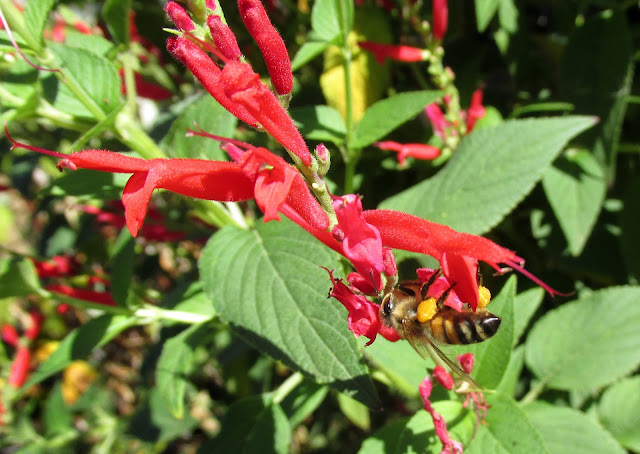
Pineapple sage (Salvia elegans) is in the Lamiaceae or mint family.

Found growing naturally in forests quite high up but does well along the east coast of Australia.

A fast growing small shrub to 1.5m, that suits most regions of Australia with large leaves that are, distinctly veined and a bright lime-green in colour.

Grow it in reasonably rich soil that has a good water holding capacity to keep it moving along during the warmest months of the year. Best in full sun.

\
Salvia elegans-pineapple sage

Tip prune whenever you pass to keep your pineapple sage more compact and lush.

Flowers occur mainly in winter but will spot flower most of the year.

Not only the leaves, but the flowers can be used to make drinks or flavour honey.

To Flavour Honey

For a small 200ml jar, fill it up with pineapple sage flowers and then pour in the honey. Leave it to steep for one month and give it a give it a little stir every so often.

You can also use the flowers as garnish in salad, and because they have a pineapple flavour, they’ll make a fantastic addition to fruit salads, and sorbets.

Corinne's Tip:When you are working with aromatic plants, place the leaf on your palm, give it a little slap to release the volatile oils, before you garnish your cocktail, then inhale the aroma as you sip your drink 

To find out more, listen to the podcast.

I'm talking with Corinne Mossati, founder and editor of the Gourmantic Garden and Cocktails and Bars websites..

Here are the links to the recipes Corinne mentions in the podcast:

 The Sage Cuban: Pineapple Sage Cocktail: http://www.cocktailsandbars.com/the-sage-cuban-pineapple-sage-cocktail/

Corinne's Pineapple Sage Cocktail:  photo courtesy of Corinne Mossati

Pineapple Sage Flower Honey: http://www.thegourmanticgarden.com/pineapple-sage-flower-honey/

Simple Syrup: http://www.cocktailsandbars.com/how-to-make-simple-syrup/


If you have any feedback why not write in or email www.realworldgardener.com

Sunday, 7 November 2021

Small Space Gardening- Courtyard Style

SMALL SPACE GARDENING-COURTYARD STYLE

Modern day gardens are much smaller than they used to be.
Many gardeners and would be gardeners, hanker for a produce filled garden with as many different edibles  as befits their lifestyle.
If you you only have a small space such as a paved courtyard or even just a balcony, but don’t know what to do next, this next segment will spur you onto creating your own oasis, without digging up the stones or pavers. 

Be inspired

  • Corinne has managed to squeeze in over 200 plants into a small paved courtyard-that doesn't even include duplicates of plants.
  • A good start is with recycling crates from your local council, to give you an idea of what works for you. Alternatively, plant into lots of containers that can be moved around to follow the sun.Then venture into raised garden beds.

Making the right choice

  • Before any planting, determine the movement of the sun in your small space and  and note down the hours of sunlight and shade in each part of your small space/courtyard.
  • Choose those edibles that like all day full sun for those spots that get 6 hours plus of sunlight such as tomatoes.
  • Leafy vegetables such as lettuce, rocket, Swiss chard and kale, don't mind a bit of shade throughout the day if your have only 3-4 hours of sunlight. 
  • If you only have morning sun then choose vegetables such as carrots, celery, and dwarf beans.
  • For those spots with morning shade and afternoon sun, the choice is climbing cucumbers, climbing peas and beans. 


Soil prep is key for Corinne.

  • Grow cucumbers on a lattice made of string.
     The raised garden beds are made up with homemade compost, worm castings and bought in compost and other organic material.

Think of vertical spaces

  • Think about growing vines like cucumbers and zucchinis and even nasturtiums, vertically.

Let’s find out more by listening to the podcast.
 
I'm talking with Corinne Mossati drinks writer and founder of the gourmantic garden website. 

Don’t be put off by lack of space you may have because no space is too small to have plants, even if it’s just herbs on the kitchen windowsill.

If you have any feedback email realworldgardener@gmail.com or write in to 2RRR PO Box 644 Gladesville NSW 1675



Tuesday, 5 October 2021

The Hidden Talents of Nasturtiums

 Nasturtiums 

with Corinne Mossati

Quite often we gardener have flowering plants in the garden but never think about bringing them into the kitchen to make something.
They may be just fillers or self-seeders, but in this case, the nasturtium, has so many extra uses other than ornamental, you’ll be inspired to do something.

Germinating  Nasturtium Seeds.
Plant the seeds in moist well drained soil, keeping the soil moist but not waterlogged.
Corrine find germination takes between 14-21 days.

Why not try the Alaska variety with variegated leaves, or 'Black Velvet' with deep red flowers and dark leaves.
The one pictured is growing in my garden, is 'Cherry Rose.'

Eating Nasturtiums-Corinnes'tips:

Leaves taste peppery and are great for adding with other greens to salads.
Why no try drying the leaves and grind them to a powder. 
When combined with salt you have a condiment to flavour food or crust the rim of your margeurita cocktail glass!

Nasturtium flowers are edible too.
Use them as you would zucchini flowers.
Nasturtium seeds are edible, often referred to as 'poor man's capers.'

Let’s find out more, listen to the podcast.
I'm speaking with Corinne Mossati, drinks writer and founder of The Gourmantic Garden: http://www.thegourmanticgarden.com
and Cocktails & Bars: http://www.cocktailsandbars.com


Her website tagline & hashtag “Grow It. Eat It. Drink It.” sums up Corinne’s garden and we look forward to more segments with Corinne.

If you have any feedback email realworldgardener@gmail.com or write in to 2RRR PO Box 644 Gladesville NSW 1675

Saturday, 18 September 2021

Grow Coriander: The Primadonna of Herbs

 THE KITCHEN GARDEN

SUCCESS WITH CORIANDER

Scientific name: Coriandrum sativum
I mentioned before that certain herbs that look alike and again I find myself talking about another herb that confuses people.

Australians refer to the seeds and leaf as coriander but in the northern hemisphere, the leaf is sometimes known as 'cilantro.'
Coriander is one of those herbs that people either love it or hate it.
Do you love it?

Coriander leaves
Coriander is easy enough to grow but being in the carrot family,(Apiaceae) its green leafy tops can look not only like other herbs, but other vegetables!
  • My guest, Toni Salter in the podcast, calls it the 'primadonna' of herbs. 
There are many things it doesn't like and without a second glance, coriander will bolt to seed giving you not much leaf at all.
What causes it to bolt to seed?
  • Soil is too dry
  • Too little water at the right time.
  • Poor or impoverished soil.
  • Poor drainage in your herb garden.
  • Temperatures too warm for it's liking.
  • Temperatures too cold for it's liking
  • Transplanting-the worst sin.
Problems with germination?
Try soaking the seeds for a few hours in a shallow saucer of water.
  • TIP: Always sow the seeds directly into the position where it will grow.
Sow it into a container if you like, but keep it there.
Coriander loves rich fertile soil, much like your vegetables.

Coriander seedlings
When to Sow in Australia

For sub-tropical and arid zones, you have August to September;
Temperate districts, sow the seeds from September until the end of November,
In cool temperate zones, October to November,
  • Sow your seeds about 1 cm deep, cover them and keep them moist.
Whether or not you sow them in rows, scatter them amongst your other veggies, or use them to grow as a shade plant for your lettuce, it really doesn’t matter.

Companion planting: plant coriander near your spinach to confuse the grasshoppers.
Let one or two plants go to seed. The flowers attract beneficial insects after which the coriander seeds can be harvested to use in cooking, once the seeds turn brown and crispy.

Coriander seeds drying on plant
A must if you like Asian cooking and even though coriander looks like parsley, as soon as you smell it, you know what you’ve got.

Heaps of Coriander seeds are used in curries, tagines and many other Asian dishes.
In fact the whole herb, including the roots can be ground up to make a Thai Green Curry paste.

Let’s find out more
I'm talking with Toni Salter www.theveggielady.com.au


If you have any feedback email realworldgardener@gmail.com or write in to 2RRR PO Box 644 Gladesville NSW 1675


Friday, 25 June 2021

Bountiful Bananas for Your Kitchen Garden

KITCHEN GARDEN

Banana Growing parts 1 & 2

Did you know that bananas are the world's largest herb. Have you ever wondered if it would be possible to grow your own bananas?
 You may have seen the plants for sale in a couple of plant catalogues and thought to give it a try, but never got around to it.
Would it help if I told you that a number of gardeners around Australia already do it and it’s surprisingly not that difficult.
  • I'm growing the sugar banana or "Musa 'Ducasse.' The flower is pictured here and yes, it's a big plant.
  • The trunk is actually layers of tissue that are wrapped like a swiss roll.
The key to fruiting is keeping the amount of stems or suckers down to a manageable number so the plant doesn't take over your garden.
 
A good number is three which includes the mother plant which has an active flowers on it, then one sucker, and a smaller sucker.
  • Get rid of all the others by chopping them to the ground.
Once the mother plant has finished flowering, it won't produce anymore, so cut the stem to the ground and mulch it up for the garden.

Banana 'Ducasse' growing in my garden photo M Cannon

NOTE: You have to buy banana plants from a QABN-Quality Approved Banana Nursery, that way you are buying a disease free plant.
You can't just take a sucker from somebody else's garden.

Bananas do like a lot of moisture so during periods of drought, the banana plant do not throw as many flowers.

The other suggestions which I thought was worth a try, is to bury some kitchen scraps in the ground near the main stem of your banana plant.

Have a listen to find out more.  


If you want more information about bananas why not email realworldgardener@gmail.com or write in to 2RRR P.O. Box 644 Gladesville NSW 1675.

Growing Bananas part 2

Harvesting your bananas

Now it's time to get down to the pointy end of growing bananas.
It is really easy to grow those banan plants so don't be discouraged.

  • You may remember that the banana plant is actually the world’s largest herb and the stem is known as false stem or pseudo stem because it consists of compact cluster of overlapping and spirally arranged leaf sheaths.
  • No bark, or cambium layer at all.

So what else is there to banana growing?

How much fertiliser?
To get your bananas ready for harvest, fertilise your banana plants well.
Fertilise well with a bucket of organic fertiliser around the base every month in the warmer months.
Or the permaculture way is to dig a pit right next to the trunk and put in fresh food scraps. Cover well so your chickens or rats and mice can't dig the scraps up.It does take quite a while, up to 6 months for the bananas to ripen after the fruits appear.
You can take down the whole bunch, but for the home gardener, that is too many bananas that will ripen at once.
  • Instead, take off a single hand at a time, and bring them into the kitchen to ripen.
  • Looking at the photo on the right, you can see that there are layers  or groups of bananas that make up the whole bunch.
  • Each layer can consist of up to 10 or more individual bananas or 'fingers' that are connected at the same point. This layer is called a 'hand.'
  • Several hands make up a banana bunch.
Fertilise well with a bucket of organic fertiliser around the base every month.
Or the permaculture way is to dig a pit right next to the trunk and put in fresh food scraps. Cover well so your chickens or rats and mice can't dig the scraps up.

The big tip is to be patient because it can take up to 6 months before your bananas become ripe.

The other tip is the whole bunch is harvested when the angles on the fruit have almost disappeared and the fruit is evenly filled.

You can also take off a hand of bananas and see if they ripen in your kitchen perhaps in a brown paper bag.
 
Have a listen to the podcast.


If you want more information about bananas why not email realworldgardener@gmail.com or write in to 2RRR P.O. Box 644 Gladesville NSW 1675.

Saturday, 20 March 2021

La Niña and the Kitchen Garden

 THE KITCHEN GARDEN

La Niña and your produce garden

Torrential rain is lashing the east coast of Australia as a write this while the west coast of enjoys a hot spell. Without sounding too dramatic, we’re starting off the kitchen garden segment with a topic about how the changing weather patterns are affecting the vegetable garden. At the moment Australia is in the grip of La Niña, a complex weather pattern, that bought rain for much of summer and now is causing flooding in many areas.
Last year's summer was quite different with bushfires in most parts of Australia.
Torrential rain driven by La Niña in my garden.

We’re not so much spruiking climate change, but really it’s more about what you the gardener can do to mitigate problems in the veggie patch because of climate events like La Niña.

This summer, the produce garden is seeing cooler temperatures during the day, increased humidity, and higher night temperatures because of the consistent cloud cover.

For those gardeners on clay soil, the soil is staying damp even during the drier periods. Veggies do not like their roots in constant water.

For those gardeners who haven't prepared their gardens for these events, they may find collar rot around citrus and other fungal problems in the kitchen garden.

The answer for clay soil in produce gardens is build raised beds. Not only does this improve drainage, but saves all that bending to ground level.

Powdery mildew is a problem with all gardens in humid weather, particularly when the crops are coming to their end of their production.

Toni recommends using a bi-carbonate spray to change the pH of the leaf surface so that the fungus cannot thrive. This is only a preventative measure. Once the mildew takes hold.

Bicarb soda recipe:
1/2 teaspoon of sodium bi-carbonate
450ml water
couple of drops of vegetable oil to help emulsify it.

Spray both leaf surfaces well until run-off. Re-apply after rain.Other problems can be fruit not ripening such as tomatoes staying green because of the lack of sunny days.

Dwarf beans are all descended from climbing beans when they perceive low light levels they will begin throwing out tendrils and revert to climbing beans. This can be just a run of cloudy days or overshadowing by trees or a neighbouring building.

Let’s find out-I'm talking with Toni Salter, the Veggie Lady. www.theveggielady.com 
PLAY: La Nina pt1_27th January 2021

If you have any questions either for me or for Toni you can email us Realworldgardener@gmail.com or write in to 2rrr, PO Box 644 Gladesville NSW 1675.