Pages

Showing posts with label Steve Falcioni. Show all posts

Friday, 25 February 2022

Stone Fruit and Brown Rot Solutions

 PLANT DOCTOR

Brown Rot of Stone fruit

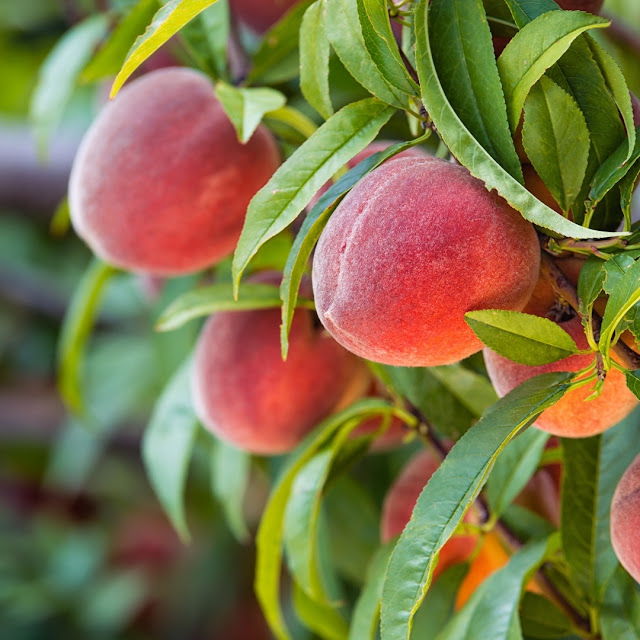
There’s plenty of cultivars of stone fruit trees that can fit into any size garden.

Trixie and Pixie dwarf nectarine and peach trees have been around for years.

“There’s even a nectarine tree classed as Super Dwarf called ‘ Peach Sunset” that is grafted onto super dwarfing rootstock to produce a more compact tree growing to around 1.5 m tall.
This Nectarine is self fertile so only one tree is needed.

  • But before we get too carried away, what are the cons for growing stone fruit?

  1. Is deciduous a con? Possibly, because stone fruit tree are deciduous so if you don't like the bare look in winter, stone fruit trees are not for you.
  2. Do you need two trees for fruit set? Not always so do your homework.
  3. Preventative spraying for peach leaf curl and  brown root of stone fruit may be needed.
Perhaps I'm preaching to the converted and you already grow stone fruit.
Also perhaps, like me, you've never had a delectable harvest stolen from under your nose due to a fungal disease.

Imagine this, ripe luscious fruit that you pick and place in your fruit bowl. A day later, the same fruit has inexplicably in part turned a mushy brown, soon to be consumed completely by the fungus.

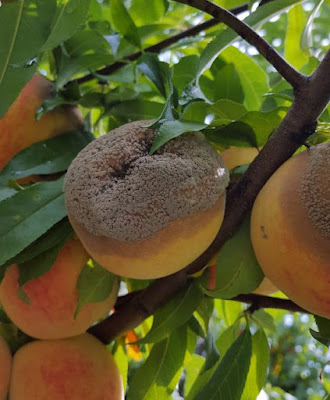
Or you have bunches of fruit on your tree and some of the start dropping off or look like in the image, with a brown sunken fungal growth.
  • The bad news is, it's too late to do something about it now.
If you don’t want a repeat of those nasty surprise in your stone fruit, you have to be pro-active with preventative spraying in winter when the tree is leafless and dormant.
Spraying with sulphur at that time is a good go to all round spray.

You may even have to open the centre of established trees a bit more than usual to increase air flow.

Still, the fruit I ate off my trees this year were super delicious and well worth growing your own stone fruit trees.

For more tips listen to the podcast.
I'm talking with Steve Falcioni of www.ecoorganicgarden.com.au   
Let’s find out

If you have any questions you can email us Realworldgardener@gmail.com or write in to 2rrr, PO Box 644 Gladesville NSW 1675.

Thursday, 22 July 2021

Dahlias and Snails

 PLANT DOCTOR

What's Wrong With My Dahlias?

Dahlias are collectible in that once you start growing them, it's hard to not to want more every time you look at a plant catalogue.
If you want more proof, then look no further than the dahlia societies www.dahliasaustralia.org.au which exist in four states, Queensland, New South Wales, Victoria and South Australia.


But dahlias need some looking after if you want perfect show quality blooms.
One horror is holes in leaves of your precious plants.
What could cause that?
One culprit could be caterpillars or grasshoppers.
Another is one of the worst marauders appear in just about every garden,  and every gardener wants them to be gone.
  • Snails is what I’m talking about, those slimy leaf munching pests that multiply rapidly and even climb shrubs and trees.
  • Did you know that inside a snail's mouth there is a file-like 'radula' that scrapes the leaves and flowers.
  • Snails are also hermaphrodite, meaning that after mating, each of them can go off and lay eggs, up to 100!
Snail Patrol or Control:
So, what do you do to try and reduce their numbers?

The big tip is to be vigilant and control their numbers before they outnumber your plants.

Copper sprays are good to control those small snails that have climbed up into the foliage.
Coffee sprays are also known to control snails.

General prevention or control-bit of a mixed bag as to their effectiveness.
  1. Classic beer trap
  2. Diatomaceous earth
  3. Ring of ash.
  4. Crushed eggshells
  • Thin copper tape is better to control snails climbing up into pots or into trees.
One thing we forgot to mention is that natural predators like ducks or blue tongue lizards are a great help.

You may not want ducks, but you can think about creating a blue tongue lizard friendly garden.
That’s in another segment.
Listen to the podcast.
I'm talking with Steve Falcioni of www.ecoorganicgarden.com.au


If you want more information about snails or have some feedback why not email realworldgardener@gmail.com or write in to 2RRR P.O. Box 644 Gladesville NSW 1675.

Thursday, 20 May 2021

Ants on Plants and Top Ten Unusual Veggies to Grow

 PLANT DOCTOR

Ants on Plants

Ants in the house are a problem because they turn up in your pantry, in your cat and dog food that you’ve put out, or just hang around the kitchen bench.
Sometimes they’re in places like the bathroom, leaving you wondering what on earth are they doing there?
Ants in the garden are another matter, however, it's pretty common to see ants running up and down on your plants, and one or two shouldn't be a cause for concern.

It's when the ants are present on your tree or shrub in large numbers that you should start to worry because they can signal other pest problems occurring on your tree, shrub or even seedlings.

Why Are Ants On Your plants in the First Place?

  • Whitefly, aphids, mites are all sap suckers.
  • It’s not just the presence of scale pests that ants are attracted to. These are all sap suckers and produce honey dew which ants like to farm. 
  • Juvenile scale which is the crawler stage, are very small and you may not notice them, although the ants will know that they are there.

Ants farming aphids

  • Sometimes it’s just the sweet nectar of the flowers that bring in the ants.
  • Ants can live in your containerised plants if the potting mix has become very dry or hydrophobic. The dry soil becomes a perfect medium for the ants to build a home in.
  • Watch to see what the ants are doing-going to the flowers only or running all over the plants.

Solution:

Horticultural or Neem oils can be sprayed to smother the aphids and controlling mealybug. Spring is the best time to control spray for scale, but you can still spray in summer. 

I'm talking with Steve Falcioni from www.ecoorganicgtarden.com.au
PLAY: ANTS ON PLANTS_24TH March 2021

If you have any questions about ants on plants, drop us a line to realworldgardener@gmail.com or write in to 2RRR P.O. Box 644 Gladesville NSW 1675.

VEGETABLE HEROES

TOP 10 UNUSUAL VEGGIES TO GROW

More people are getting into growing produce and possibly are overlooking the more unusual vegetables.
Perhaps they’ve never heard of them, or they are wondering how to grow them or been even a little afraid.
Winter Radishes
Because we’re leading up to the cooler months, I’ll start with winter radishes, yes there’s more than one.
The one often used in Asian cooking is  Daikon.  Then there’s black Spanish radish and watermelon radish.
Daikon radish

Daikon is a Japanese variety that has long white cylindrical roots.
Daikon grows quite large so give it a bit of space.
This one’s good for pickling.
Black Spanish radish comes in two varieties, a long and a round.
The long grows to 25cm and is cylindrical, while the round is a turnip shaped.
Black Spanish radish
Both have very dark almost black skin and white inner flesh.
Sow it in late summer and autumn.
Watermelon radish have round white skins and a deep pink inner flesh. They are usually best around 8cm in length.
Jicama is a turnip shaped root vegetable that tastes sweet and crisp and can be eaten raw or cooked.
It stays crisps when looked, similar to water chestnuts in texture.
The flavour has been described as resembling snow peas but slightly sweeter.
It’s actually the root of a vine Pachyrhizus erosus.
Benefits are lots of vitamin C and fibre.
Easy to germinate from seed, although soaking overnight will speed the process up.
It can be sown all year in tropical areas but best in spring in temperate and sub-tropical regions.
Rich in vitamin C.

Apple eggplant is actually Thai eggplant.
Thai eggplant
It’s quite a small rounded dark green looking eggplant like you’ve never seen before.
Best sown in spring in all areas.
Interestingly you can eat it raw in relish or in a stir-fry, which I think, most chefs would grow it for.
Unlike other eggplants, these little gems don’t need soaking to remove any bitterness.

Ethiopian cabbages cope better with variations of temperature and moisture. Looking a bit different from your regular cabbage, because instead of around ball, their leaves are open.
Their appearance explains why it’s also called Ethiopian kale.
Growing to a height of 1.5m and 1m width. they still produce tender leaves that have a buttery and mustardy taste if you can imagine that.
Best yet, is the white cabbage moth steers clear of them.
Available from www.australianseed.com
  • Taro root for carb lovers not avoiders.
Makes a great substitute for regular spuds and even sweet potatoes.
Another tropical or subtropical plant, but why not try growing it wherever you are perhaps in a large pot as it grows to 1-2 metres tall.?
Plant it any time of the year in frost-free areas, and in spring in cold areas. Best growth occurs at 25-35°C.
Each plant grows one large tuber with smaller hangers onners.
The leaves are attractive, similar to Alocasia or elephant ear plant.
Taro has a sweeter taste than other carbs, and is loaded with fibre.
Jerusalem artichokes, are in the sunflower family with tubers that look a bit like ginger roots.
Tastes slightly nutty when cooked.
Jerusalem artichoke tubers

These are high in iron
Plant the tubers in spring by cutting them into 2 or 3 sections, each one with an 'eye' then cover with 10cm of soil.
Full sun is best.
Celeriac some of you might know because it occasionally gets a mention in the veg heroes section.
With a name like celeriac, you’d have guessed it was related to celery but also parsley.
Unlike celery or parsley, you eat the bottom bit that looks like an ancient looking sphere that perhaps belongs on a show about aliens.
All that aside, the flavour is quite nice, especially as a mashed potato substitute.
The flavour could be described a lighter mix of parsley, celery and nuttiness.
Celeriac is slow to grow so plant early in spring (after the frosts have passed) for mid-autumn harvesting
Romanesco broccoli is another that might a bit familiar.
Romanesco broccoli
It looks like a pointy cauliflower that turned bright green.
Grow it the same way as you would broccoli or indeed, cauliflower.
Daikon, bitter melon, romanesco, and saldify are just a few of the thousands of unusual but highly nutritious vegetables grown around the world.
Adding some of these veggies to your diet will not only expand your palate and add flavour to your dishes but also potentially boost your overall health.
Don’t be afraid to try these unique vegetables if you spot them at farmers markets or your local grocery store.
AND THAT WAS YOUR VEGETABLE HERO FOR TODAY

Friday, 26 February 2021

How to Grow Healthy Seedlings and Patty Pan Squash

 PLANT DOCTOR    

What's Going On With My Seedlings?

People have been turning to gardening in droves this year, and for one reason or another, they’re into growing their own food.
A lot of new gardeners, though, are finding it difficult to either get those seeds to germinate, or keep those seedlings going.

Here are some of the common problems:
  • Seeds germinate and grow for a while then die. Number 1 culprit is drying out.
    • Seedlings are for the most part growing in a shallow soil and all it takes is for a bit of warm weather, then unless you're there on the spot to water them, they shrivel up and die.
  • Seedlings growing in moist soil because you've somehow managed to keep them hydrated. If they keel over at this point, it's due to 'damping off.' The seedlings is attacked by fungal or bacterial infection, the end result of which is death of your seedlings.
  • Overwatering and poor airflow is another possibility.
  • Seaweed solution may help with overcoming this problem.
  • Watering with a tea with strong antimicrobial properties, such as strong chamomile or cinnamon tea may work as a preventative. 
  • Create a clean environment as possible by (a)sterilising your soil by placing it in the oven for 30 minutes at high temperatures and (b) wipe down pots and benches with a 10% solution of bleach. 
  • Seedlings just sitting with no growth for weeks are a sign of insufficient fertiliser. Water in a liquid fertiliser immediately and follow up as per dosage instructions. 
  • Although, one thing to watch out for:The seeds have germinated but mysteriously, the tops get chewed off. 
    I’m still wondering how the slug go into the closed mini-greenhouse and ate my basil seedlings.
Hopefully you’ll be inspired to get back into growing from seed and have all the information you need to get those seedlings going.

 So what help do they need? Let’s find out more by listening to the podcast.
I’m talking with Steve Falcioni from www.ecoorganicgarden.com.au

If you have any questions about seedlings, drop us a line to realworldgardener@gmail.com or write to 2rrr PO Box 644 Gladesville NSW 1675


VEGETABLE HEROES

Summer Button Squash is the yellow or green saucer shaped members of the Cucurbit family that includes pumpkins, melons and zucchinis. Cucurbita pepo.
If you don’t like the taste and texture of Button Squash, some even call patty pan squash, maybe you need to buy a different variety to zhuszh up your taste buds.

A Bit of History
Did you know that squash comes from a native American word which means eaten raw or uncooked?
No surprises that archaeologists have traced squash origins to Mexico, dating back from 7,000 to 5,500 BC.

  • In terms of nutrients, button squash give bananas a run for their money.

Button squash are small veggies that look a bit like space ships with scalloped edges. 
It’s a twining vine with large, broad, spiny, lobed leaves and an angled, prickly green stem.
Squash grow to between 3 and 5cm in size, and the vines like to spread out, but will follow a trellis if they’re tied to one. 

  • Seeds can be planted individually into small holes or planted on small mounds, three to five to a mound. If you’re doing the mound method, when the seeds sprout, pinch off the weakest vines until only the strongest one is left. It’s better to pinch off the weak vines, as pulling them will disturb the roots of the strong one.
  • Like a lot of vining veggies, they take up a lot of space, but one squash plant can produce a lot of squash. Unless you’re feeding an army only plant one or two mounds of squash then.

Flowers on Squash, where are they?

Squash have male and female flowers that bees, flies, wasp or other creatures must pollinate it. Only after fertilisation, grow those little buttons.

If you got male and female flowers but not too many squash, plant plenty of flowers alongside your squash otherwise you’ll end up having to hand pollinate using an artist’s paintbrush.
Mostly gardeners start to worry when they see only male flower.
It is perfectly normal for the males to arrive first, and, they do so in big numbers.
A week or so goes by without any ladies appearing, and you are beginning to think there's a problem.

  • The female flowers usually arrive 10-14 days after you spot the first male. (Sometimes it takes a little longer than this).Once the ladies appear, there’ll only be a few at a time.
  • The male flowers greatly out-number the female flowers.
  • It’s fairly uncommon for females flowers to arrive first but does occasionally happen.

Fertilising your squash
Squash are, like most vegetables, heavy feeders and need lots of fertilizer and water.

  • Don’t over fertilize with chook poo pellets or you’ll have big plants and no squash.
  • The vining types of squash need the extra space and will invade even more space if allowed, so carefull planning may be needed.
  • Water requirements are high and you really need to be on top of keeping up the watering for your button squash during hot weather and when fruit is filling out. If you don’t,  you’re very likely get shedding of flowers and partly formed fruit.
  • Button squash grows very quickly and will start producing us in about 8 weeks.

Harvesting
Pick your button squash carefully by cutting them from the vine through their stem.
  • Did you know that button squash need to be harvested often even commercially  because of their very soft skin and so they’re very labour intensive to grow?
  • Picking should be done regularly, at least every day as the fruit develops.
  • If you leave your squash on the plants too long they’ll stop growing new ones altogether.
  • Picking your Summer squash at about 2 ½- 3 cms in size is when they’re at their most tasty.
If you plant an open pollinated type, (doesn’t have hybrid in its name) you can let one or two squash grow out until they are completely ripe and save the seeds from them at the end of the season.
Some varieties from various online seed suppliers.
There’s a French heirloom variety Squash Jaune Et Verte especially for those of you who are not convinced about the merits of growing squash. 
Picked young, the flesh is sweet and buttery and the skin cooks to lime green. Compact variety producing scallop shaped fruit over a long period. 
Takes 7 weeks from seed to harvest.
New Gippsland Seeds-Golden Ruffles Hybrid is a Yellow Button Squash- High quality button squash capable of tremendous yields. Fruit gold, often with a green end spot. Tasty and popular.
Eden seeds_EARLY WHITE BUSH SCALLOPED Known pre 1722
Greenish-white skin, with lots of round flat fruit on a bushy plant. Best when picked young. 46-60 days.
GREEN TINT

Scalloped patty pan squash, pale green, harvest 7.5cm—10cm, fine texture, medium sized bush, very productive over a long period, popular traditional variety for home gardens. 47-56 days.
Seeds per packet: 17
Why are they good for you?
Summer squash is very low in calories and high in fibre.
Button squash is rich in beta-carotene an excellent source of vitamin C, folic acid and calcium.
One cup of summer squash has nearly as much potassium as a banana!
They also contain the valuable mineral nutrient phosphorus.
Button squash are vitamin C
The darker skinned squash supply some beta carotene.
Did I say they were low in calories?
100g of squash has just between 85 and 105kJ.

THAT WAS YOUR VEGETABLE HERO FOR TODAY


Saturday, 9 May 2020

Fungus in The Veggie Garden Begone But Save Water

VEGETABLE HEROES

  • Dealing with Fungal Problems in the Vegetable Garden
So, you’re looking at your spinach and you see holes in the leaves, but they’re all uniform and perfectly formed, right?
What insect does that?
Or, are the stems or your Silverbeet have an ugly blackish brown stain down the middle of them?
Perhaps the leaves have got that rusty look, and definitely look some-one had a go with a blow torch?
Wait, have your cucumber leaves gone all white and crispy, then start turning brown and collapse in a heap in the veggie bed?
  • You probably have read or heard the advice that the most important things you can do to prevent fungal problems is to avoid overwatering, overhead watering and excessive fertilizing and keep your garden free of debris.

O.K. what about some of us that had all that rain?
  • Or you might’ve heard that you need to mulch well and avoid watering the leaves or splashing soil borne particles on the leaves.
One things for sure, you cannot water or fertilise away the problem.
  • Firstly what is this fungus thing anyway? 
Fungus are structures which produce spores.
Disease‑causing fungi penetrate the plant for food during their growth stage, then produce spores which can, in turn, produce new fungus.
The fungus feeds of your plants because not containing chlorophyll, it can’t make its own food.
Did you know that there are two main types of spores?
Short-lived spores which quickly produce new fungus to grow and spread through plants while there is plenty of food.

These spores allow a fungal disease to spread very quickly during the growing season.
Then there’s the  Long-lived spores which are very hardy and allow a
disease to carry over during periods of stress, for example when there is no food.
So what does fungus love?

Which fungus shall I start with.
  • How about powdery mildew?
A fungal disease around a lot in spring and autumn when days are warm and nights are cool.
Powdery mildew is a white or grayish powdery/mouldy growth that you see on the leaves and new shoots.
The leaves look deformed, and will always start to collapse, particularly on the cucurbit family, like Pumpkins, zucchini and cucumbers.
  • The leaves are never going to return to a normal appearance, so getting rid of them will help to stop the spreading of fungal spores.
Yes, that includes the ones that have fallen into a crumbled mess in the veggie bed.
The next fungal problem I’m going to mention appeared on my spinach this year. That is Fungal leaf spot.
Having said that, I’ve had several good months of harvesting spinach and silverbeet, so I can’t complain.
There are many types of leaf spot diseases that can affect beetroot, broad beans, carrots celery, peas, potatoes (early blight) silverbeet and tomatoes (targetspot).
Sometimes the leaf spots cause only slight damage, but other times they practically destroy the leaves of the plant in question.
How do I fix this?
Basically, if you’ve already got it, you can’t because as I mentioned, the leaves won’t return to normal, but you can stop the spread to other new leaves and other plants in the garden.
All of these above symptoms signal fungal problems in the garden, a lot of which can be fixed with physical things like improving air circulation around the plants.
You can also dig the problem leaves into the soil since sexual spores of the fungus won’t develop on buried leaves.

In all cases, fungal problems can be treated organically
You can try spraying with a good compost tea, or seaweed extract.
Or secondly, try spraying with bi-carbonate of soda (sodium bicarbonate) because it will also kill powdery mildew.
Facebook:To make mix 1 tablespoon of baking soda, 2 ½ tablespoons of vegetable oil with 4 litres of water.
TIP: The sodium in the baking soda will combine with chlorine in your water supply to form table salt (sodium chloride).
A better choice is potassium bicarbonate where the potassium becomes a plant nutrient.
This product is available from your garden centre or nursery and is also sold online.
I’ll put a link to the name on my website and facebook page.
AND THAT WAS YOUR VEGETABLE HERO FOR TODAY

PLANT DOCTOR
Saving Water and Soil Wetters
The weather has started to cool especially in some districts, however, there are still others that are experiencing warm conditions.
Not far from many gardeners thoughts, are saving water.
For those on town water, the water bill may seem pretty high but if you’re relying on tank water, then water may need to be conserved ever so carefully.

In this next segment, Steve and I go through some water saving tactics, some old some new.
I'm talking with Steve Falcioni from www.ecoogranicgarden.com.au
Let’s find out .

There are plenty of water saving tips that you could try if you're not doing that already.
  1. Wash your vegetables in a tub of water
  2. Run-off the cold water for your shower into a bucket or watering can
  3. Direct the water from your washing machine onto the garden.
  • Grey water is not regarded as sterile. You should not be storing grey water.
  • Not safe for edible plants.

How Wetting Agents Work?

Soils that have been dry for a long period or are low in organic matter may become water repellant.
When you water, it tends to run off or pool on the surface.
Why? soil particles develop waxy coating.
Wetting agents contain molecules that adhere to waxy particles and water at the same time.
When applied to the soil, the molecule grabs onto the soil particle that's coated in wax, so that when you water,  the water gets grabbed by the wetting agent so the water penetrates the soil.

If you have any questions of course, why not email realworldgardener@gmail.com or write in to 2RRR P.O. Box 644 Gladesville NSW 1675.

Saturday, 19 October 2019

Holly Leaves, Asian Greens, and Watching Citrus

Host Marianne and Steve from www.ecoorganicgarden.com.au are talking about citrus and things to watch out for in Plant Doctor growing an Asian greens in Vegetable Heroes; holly leaves can be native in Plant of the Week plus which flowers are ethylene sensitive in Talking Flowers

PLANT DOCTOR

NEW Citrus Watch
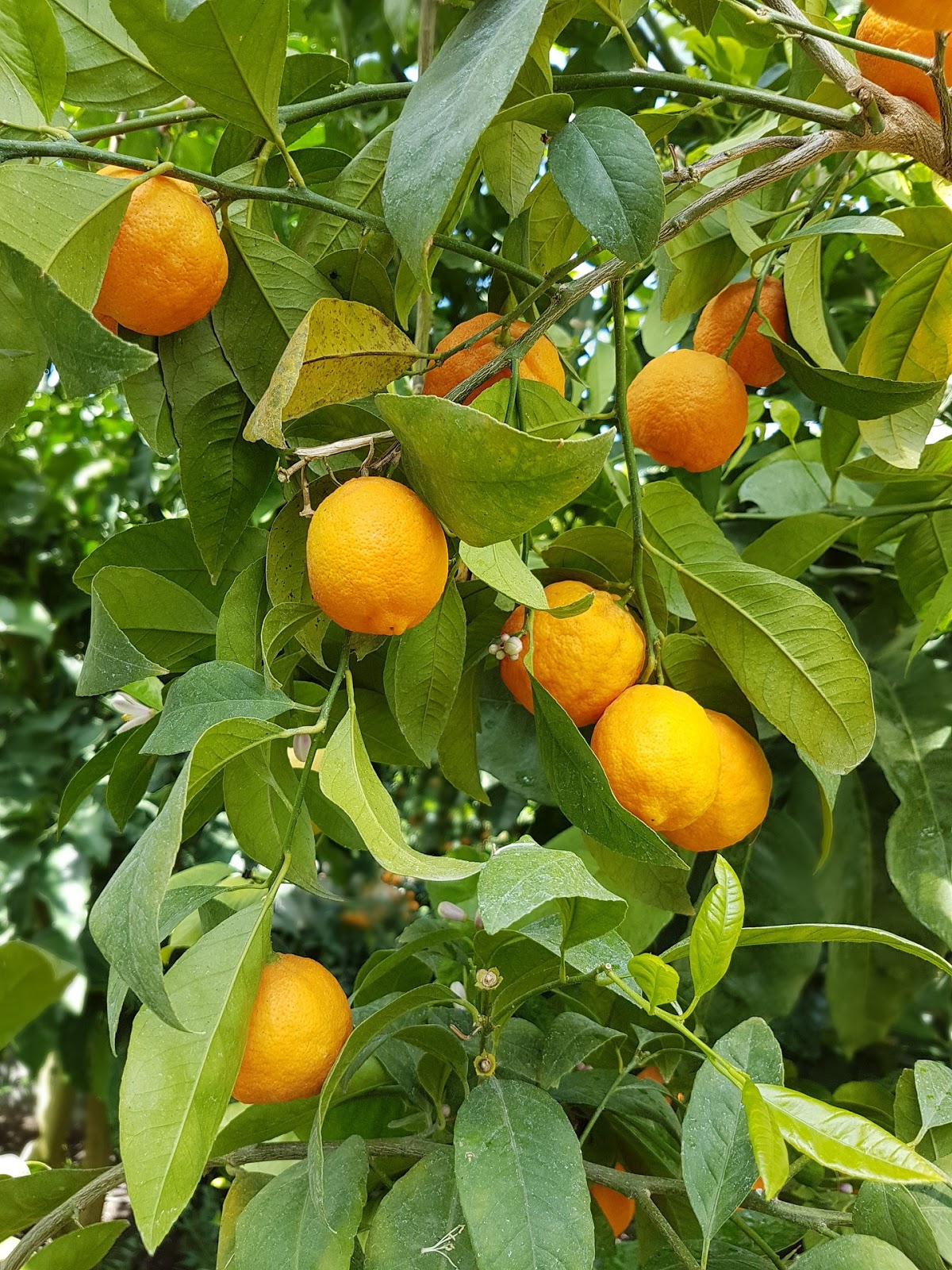
Citrus trees have their fair share of pests of diseases and control is better if it’s done proactively.
Certain times of the year are crucial in beginning your control program, but don’t worry, it’s not too daunting.

Let’s find out what needs doing
I'm talking with Steve Falcioni of www.ecoorganicgarden.com.au

There are several types of pests
Sap Sucking Pests: control with botanical oils such as eco Oil
  • mites, 
    Fruit flies sting the fruit leaving a telltale black spot on the outside.
  • aphids,
  • scale, 
  • bronze orange bug- need to control at green nymph stage when the bugs measure only a few millimetres. Once they start to colour up, oils will not control them. 
  • neem oil is registered for control of bronze-orange bugs on ornamental citrus.
Chewing Pests; caterpillars: control with Dipel
Queensland fruitfly: control with pheremone lures, spinosad based pesticides and/or exclusion netting.
Mediterranean fruitfly (found in W.A.) control with spinosad based pesticide and/or exclusion netting.
Timing is the key for pests and diseases because they have a lifecycle which tells us when the pest is most vulnerable or when the diseases is most likely to strike.
This is a good indicator of when control is most effective.
After all, you don’t want to waste your time, energy and money using a product that won’t work as well as it should because it’s the wrong timing.
If you have any questions for me or for Steve, why not write in to Realworldgardener@gmail.com or write in to 2rrr, PO Box 644 Gladesville NSW 1675.

VEGETABLE HEROES

Asian greens.
  • Did you know that Asian greens are all a distant relative of Broccoli, Cabbage and Cauliflower?
  • Asian Greens have been grown in China since the 5th century however, it wasn’t until the 
  • 18th century when Asian greens made their way into Europe after seeds were sent.
  • As for Australia, wasn’t until Chinese migrants, who arrived during the 1850’s Gold Rush, brought their traditional vegetables with them.
  • When the gold petered out, many Chinese became market gardeners growing the pak choi family and other leafy green vegetables.Chinese market gardens still exist around the capital cities today.
    Tatsoi, Mustard Greens, Mizuna
Many Different Names for Asian Greens.
To some people because there are many different types, have many names which may even have different spellings depending where they come from. Names include Chinese White Cabbage, Chinese Chard, Chinese Mustard Cabbage,  bok choy, pak choy paak tsoi, choy sum  - as I said Confucius...er... confusing!
  • These are all non-heading forms of Chinese cabbage with thick white crisp leaf stalks and veins and shiny smooth broad or wide dark green leaves that create a loose cluster.

They all tend to have smooth edges to the leaves.
There are also those cultivars that have pale green stems instead of white, and the leaves are paler green in colour.
Pak choy and bok choy are basically the same plant.
“Bok Choy has a white stem, and pak choy has a green stem.
Choy sum, is also known as the Chinese silverbeet.
Confusing names aside, when to grow them?
Asian greens-can be grown basically anywhere in Australia.
The main commercial crops are Gympie, the Sunshine Coast, Windsor in Sydney, and the Metropolitan area in Melbourne.
Sometimes Asian Greens go to seed too quickly.
  • The right climate and timing is very important and this depends on where you are.
  • If you are battling against your Asian greens-Pak Choi, Bok Choy bolting to seed the reason is plant bolts to seed early because they want to reproduce.
  • If your soil is a bit too sandy, which has high silica content, then this will lead to early bolting.
  • So keep topping up your organic matter in the soil and your harvest should be fine.
  • This normally is a good indicator that the soil is out of balance, ie there needs to be more organic matter in the soil.
    Bok Choy
  • For example in sub-tropical areas, Asian greens can be planted in most months of the year, but April, May and September to November are best.
  • In temperate areas of Australia-remember temperate is from around Sydney down to Tasmania but only includes the coastal areas-here you can sow the seeds now and shouldn’t have the bolting to seed problem.
  • Asian greens all love full sun, except in parts of Australia with very hot summers.In these hot spots, part shade is fine, so consider using some other plants, like beans and sweet corn, as ‘living shade’. Or erect a shade tent.
  • How To Sow
  •  Before sowing seed work in a plenty of compost and blood and bone. You should also add some Potash because Asian greens like not only lots of Nitrogen but lots of Potassium.
  • The seeds for Asian greens are very small so don’t bury them too deep. Just make a small impression in the soil about 5mm deep.
  • Sprinkle them in the row and  lightly cover them with soil.
  •  Asian greens also like lots of magnesium and because magnesium helps germination, put about half a teaspoon of Epsom salts, into two litres of water. Give it a good shake around and then water the seeds with that mixture.They will come up in about a week.
  • In six weeks, you’ll be harvesting your Asian greens.
Harvesting
Choy Sum Stalks
Pull them out of the ground then remove the root ball and trim it with a knife. Wash them to remove the sand and the greens are ready to cook.
Asian greens tend to attract insects, which love to eat them. “Aphids, cluster grubs, diamond back moth.
Everything will have a chew on them but it doesn’t matter because even if you’ve got a hole in the leaf, it makes no difference to the cooking or flavour and once these leaves wilt down, you won’t even see the hole.
Why are Asian Greens good for you?
In many Asian cultures, people believe that food should be their medicine.
Bok choy would be a good choice as we’re an excellent source of vitamin C
• Asian greens contain dietary fibre as well as some iron, calcium and folate.
• Also a good source of beta carotene which your body can make into vitamin A. Your eyes need vitamin A.
THAT WAS YOUR VEGETABLE HERO FOR TODAY

PLANT OF THE WEEK

Holly Leaved Fuchsia:Graptophyllum ilicifolium
There are those gardeners who think that native plants look straggly or messy and won’t plant them in the garden. 
No mixing up of plants for them.
Perhaps the holly leaved fuchsia will have them changing their minds because it looks more like something from the northern hemisphere.
A medium shrub 3-5m high found in fairly dry rainforest areas or along creek bank.
Actually occurring only in a small pocket west of Mackay in Queensland.
Moderately fast grower in warm climates, but slower in cool temperate areas.
WatchLet’s find out more. I'm talking with Adrian O’Malley, horticulturist and native plant expert.

PLAY: Holly Leaved Fuchsia_9th October_2019
Graptophyllum ilicifolium, or holly leaved fuchsia is quite unusual, and may just suit your garden.
Leaves look like those of a holly bush so very useful for Christmas decorations perhaps?
The flowers are fuchsia like, but obviously this plant is tougher than your regular fuchsia because of the tougher leaves.
The flowers appear in spring and summer along the stems.
 
Graptophyllum ilicifolium: holly leaved fuchsia
If you have any questions for me or for Adrian, please write in to realworldgardener@gmail.com