Pages

Showing posts with label Preserving summer produce. Show all posts

Saturday, 18 March 2017

Everlasting Flowers. Some Seeds and Fairy Wrens

WILDLIFE IN FOCUS

Red Backed Fairy Wren and Superb Fairy Wren, What's the Difference?

This little bird is the smallest of the wren species in Australia.
In fact it’s smaller than a sparrow and because it’s so small, that it’s called the Elfin wren.
Red Backed Fairy Wren
The males of course have all the colour being a glossy black with a scarlet patch, while the females are brown.
They can't be mistaken for a sparrow because they're smaller and have that characteristic pointing up tail, bouncing around like little ping pong balls.
Let’s find out what’s great about this bird.


Here's the difference.
The Red Backed Fairy Wren is smaller and shyer than the Superb Fairy Wren , but has a similar call.
Female Red Backed Fairy Wren, not red at all.
Most of us won’t see this Fairy Wren because Red-backed Fairy-wrens are essentially birds of Australia's north where they are mainly restricted to the more humid zones closer to the coast.
In eastern Australia they do extend south  all the way down the NSW north coast to near Newcastle and in W.A. south to Cape Keraudren, again along the coast.
Apparently they’re common around the outskirts of Brisbane and Darwin.
If you have any questions about Red Back Fairy Wrens, drop us a line to realworldgardener@gmail.com or write in to 2RRR P.O. Box 644 Gladesville NSW 1675.

 VEGETABLE HEROES

Making Your Own Seed Tape, seed mats or discs is today’s topic.

Would you believe that it was only twenty-plus years ago, several seed companies started making and selling seed tapes - Seed tapes are strips of dissolving or quickly decomposing material that have imbedded seeds spaced at regular intervals.
They’re used to make dispersal and spacing of difficult-to-handle seeds .
The tapes also make it easier to make straight rows.
Planting seed tapes or mats is easy because the arranging of seeds is already done, or if you are making your own you can do it indoors.

Why have seed tapes?
Is it only for beginner gardeners?
Seed tape has several advantages.
No seed is wasted; the seeds are embedded into the paper tape one at a time and are perfectly spaced and ready to go into the garden.
This also means that no thinning is required.
They’re especially useful for tiny seeds which can be difficult to plant such as radish, carrot, lettuce or parsnip. 

Just about any seed can be put onto a seed tape, however, so if you wish to make one with larger seeds, there’s no stopping you!

Seed tapes also stabilise the seeds positions in the soil, keeping them in place even when they are hammered by heavy rains.
And, if you cover seed tapes with weed-free potting soil, the seeds can germinate with no aggravation from weeds.
Several seed companies in Australia sell a variety of seeded tapes that are incredibly easy to plant, or you can make your own.

That’s right, gardeners can make their own seed tapes!
Seed tapes are long and skinny, and intended to do a superior job of spacing seeds uniformly in the row.
They do this quite well, although some experienced gardeners have said that the seeds on most seed tapes are too close together.
This may be true for some crops, like radishes, but not for small, slow-sprouting carrots.

How to make this tape then?

You can use unbleached toilet paper to make my seed tape.
I think that paper towels or even newsprint would work as well, although I haven’t tried them.
Begin by mixing approximately 2 Tablespoons of white flour with 1 Tablespoon of water to make a thick paste.
This will act as the glue to hold the seed in place.
You don’t want this to be watery and thin because you want it to dry quickly so that the seed does not have a chance to absorb the water.
Unroll the toilet paper until you have about 1 metre of it are lying flat on the table in front of you.
Fold the toilet paper in half the long way, and then unfold.
You’ll be placing the seed in the middle of one half of the toilet paper (about 2.5 cm or 1″ from the edge of the toilet paper).
From the seed packet, figure out how far apart you need to space your seeds.
Don’t use the distance given on the packet for planting – use the distance that the packet suggests for thinning.
For carrots, I placed my seeds 5cm apart.
Use a ruler to guide you as you space seeds
If it helps, you can use a pen or marker to mark the spot on the toilet paper where the seed will go.
Now, dip a tooth pick, cotton bud or artists paint brush into the flour paste to get a small amount of paste on its tip.
Use this to pick up just one seed.
Sounds fiddly I know, but be determined. You can do it.
Using a ruler as a guide, place the seed onto the toilet paper at the proper distance apart for the seed you are working with.
When you’ve “embedded” all of the toilet paper, add a few dots of your flour paste every few cms near the edge of the toilet paper and fold the toilet paper back in half.
Rub gently to allow the paste to glue the two sides of toilet paper together.
Continue working in the same manner until you’ve used all your seeds, or until you’ve made as much seed tape as you need.
Be sure to leave the toilet paper spread out until the paste is completely dry. Write the name of the seed on one end of your seed tape, and then you can roll it up and store in a cool, dry spot until you’re ready to plant.
The faster it dries, the better, since you don’t want the wet glue to trigger germination (it shouldn’t be wet long enough for this, but better safe than sorry).
When dry, roll them up and store them in plastic bags, along with the seed packet, until it is time to plant.
Now your tape is ready to use!
I heard of other gardeners making their seed tape using paper towels and the flour and water glue.
Just make a paste of flour and water and spread a thin layer of it onto the paper towel. Then put the seeds on and a second layer of the towel.
Works great and the paper towels hold up just a little bit better than the toilet paper. You do have to make sure you dry it well after making it if you aren't going to plant immediately, but that usually just takes a day out in a dry place.
How To Use Seed Tape
Use your seed tape in long flower boxes, raised beds, or right in the garden.
All that you have to do is dig a trench the recommended depth for that seed, lay the tape down, cover with garden soil and water gently.
The paper biodegrades into the soil as the seeds germinate and grow.
For best results, be sure to keep the seed consistently moist.
AND THAT WAS OUR VEGETABLE HERO SEGMENT FOR TODAY!

THE GOOD EARTH

Preserving Summer Fruits

Do you have fruit trees in your garden?
Citrus are fruits so you probably answered yes to that.

So what do you do when the fruits all come ripe at once?
Jams and preserves and possibly pickles are the first things that come to mind for most people, but there are a lot more methods of preserving fruit to use later on in the year. Let’s find out about this preserving business.
I'm talking with Margaret Mossakowska from www.mosshouse.com.au

I hope that’s inspired you to try several different methods of preserving your fruit.
We didn’t even cover making pasta sauce with all those tomatoes that you’re growing right now.
If you have any questions about preserving summer produce or have some information you’d like to share, why not email realworldgardener@gmail.com

PLANT OF THE WEEK

NEW Everlasting Daisies.

Bracteantha bracteata
Have you ever been to see the wildflowers in Western Australia?
It’s on my bucket list.
In the wild, these fast-growing annuals perform brilliantly under extreme conditions. They germinate with the first rains in winter and by late August are in full flower, adding bright colour to the otherwise harsh landscape of outback Australia.
But it’s one particular wildflower that we’re focussing on toda

Let’s find out about this plant.
I'm talking with the plant panel: Karen Smith, editor of Hort Journal www.hortjournal.com.au and Jeremy Critchley, The Green Gallery wholesale nursery owner. www.thegreengallery.com.au


Everlasting Daisies at Wittunga Botanic Garden, Adelaide. photo M Cannon
Here’s a tip to keep those everlastings for longer in the vase.
The trick is to pick the flowers when they are young and just opening.  
Then hang upside down in a cool, dark room.
Once dried, the stems can be trimmed and they can be placed in vases or you can replace the stems with florists wire.
If you pick the flowers when they are fully open the petals will fold back towards the stem and the flowers will fall apart.

Friday, 15 January 2016

Super Ferns and Super Fruit

THE GOOD EARTH

Preserving Summer Fruits
Do you have fruit trees in your garden?

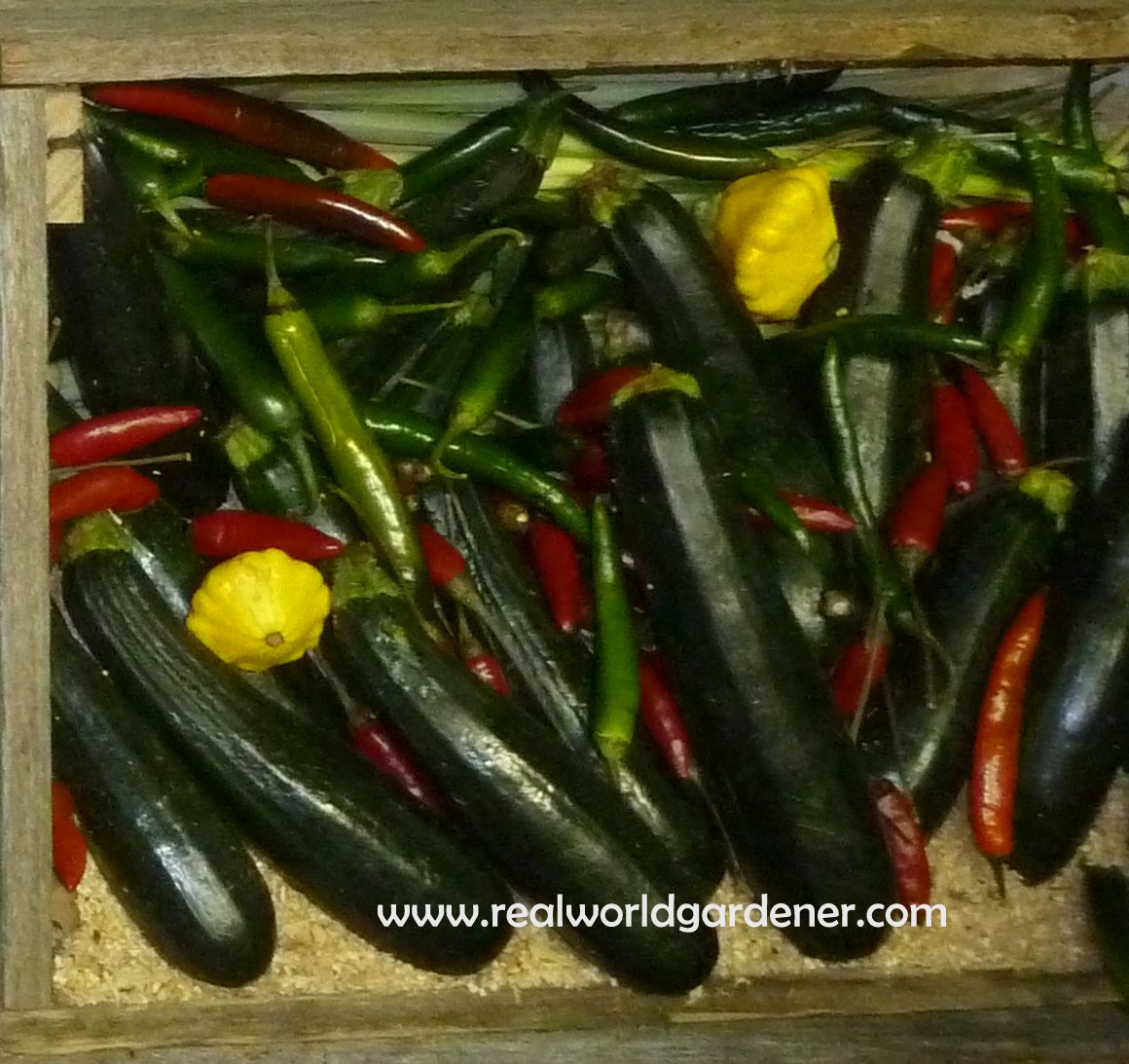
Preserved oranges. Photo: Margaret Mossakowska

Citrus are fruits so you probably answered yes to that.
So what do you do when the fruits all come ripe at once?
Jams and preserves and possibly pickles are the first things that come to mind for most people, but there are a lot more methods of preserving fruit to use later on in the year. Let’s find out about this preserving business.
I'm talking with Permaculture North President, Margaret Mossakowska.


I hope that’s inspired you to try several different methods of preserving your fruit.

Electric dryers are a very efficient way of drying fruit because they're quite enclosed and don't use nearly as much gas or electricity as your conventional oven.

You can dry anything, any produce literally, even carrots.

Drying as a good alternative to other methods of preserving except of course if you have a root cellar or under-house garage where the temperature is constant and cool.
In here you can store your veggies in sand.
We didn’t even cover making pasta sauce with all those tomatoes that you’re growing right now.


If you have any questions about preserving summer produce or have some information you’d like to share, why not email realworldgardener@gmail.com
 or write in to 2RRR P.O. Box 644 Gladesville NSW 1675.


 VEGETABLE HEROES

This weeks Vegetable Hero is ZUCCHINI or Cucurbita pepo.
Summer squashes, and winter squashes, are native to the Americas and belong to the family of curcurbita. 
Did you know that Archaeologists have traced their origins to Mexico, dating back from 7,000 to 5,500 BCE, when they were an important part of the diet which was mainly made up of maize, beans, and squashes. 
Ever wondered what a Courgette is?While Zucchini is the more common name in Australia, Italy,North America, and Germany, courgette is the name mostly used in the United Kingdom, Greece, New Zealand, Ireland, France, the Netherlands, Portugal and South Africa.
So What Do They Look Like?
 Zucchini have a similar shape to cucumbers and can be dark or light green.
You can also get golden zucchinis that are a deep yellow or orange colour
 
The best times to sow Zucchinis for those who haven’t this season are;
In temperate areas, from September through to January, in Cool temperate areas, you have been October and January, in arid areas, yes that’s you in Alice Springs and Broken Hill, you have a bigger window, September through to March, sub-tropical zones, August to February, but for tropical areas, now’s too hot.
Your Zucchini planting time is April to August.
Very different from the rest of Australia!
Having said all that Zucchinis are great for the beginner gardener because they are quick and easy to grow.

Prepare your soil with the usual digging in some compost or cow manure.
Zucchinis are light feeders so won’t need much more than an occasional feed with some liquid fish fertiliser.
Sow your zucchini seed where you want them to grow.
TIP: Planting your seeds deeply will make your plant more drought tolerant.
Just like cucumbers, zucchinis take up a lot of space so maybe try growing them vertically.t
that way there’s also improved air circulation so the fungal problems are a lot less.
If you have heavy soil or only have a balcony garden, you could grow them in pot which would need to be about 30cm diameter.
TIP:The important tip with growing them vertically is have lots of soft ties, like old panty hose cut into strips, so you can tie up the stems as they grow.
That way they won’t flop all over the place and probably break their stems.
If you don't get many bees or pollinating insects around your way you might need to pollinate the zucchini flowers yourself

ZUCCHINI LEAVES
Fully grown zucchini leaves tend to look a motley silvery grey colour which looks like the fungal problem powdery mildew.
Unless you’re watering the leaves this shouldn’t happen.
Powdery mildew grows on wet zucchini leaves or on any veggie leaves that are wet.
By watering where it’s needed most, the roots, not the leaves you shouldn’t get this problem.
In summer you'll need to keep your zucchini's water levels high, because they dehydrate very quickly on hot days so mulch them heavily (but remember to keep the mulch away from the main stem).
Zucchini problems
There are two main problems that gardeners have when growing zucchinis.
when the fruits are 5cm long, they rot and drop off. This is a pollination problem.
You might have to pollinate them yourself.
Next year grow a whole lot of flowers nearby like Borage, nasturtiums or marigolds.
The second problem sounds like blossom end rot where fruit almost ready to harvest starts rotting from the top.
If this happens you need to add lime to the soil at the time of planting.

Too late this season. Otherwise it can be caused by irregular watering, that means, too much drying out in between waterings.
If your plants have many days of no water and then a glut of it, blossom end rot can develop, ruining the fruit.
By picking your Zucchinis regularly, usually when they’re about 20cm long; this helps the plant keep on cropping. If you let Zucchinis grow too big-like a metre long, they’re not much good as a vegetable to eat because they become too tough and contain mostly seeds.
The flowers are also edible - they can be used in salads, as garnish, and even fried.
Why is it good for us?
Zucchini and other Squashes
The zucchini vegetable is low in calories, about 15 calories per 100 g fresh zucchini.
1/2 cup of zucchini also contains 19% of the recommended daily amount of Manganese
As well as Zucchini containing large amounts of folate and potassium, the rind contains the nutrient beta-carotene, so to get the most out of your zucchini, you should also eat the rind.
If you want some unusual varieties, go online to buy the seeds of Goldfinger Hybrid, or Costata Romanesco-speckled with light coloured ribbing.
Storing Zucchini-Store zucchini fresh and unwashed in a cold dry place, like the fridge, for about 3-5 days.
After that they start to get soft and wrinkly, and nobody wants that. Makes you wonder about the zucchinis that you buy in supermarkets. How has their shelf life been increased? Better to grow you own.
AND THAT WAS YOUR VEGETABLE HERO FOR TODAY

DESIGN ELEMENTS

Green as the Main Colour Scheme
Foliage colour leads this garden design.
Would you believe that not everyone likes flowers in the garden.
But colour just doesn’t colour from flowers, it also can come from, foliage, bark, pottery, furniture, fences and even artwork, but in the end it is all about colour.
So what kind of a garden is it with no flowers?
Let’s find out; I'm talking with English Garden Designer Lesley Simpson.


The easiest colour scheme to use is the one that uses only one colour and green as the main colour is very calming and refreshing.
Green doesn't need the addition of anything else to make it work and of course we're really talking about using different types of foliage colour in the garden scheme.
There's a huge range of foliage colour to choose from; the blue-greys of Eucalypts, silver foliage of Mediterranean plants to lime greens and variegated foliage.
When you get down to it, our gardens are really about colour and are meant to enhance our lives.
Perhaps also to make our homes look better from the street.

PLANT OF THE WEEK

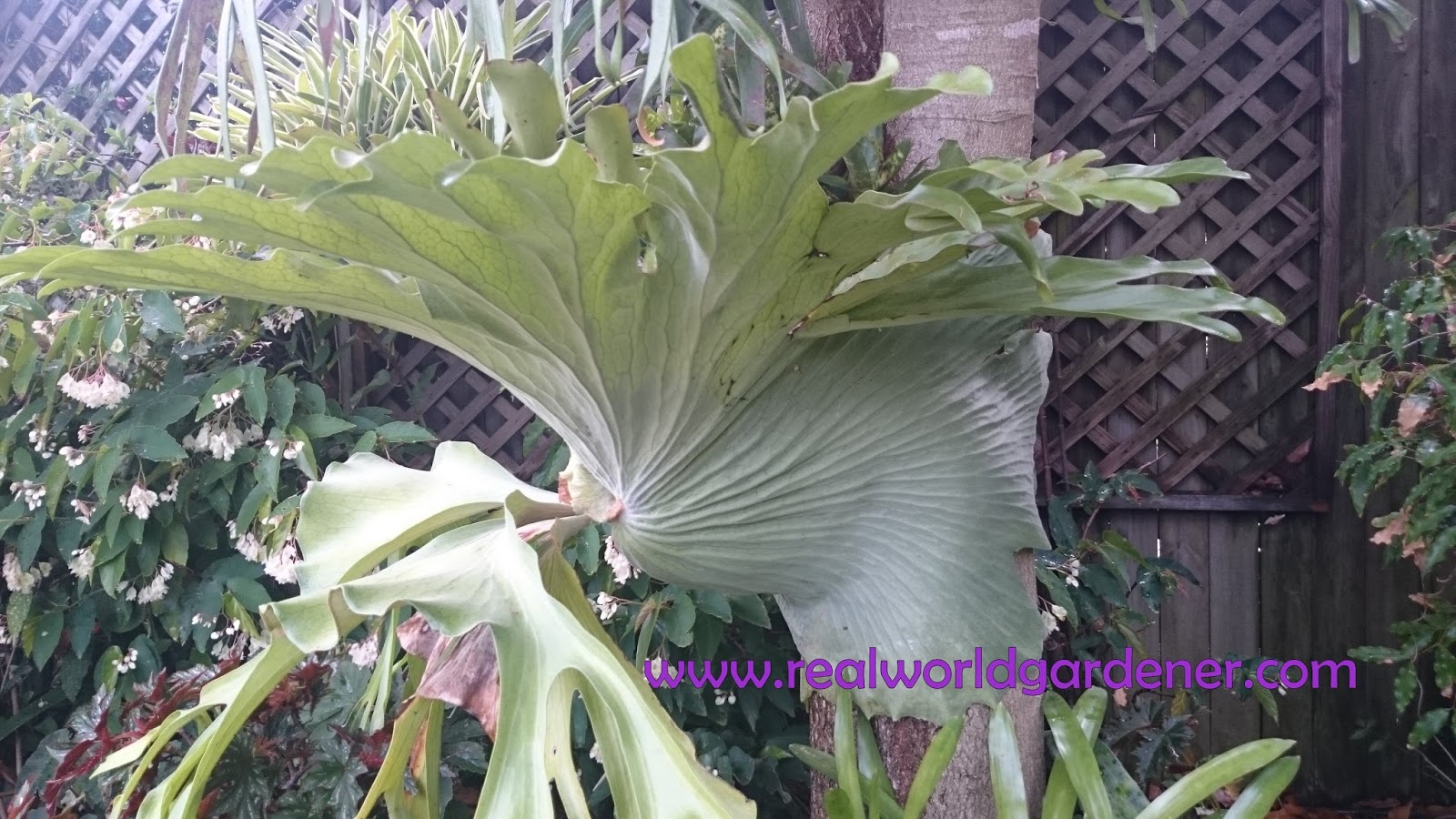
Staghorn Fern Platycerium superbum
Staghorn Fern
They make a nice plant for your balcony, verandah or just somewhere perhaps on a tree in the garden and are very easy to care for.
They can be grown year-round outdoors in areas protected from frost and freezing. In their natural habitat they can be seen growing high up in the crowns of trees.
Let’s find out some more by listening to the podcast.

Staghorn ferns are native to tropical central Africa including Madagascar, southeast Asia, the Pacific islands and Australia.
One species is native to the Andes mountains of Peru.
Platycerium superbum has greyish green fronds that lay flat over the root system which is attached to a support.
This fern has two distinct leaf forms.
Flattened sterile shield fronds protect the anchoring root structure and take up water and nutrients. This ‘nest’ frond is designed to collect falling leaves and insects and funnels it to the feeding roots.
This is the place gardeners usually throw in banana peels for the same reason.
Platycerium superbum

These give the fern a valuable source of potassium and calcium, nutrients required for the production of their large fronds.
It's from this frond that the fern attaches itself to the host tree.