Pages

Friday, 16 October 2015

Life Is A Healthy Garden

SOIL SAVVY

Wouldn't you like a garden this this one; thriving, lush and disease free?
So nice you could hold a tea party.
Sometimes our garden plants go along for years then all of a sudden, they drop dead and we’re left wondering why?
The answer can lie in a number of different factors and a slip in hygiene practises in the garden sometimes has a role to play in the demise of your plant.
So what does that mean for us gardeners?
Let’s find out with Soil Scientist Penny Smith


Your soil is a living eco-system so don't go pouring anti-fungal drenches on your soil or you will end up with no micro-organisms.
Spray tools with methylated spirits and water solution
Hygiene practises in the garden is more than just keeping your garden tidy.
Pathogens can lie dormant for many years, just waiting for the right conditions.
Good garden hygiene, is sometimes referred to as “clean gardening practices”, will help to prevent the build up of pathogens and pests.
Make their life short in your garden by following best hygiene practises.
Secateurs can spread fungal problems, so clean tools between plants.
In fact after the jobs done, spray all the tools that you have used with a 70% methylated spirits and 30% water solution. Keep the solution in a labelled spray bottle where you keep your garden tools.
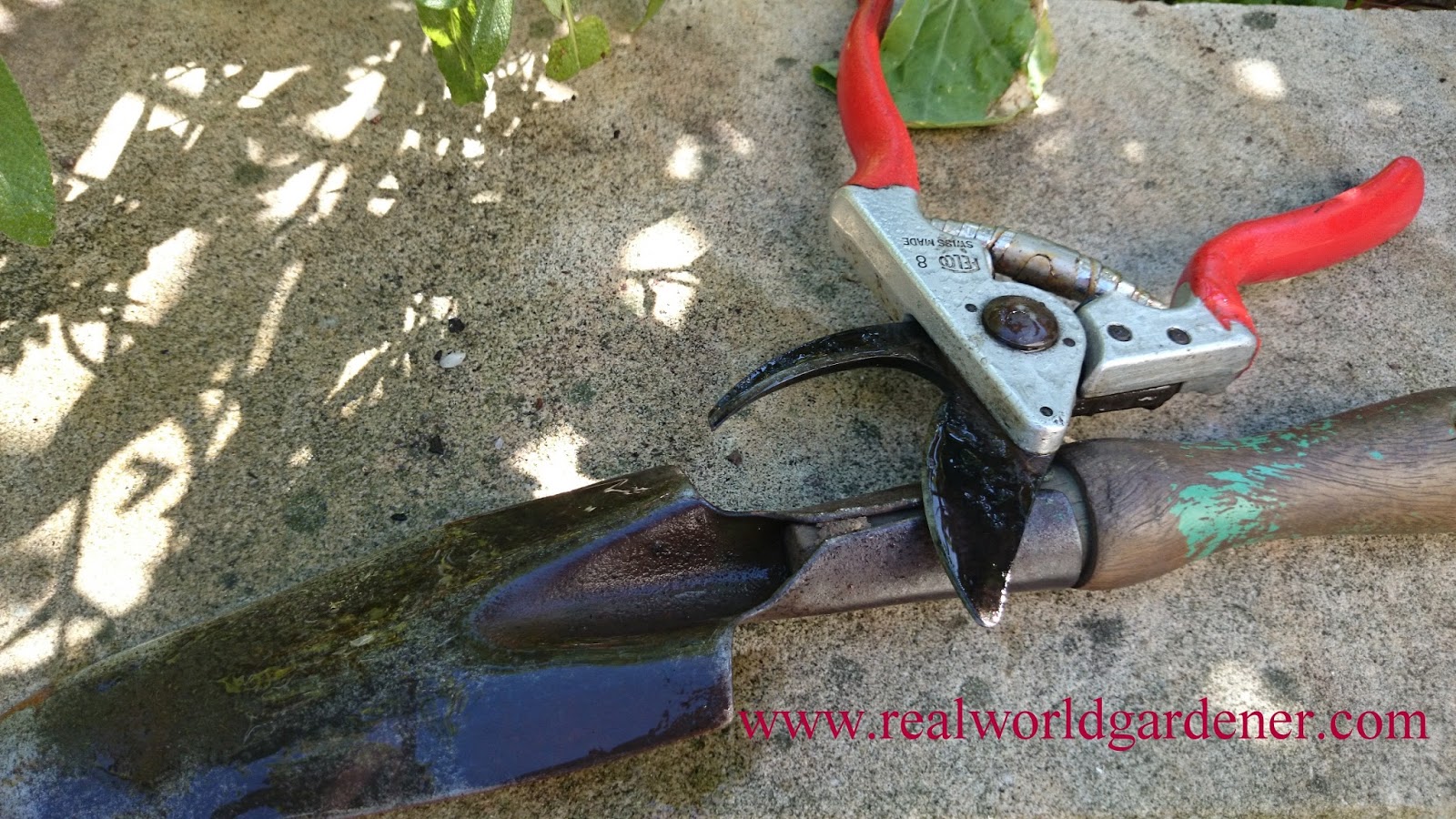
Disease-spreading organisms can, and will, be carried from plant to plant by using contaminated pots, trays, soil, tools and even our hands if proper precautions are not taken.
Pots, seed trays and propagating tools should be kept scrupulously clean on an ongoing basis.
Growing containers should be thoroughly cleaned and disinfected before each replanting. They can be scrubbed and cleaned using water and a natural detergent and then disinfected by soaking in a 10% bleach solution before being rinsed with clear water and allowed to dry.
Better yet, a quality garden disinfectant may be used for this purpose. Cutting and digging tools, including hands, should also be washed and disinfected after each use

If you have any questions about hygiene practises in the garden or have some information you’d like to share, why not email realworldgardener@gmail.com or write in to 2RRR P.O. Box 644 Gladesville
NSW 1675

VEGETABLE HEROES

Perilla (Perilla frutescens) also called Beefsteak plant, Chinese Basil and Purple Mint
Perilla belongs in the Mint or Lamiaceae family and originates in China and Central Asia.
Perilla has some amazing properties that will surprise you.

You’ll be amazed to hear that one of the components of the volatile oil extracted from perilla; Perilla-aldehyde, can be made into a sweetener, said to be 2000 times sweeter than sugar, with very low kilojoules. 
This sweetener has been used as a substitute for maple sugar or licorice in processed foods.
Not only that amazing fact but analysis of perilla’s anti-microbial properties, has shown it to have over one thousand times the strength of synthetic food preservatives.
Did you know that Perilla is grown as an oil seed crop from Japan to northern India?
The oil makes UP HALF the seed’s weight!

The oil is used not just used in cooking as you might use linseed oil, but it’s also got industrial applications such as in paint, printing, and paper manufacture. 
Perilla contains a natural red pigment called shisonin which is used in food processing as a colourant.
So what is Perilla then?
Perilla is a fast growing annual plant that grows to around 50cm to 1m tall.
Perilla comes in several varieties and the leaf size and shape look a lot like unpatterned coleus or large a leafed Basil plant.
There is also a frilly, purple-leafed variety that’s quite ornamental as well as being used in cooking.
If you saw the purple variety you might think that the leaves are a bit similar to Beefsteak plant or Iresine herbstii.
Perilla the plant itself has two lipped flowers in either white, pink or lavender-purple, that grow in the leaf axils and terminal spikes.
The plant has a very bushy canopy of opposit leaves forming on square stems, like all Mint family plants.
Leaves are oval shaped to 15cm long, and are aromatic with a fresh flavour similar to lemon and mint.
Perilla will grow from seed but needs cool conditions and light to germinate.
Before sowing, garden suppliers recommend that you place the perilla seeds into a bowl or glass that contains a couple of cm’s of water.
Soak the seeds overnight or for 12 hours.
Sprinkle the seed where it is to grow in autumn or in early to late spring’
Because Perilla is a herb, you could grow this in a tub or pot if you live in colder districts.
For growing Perilla pick a sunny and well-drained spot with some afternoon shade if the summers are hot.
Add plenty of organic material to the soil and keep it moist.
In temperate climates, the plant is self-sowing, but the seeds aren’t viable after long storage, and germination rates are low after a year.
However if you don’t want it to self-seed, cut off the flower spikes as they appear.
This will also increase the life of the plant.
There are a couple of companies that sell the seeds either listed under Salad Greens or Asian Vegetables.
 I have found two varieties that you can buy, under Salad Greens, there is Perilla Green Leaves and flower stalks eaten raw, or with tempura, leaves have a deep green colour and Perilla Red (Crispa) Leaves and flower stalks eaten raw, or with tempura, with a deep red colour and pleasing aroma.

Sow both of these in late spring.
If you can’t get the seed but have some at your local fruit and veg store, here’s a way to get some plants/
I found this on a blog. Maki says she grew her Chinese variety from cuttings from ones bought at an Asian grocers.
Just pop some in a glass of water and they should strike.
It was dead easy according to Maki so I'm pretty sure yours are going to go OK too.
How Do You Use It In Cooking?

Red perilla is used as a red or pink food colouring, for pickling fruit and vegetables, especially preserved ginger and pickled sour plums, and as a dried powder to be used as a side dish with rice, as an ingredient in cake mixes and as a flavouring in beverages. 

Green Perilla is used as a sweet-spicy flavouring for oriental dishes such as stirfries, with raw fish and sliced cucumber, in vegetable dishes, rice and soups and goes well with sweet potato.

The Japanese often eat the fresh leaves with sashimi (sliced raw fish) or cut them into thin strips in salads, spaghetti, and meat and fish dishes.
It is also used as a savoury herb in a variety of dishes, even as a pizza topping (initially it was used in place of basil)
The seeds of perilla are used to make oil, and to flavour foods, especially pickles and also on baked goods, like sesame seeds.
The flowerheads are also used as a condiment.

You may even be able to order in some Perilla herb from your garden centre, as they certainly sell small plants online. www.herbcottage.com.au
A little hard to get I know, but sometimes, you can be lucky and you’ll be rewarded with this amazing plant.
Why is it good for you?
Perilla leaves are high in the minerals calcium, iron, and potassium, rich in fibre and riboflavin, and very high in vitamins A and C.
It has anti-inflammatory properties, and is thought to help preserve other foods.

AND THAT WAS OUR VEGETABLE HERO SEGMENT FOR TODAY!

DESIGN ELEMENTS

This series on best fit gardening is coming up with solutions for those difficult situations in your garden that seem almost impossible to solve.
If you can't have a garden like this one because of the location and soil at your place.
Try for something that best fits the situation.

Areas that receive hot baking sun in summer and shade in winter will always prove a challenge and sometimes end up being a haven for weeds.
This week's challenge was an east facing clay bank between mature eucalypts with a Tradescantia problem
Yes, the weeds that seem to creep up on you when you’re not watching, almost overnight.
So what can be done if you want weed suppression?
Let’s find out by listening to the podcast with Garden Designer Peter Nixon. www.paradisusgl.peternixon.com.au


Kalanchoe fedtchenkoi variegata
 Planting suggestions were:Kalanchoe fedtchenkoi variegate-Lavender Scallops, for sub-tropical to warm temperate districts.

Cyanotis foecunda-south African Pussy Ears for warm temperate to cool temperate.
Has striking silver foliage.
Cyanotis foecunda
Ceratostigma willmottianum-Willmotts Blue or Chinese Plumbago:For cool temperate areas.

Tradescantia is now the politically correct name for what we once called Wandering Jew.
It’s particularly good to get rid of this weed because it seems to harbor so many things that make our pets itch and us sneeze.
Spraying might seem the easy option, but those waxy leaves and stems seem impervious to weed killer.
Wear gloves and try and rake up as much as possible to get on top of it, then closely monitor the patch for any more outbreaks.


PLANT OF THE WEEK

Teucrum fruiticans Germander

Members of the Teucrium genus that is featured today in plant of the week are commonly known as germanders.
There are hundreds of species, including herbs, shrubs or subshrubs.
They’re found all over the world but are most common in Mediterranean climates which might make you think that they are tough little plants.
You would be right.
Let’s find out about them with the plant panel, Karen Smith www.hortjournal.com.au and Jeremy Critchley owner of www.thegreengallery.com.au
by listening to the podcast

The idea that Teucrium was named after the King of Troy sounds fantastic, but in reality it’s more likely that Linnaeus named the genus after a Dr. Teucer, a medical botanist.
The species Teucrium fruitcans grows to 1-8m x 1.8 m.
Ornamental, silvery foliage year round.
Deep, true blue flowers from autumn through to late spring.
Very hardy and dry tolerant shrub once established.


Suitable for clipping  and for hedging.
Prefers a full sun location in most soil types given good drainage. Withstands dry conditions well once established but should be watered deeply occasionally during extended periods of heat. A hard prune after flowering will encourage a dense habit. If hedging, lighter but more frequent prunes to shape is required.

Teucrium fruiticans "Silver Box" is a new release only growing to 0.8 m x 0.8 m.

Why it’s called Germander?
Taken from medieval Latin germandra, based on the Greek khamaidrus, literally ‘ground oak’, from khamai ‘on the ground’ and  drus ‘oak’ (because the leaves of some species were thought to look like those of the oak).

If you have any questions about growing Germander or Teucrium, why not write in to realworldgardener@gmail.com

Friday, 9 October 2015

Ring a Ding Dong and Roses

PLANT DOCTOR


We love our roses don’t we?

What’s not to like?
Just inhale the perfume, and feast your eyes on the shape and form of the flower and the whole gorgeousness of a bunch of roses.

On the other hand, there’s the thorns on most, the pruning and the dreaded diseases that they get if they’re not in the right environment.

So what can we do about the most common problem on roses?

Talking with eco Organic Garden General Manager, Steve Falcioni.
Listen to the podcast to find out more.


Black spots have a soft edge and initially they're just black about the size of a pea.
As the fungus progresses the leaf yellows and then drops off.
symptoms show up 3 to 10 days later of mild temperatures of around 24 degrees Centigrade and high humidity.
Usually black spot starts on the lower leaves and works its way up,
Sometimes it can defoliate the whole bush.
Even though you've sprayed your roses in winter to control fungal problems, fungal spores blow in on the wind from somewhere else.
Some of the cultural controls they you need to do before spraying are:-make sure your rose has 6 hours of direct sunlight and logs of good air movement.
Winter pruning should have opened up the bush as a way of reducing the humidity issue.
Also rose are heavy feeders so make sure your roses are well fed.
I hope this peaks your interest in getting out there and spraying those roses with whatever method of control you choose.
Starting early is a good way to get a jump on those fungal diseases before the weather warms up and the humidity increases.
Organic sprays include whole cream milk, but is only effective if sprayed on sunny days.
Bi-carb soda and horticultural oil.
Potassium bicarbonate sold as eco Carb fro, www.ecoorganicgarden.com.au
Potassium bicarbonate changes the osmotic pressure on the leaf causing any fungal spores to burst.
While you’re out there, why not pick some roses for inside the house.
If you have any questions about your rose bushes or have some information you’d like to share, why not email realworldgardener@gmail.com or write in to 2RRR P.O. Box 644 Gladesville NSW 1675.

VEGETABLE HEROES

Lentils, Lens culinaris

Lentils are a type of bean that first grew in South-West Asia.
They’ve been around for thousands of years and were already a farming crop in 10,000BC.

 Another interesting fact is that as you’d expect, about a quarter of the worldwide production of lentils is from India, mostly for it’s own domestic market but Canada is the largest export producer of lentils in the world?
Why should you grow them?
Not only are they easy to grow, but lentils are also easy to store for later on.
It might be a fun thing to do just to see how they grow, and like all legumes, they’ll add nitrogen to your soil.
But on the upside, lentils have a lot of protein and they’re easy to cook just by boiling them in water to make either soup or Dahl for a fairly short time.
Perhaps serve up some fish or chicken on a bed of lentils as they do in fancy restaurants?
Lentil flour is used to make pappadams or added to cereal flour to make breads, cakes and baby foods.
You can also eat the immature pods and sprouted seeds as a vegetable.
What are Lentils?
Lentils are a hardy annual; they are a member of the pea family.
Lentils grow on low bushes from 25 - 40cm tall.

The lentil has small whitish to light purple pea-like flowers.

The pods are small, broad, flat and contain one or two flat, lens-shaped seed that are green or yellow to orange, red or brown.

You’ll need to plant 4 -8 plants for each member of the family.
Growing Lentils-.
Did you know that dried lentils can also be sprouted by soaking in water for one day and then keeping them moist for several days?

 Sow lentils in spring as early as 2 weeks before the average last frost
Plant lentils in full sun in a loose, well-drained soil rich in organic matter. They will grow in poor soil however which is good news for those gardeners with sandy soil.
You can also sow your lentils into a pot if you don’t have a big garden.
Tip: Lentils hate waterlogging.
Lentils grow best in a fairly neutral soil with a pH between 6.0 and 6.5.
Add some compost to the soil before sowing also helps.
Lentils can be started indoors before transplanting to the garden; and lentil seeds will germinate in 10 days at 20° C.
Plant lentil seeds 5 – 10 cm deep, spaced 2 cm apart. 

Keep lentils evenly moist, but on the upside, Lentils are more drought tolerant than other beans. 

Don’t water lentils once the pods have begun to dry.
Side dress lentils with compost tea when plants are 10 cm tall and again at flowering.
When Are They Ready?
Lentils need around 11 to 15 weeks or around 3 months to come to harvest.
Lentils are normally used like dry beans or peas.
For dried seeds, pick your lentil pods when they have matured and hardened. You can tell this when the lowest pods on the plant start to turn light brown and when you give the pod a light shake, it gives off a rattle.
Tip: Leave lentils unshelled until you are ready to use them.

You can buy lentils as seed for Microgreens and for sprouting so these could be used for sowing in your vegetable garden or in a pot.

Why Is it Good for You?

In a 100 g serving, raw lentils provide 353 calories and a rich source of many essential nutrients, particularly dietary fibre and protein.
Micronutrients in high content include folate, thiamin, phosphorus and iron

Lentils have the second-highest level of protein of any legume, after soybeans.
Red (or pink) lentils contain a lower concentration of fibre than green lentils
AND THAT WAS OUR VEGETABLE HERO SEGMENT FOR TODAY! 

DESIGN ELEMENTS

Manettia bicolour
Senecio mikanoides
Talking with Garden Designer Peter Nixon from Paradisus

Last week we started a series on best fit planting for various scenarios in many people’s gardens.
Best fit planting means that your being careful with your selection of plant so that it actually lasts in that spot.

Unless of course you decide you don’t like it, but otherwise, if you choose for the conditions that it’s going to grow in, then your plant should thrive.
The first scenario was how to hide a boundary fence in a narrow passageway at one side of the house.
After all, if you’re looking out the window at that fence, it’s not that attractive.
Much better to have some sort of green plant giving off a sense of peace and tranquillity than a brown either paling or Colourbond fence.
Listen to the podcast to hear more about this topic.


Stephanotis floribunda
Peter mentioned Senecio mikanoides and Manettia bicolour as two possible climbing plants for the narrow passageway.

Other climbing plant suggestions apart from the Meuhlenbeckia, are Star Jasmine, Hoya carnosa, Mandevilla Aloha series and Pandorea Snow Bells and Stephanotis floribunda.

These are all evergreen and should fit that narrow passageway as well.

If you have any questions about hiding the boundary fence or have a suggestion why not write in or email me at www.realworldgardener.com

PLANT OF THE WEEK


The exotic Fuchsia plant has very attractive delicate flowers and perhaps the native version isn’t quite so showy.

On the plus side, native fuchsias or Correas are much more hardy and won’t die on you after a season or two because you’ve either overwatered or underwatered it.

Correa baeuerlenii

Correa belongs to the family Rutaceae, along with Australian native plants, Boronia and Philotheca.

The name Correa is taken from José Francisco Correa de Serra, a Portuguese botanist.
 
They are mainly prostrate to small or medium shrubs, growing to a height of plus or minus approximately 2 metres as a general guide with a similar spread.
Karen recommends Correa baeuerlenii, Chef's Hat Correa and Correa glabra for hardy garden situations.
Correa Ring a Ding is one of the latest cultivars to be released.
 
Talking with Hort journal editor Karen Smith and nursery owner Jeremy Critchley www.thegreengallery.com.au

Coreas can be grown in most soil types in sun or part shade.
Correa Ring a Ding
Good drainage is important however, and raised beds are suggested for heavy soil conditions.
Once established, plants flower from early autumn to late spring.

Most plants could sprawl but giving it a light prune can give you  a more compact shape.
However, correas can be hard pruned but I prefer a little and often.
The more your lightly prune the more flower you will get.

Flowers have four petals usually fused into a pendulous bell.
Eventually this flower can split at its end point and reflex adding to variety and intrigue.
Six to eight stamens can extend a little beyond the calyx tube with pollen-presenters most evident.


If you have any questions about growing Correas, why not write in to realworldgardener@gmail.com


Friday, 2 October 2015

The Early Days of Gardening and Electric Blue Hues

WHAT'S COOKING

Imagine if you didn’t have a stove, fridge, or not too many shops to buy your groceries or bread.
What would you do?
That’s what life was like for the early colonists of Australia.

Elizabeth Farm
Rouse Hill Historic House
Growing your own veg, and being self-sufficient, would’ve been a priority wouldn’t it?
Did you know that Garden Island, now a navy base, was named for the kitchen garden established there by the crew of the Sirius?
Perhaps you would work out to make Damper but could your make your own bread?
What rising agent would you use?
Let’s find out. Talking with Gastronomer Jacquie Newling from Sydney Living Museums.

You might have thought that it cooking with ‘bush foods’ or ‘bush tucker’ was something new that chefs in classy restaurants are keen to try.
But no, early colonists embraced native produce, adapting local ingredients to their tastes and cooking techniques.
Also, early colonists were given a weekly ration of 5.5 Kg of flour.Certainly enough to make a stand 600g loaf of bread.Colonists could make their own either ‘hearth’ or damper-style bread, either in hot ashes or in a Dutch oven, or take their flour to the public bake-house.
Many householders settled for ‘soda’ bread, using bi-carbonate of soda as the rising agent, and added buttermilk for extra flavour because baking soda was available at least from the 1820s,
f you have any questions life in the early 1800’s, or have some information you’d like to share, why not email realworldgardener@gmail.com or write in to 2RRR P.O. Box 644 Gladesville NSW 1675.


VEGETABLE HEROES

Parsley-Petroselinum crispum is, by far the most commonly mentioned herb in recipes all over the world.
Parsley’s name comes from two Greek words Petrose meaning rock; beause it grows on rocky cliffs and old stonewalls in the Mediterranean; and selenium an ancient name for celery-so one can think of it as “rock celery”.
We all know what Parsley (Petroselinum crispum) looks like.
That bright green, biennial herb that is very common in Middle Eastern, European, and Australian cooking.
Parsley comes in two forms, curly leaf and Italian or flat leaf.
Curly leaf parsley is often used as a garnish but many people think flat leaf parsley has a stronger flavour but I find it hard to tell the difference.
However, scientific evidence shows that from chemical analysis, flat leaf parsley has much higher levels of essential oil, so it must be true.

Myths and Legends?
Did you know that both types of Parsley were around and used by ancient Romans in the fourth century BC?
Something you might not have known is that the Ancient Greeks crowned winners of major sporting events with wreaths of parsley.
There’s an old wives’ tale that says you could bring about the demise of an enemy by plucking a sprig of parsley while speaking his (her?) name.


In Medieval times revellers placed it on their tables and around their necks to absorb food odours.
It was also used as a poison antidote.
Parsley was introduced into England from the Mediterranean, where it originally grew wild, in the 16th century and in The Tale of Peter Rabbit by Beatrix Potter, Peter Rabbit “ate some lettuce and some broad beans, then some radishes, and then, feeling rather sick, he went to look for some parsley.”

Growing Parsley

Parsley seeds are slow to germinate.
I’ve heard that the reason for the slow and unreliable germination of parsley is that the seed goes nine times to the Devil and back before coming up.
The un-germinated seeds are the ones that the Devil keeps for himself.
Here’s a tip to help with germination- To give them a jump start try soaking them in water for 24 hours before planting. Parsley seeds should be planted in a shallow trench and covered over with a 1.2 cm layer of fine soil.
I find Parsley sows itself if you let a couple of plants go to seed.


Another reason for letting it go to seed, especially for organic gardeners, is that the flowers of Parsley attract beneficial insects like parasitic wasps and predatory lacewings.
These are the bugs that eat the troublemaker bugs in the garden.
Parsley needs full sun, but will cope with a little shade.
It likes well drained soil that’s got some organic matter like cow manure or garden compost mixed in with it.
It will grow in pots or containers, but because it has a large tap root when it matures, you’ll need to pull it out and start again every couple of years because it’ll have used up the potting mix by then.
Parsley may be cut from the stalks any time after the leaves are fully formed.
Cut the outside leaves and stems, but allow the inner stems to grow so that there is a continuous production of new leaves.
Why Is it Good for You?
Parsley has many health benefits.
It has dietary calcium, iron, riboflavin, thiamine, carotenes, ascorbic acid, and vitamin A.1 and vitamin C and folic acid.
It’s also good for blood pressure, the heart and stomach, and for pain relief. Arthritic aches and pains are supposed to be relieved by taking parsley.
Parsley is mildly laxative –but I haven’t found out how much of it you need to eat for this to work.
Make a hot poultice of Parsley to relieve insect bites and stings.
Parsley is a natural breath freshener.
If you chew on a few sprigs of Parsley it’s supposed to reduce the odour of garlic breath.
This is thanks to parsley’s high chlorophyll levels.
AND THAT WAS OUR VEGETABLE HERO SEGMENT FOR TODAY!  

DESIGN ELEMENTS

How do you hide that Boundary Fence when there’s not much room to plant anything?
Plus, you’ve got to stop the neighbours from peering into your house from the second storey.
Questions like that are being asked all over the country and we’ll try to solve that and other problems in this series of Best Fit Gardening.
Talking with Garden Designer Peter Nixon. Let's find out more....
Peter's suggestions are Pavonia coccinea "Shooting Star', a sub-tropical free standing, scarlet flowering evergreen shrub growing to 2.4m.For a warm temperate bamboo, Peter's choice is Drepanostachus falcatum or Blue Bamboo non-invasive clump forming growing to 3m with feathery foliage and ultra fine stems or culms.
Blue Bamboo


Pavonia coccinea Shooting Star
There are many types of Bamboo that fit into small spaces and only spread 1 ½ metres.There’s also many different heights, some only grow to 3 or 4 metres, some to 6 metres and some reach for the sky at 8 plus metres.


For cooler climates, don't go past Magnolia " Kay Paris" -ginger flock backed ornamental leaves, lemon scented large white flowering and growing to 4 metres high and 1 metre wide if left untrimmed.for cool climates you could also choose Choisya ternata or Mexican Orange Blossom.

If you have any questions about hiding the boundary fence or have a suggestion why not write in or email me 
 

 PLANT OF THE WEEK

Talking with the Plant Panel; Karen Smith editor of www.hortjournal.com.au and Jeremy Critchley owner www.thegreengallery.com.au
Do you love blue flowers? If so you’ll love this next plant,

Lobelia spp.is usually sold as an attractive annual herb but there are new varieties that are biennial or even perennial.
Lobelia it’s an easy-to-grow, carefree plant that prefers cooler climates but grows all through the summertime.
Butterfly like blue flowers smother the plant for many months.
Flower colour is the brightest of brilliant blue.
It flowers so much it will be still going right through until the first frost.
Did I mention that the flowers are really, really blue so let’s find out what it is…

Lobelia species are native to North America, South America and Southern Africa There are many selections of Lobelia erinus grown in gardens around the world and growing lobelia is an asset to the garden.
Lobelia erinus from which Lucia Dark Blue is bred and selected is South African in origin.
'Lucia' Dark Blue

Location is the key to success with Lobelias.
They need a well draining garden bed or container in full sun to part shade for some of the day.
Keep the soils evenly moist and mulch to conserve moisture and keep the soil cooler.
Once plants are established a regular but diluted liquid feeding programme every two weeks or so is beneficial.
Insect pests and other diseases are not a serious problem.
A light prune when plants are beginning to look a bit sad together with an application of a balanced fertilizer will promote new growth and another crop of flowers.


Friday, 25 September 2015

Allsorts of Gardening

SPICE IT UP

Have you ever wondered where the confection licorice comes from?
Did you ever think that it came from a plant?
Perhaps from a plant’s leaves, the stem, the flower or the roots?
Does the name licorice make your mouth water thinking about the soft mostly sweet confection.

Perhaps you think of your favourite, the Licorice Allsort.
Just imagine if you had a swag of recipes with licorice.
Would they belong in some dream world for the sweet of tooth?
But if manufacturers didn’t add all that sugar and flavour could you use licorice in savoury dishes?
Let's find out by listening to the podcast with Ian Hemphill from www.herbies.com.au


Did it surprise you that Roman soldiers were chewing the dried licorice root all that time ago to give them endurance?
To make confectionary licorice, the licorice root is boiled to make a sort of molasses called Pontifract cakes which is very bitter and very strong.
Apparently you can buy Pontifract cakes in England!

Certainly if you chew the dried root, it’s definitely not the same experience as eating the confection but there is that definite licorice flavour.

Dried licorice root is used to make a Chinese Master Stock.
To make this Master Stock, boil soy Sauce, water and sugar and boil for a few hours with Fennel, Star Anise, Chilli, Black Pepper and Licorice.
Powdered Licorice root can be used to make Licorice Ice-cream.
If you have a herb garden, why not give the licorice plant a go.
It certainly will do well in frost prone areas because it dies down over the winter months and re-shoots in Spring.
If you have any questions growing Glycorrhiza glabra or licorice plant, or have some information you’d like to share, why not email realworldgardener@gmail.com or write in to 2RRR P.O. Box 644 Gladesville NSW 1675.


VEGETABLE HEROES

This weeks Vegetable Hero is the CHILLI - Chilli peppers or Capsicum annuum or Capsicum chinese.
Have you ever witnessed someone, perhaps a fellow diner at a restaurant, gulping lots of water or waving their hand in front of their mouth because their mouth feels like it’s on fire?
Maybe you were that diner at an Indian restaurant.
Apparently Columbus accidently discovered the chilli pepper.
Was that from taking a bite out of one I wonder?
The chilli pepper comes from a pod-like berry of various species of the capsicum family found in Latin America.
Where Does The Heat Come From In Chillies?
Want to know the best way to get rid of the burning sensation?


The heat in chillies comes from the compound “capsaicin.”
Capsaicin is hydrophobic, meaning it doesn't dissolve in water but readily dissolves in fats and oils.

Chilli selection Photo David Little
And this explains why, something with a lot of fat in it - like yogurt or milk - is going to dissolve the compound and wash it away, and not water.
Ian Hemphill from Herbies Spices, recommends a spoonful of sugar to take the heat away.
Did you know that there are over 2000 different varieties of chillies most of which have some degree of pungency, hotness or fieriness.
Chillies come in various colours, sizes and states of smoothness or wrinklieness.
They can be yellow, red, brown and green, long short, round, bell shaped, tapered and thick or thin.
TIP:The colour of chillies is no guide to their hotness
All chillies begin life green and turn yellow or red as they ripen.
As a rule red fresh fruit are two or three times hotter than green fruit, and dried pods are up to ten times hotter than fresh pods.
Generally, the smaller chillies are the most pungent or hotter giving you the most burning sensation.
Did you know that most of the heat is in the seeds and the membrane, so if it's your first time trying chillies, or you don't like too much heat, get rid of this part.
Soaking a chilli in vinegar also dilutes this effect.
If you then throw out the first lot of vinegar and soak the chillies again, you’ll further reduces the heat.
But wouldn’t you just use a milder chilli?

Now the burning question, how is hotness of the chilli measured?

The unit of hotness is the SHU or Scoville Hotness Scale.
Wilbur Scoville was an American chemist who devised a test based on repetitively diluting an extract of the pepper with sugar water until the heat was no longer detected.
Hot chillies Photo David Little
By the way, now testing is more carried out using accurate laboratory equipment, like a chromatograph, and equating 15 parts per million (PPM) of capsaicin with an increase of 1 on the Scoville scale.
The heat comes from that same chemical compound called capsaicin which I’ve mentioned already,(the active ingredient in chillies), this intensifies as the chilli matures..

There is a theory that the heat in chillies caused by capsaicin was an adaptation to prevent animals from eating chillies so that birds, which are a better distributors for their seeds, can eat them. Birds don’t feel the heat of the chilli.

How to Grow and When to Sow your chillies.

Sowing chilli seeds can be done throughout the year in Tropical and sub-Tropical climates. Lucky guys.
Being a warm season plant the season is shorter in temperate climates only fruiting over the summer months and dying back in winter.
They’re totally not suitable in areas where frosts occur but if you really are determined to grow chillies, perhaps try them in a pot and place it a very warm verandah.
Because warm conditions over a five-month growing period are necessary for any good quality fruit.

Chillies need soil temperature of 15–30°C to germinate so if you’re in a cool temperate or even a temperate climate, start off your chilli seeds in a punnet or tray or pot using seed raising mix.

Chillies need a slightly warmer temperatures than tomatoes or cucumbers.
For good fruit development, night temperatures of 15–17°C and day temperatures of 24–30°C are best.
Make sure your Chilli plants are in a position that receives a good amount of light.
Chilli seeds can be tricky to germinate taking anything from 1 to 6 weeks so don’t give up.
To grow chillies well, add lots of high nitrogenous matter, like Nasturtium or comfrey leaves to the soil as well as compost and manures, so you won’t have to fertilise with chemical fertilisers.

There’s no special soil or potting mix that they need, just start to add a side dressing of fertilise when you see the flowers develop and don’t let them dry out too.

Protect your chilli plants from wind by tying them to supporting stakes.
There’s quite a few pests that like chilli plants like aphids and spider mites. Spraying with a horticultural or preferable a botanic oil to suffocate them, is the best solution.

The most common species of chilli peppers are:
Capsicum annuum (common varieties such as bell peppers, paprika, rating of 2 out of 10,
jalapeños rating of 6)
Capsicum frutescens (includes cayenne and tabasco peppers having a rating of 8-9)
Capsicum chinense (includes the hottest peppers such as habaneros having a 10 out of 10 on the heat scale.
Capsicum pubescens (includes the Thai chilli with a rating of 9)
Capsicum baccatum (includes the South American aji peppers). 
Worm Farms and Chillies are Partners
If you really like your chilli peppers and want to get the most heat out of your home grown plants, then you’ll need to start a worm farm and apply worm tea or worm juice to your chillies.

That’s according to Mark Peacock, a plant scientist from the University of Sydney, who in 2011 helped to cultivate the world's hottest chilli, the Trinidad Scorpion Butch T.

Like all fertilisers, 'worm juice' is rich in nutrients like phosphorous and nitrogen, but what makes it particularly effective for bringing out the heat in chillies are the bodies of insects that have decomposed in the worm farm.
The insects in there are living and dying pretty rapidly, and bits of their shell will break down.
When you apply the juice to the plants' roots, the chilli plant responds as if it’s getting eaten by insects."
This in turn makes the plant produce more of their defensive compounds like capsaicin.
Why are they good for you? 
More chilli Photo David Little

Don't include too many chillies in your diet if you're interested in: Weight gain.
Chillies contain more vitamin C than citrus fruits.
Also when you cook with chilli, it only loses one third of its vitamin C content so you don’t have to worry about eating them raw!
Chillies are also thought to help buffer pain from arthritis, and headaches
Chillies are high in Vitamin A, Vitamin K, Vitamin B6, Potassium, Copper, Manganese, Dietary Fibre, Thiamin, Riboflavin, Niacin, Folate, Iron, Magnesium and Phosphorus.
One Chilli divided into a dinner for four doesn’t cut it though but you’ll get a small proportion.
Capsaicin in chillies will cause an unpleasant burning sensation to eyes and skin. Try to avoid handling them too much, wear gloves if possible, and be sure not to touch your face or eyes during preparation.

AND THAT WAS OUR VEGETABLE HERO SEGMENT FOR TODAY!

TOOL TIME


Talking with Tony Mattson, General Manager of www.cutabovetools.com.au
What do you do at the end of a few hours’ worth or even a day’s worth of gardening?
Do you remember to put the tools away?
More importantly do you give your tools a wipe down to remove all the gum and gunk after pruning?
We gardeners sometimes overstretch ourselves when we’re out in the garden and some of those finishing tasks get neglected. Let’s see how we can fix all that on tool time.

Tool time covered sharpening secateurs in a previous segment and you can hear the podcast of that segment by putting in sharpening secateurs in the search bar on www.realworldgardener.com
Are you surprised about steel wool not being so good to use on the blades of your pruning tools?
Encouraging rust to grow is not what we want at all so those soft brass brushes are the ticket for giving your secateurs a good clean.
Now that they’re nice and sharp let’s resolve to keep them nice and clean each time we use those pruning tools.
Then we coat the blades with some sort of machine oil based, such as sewing machine oil or even some olive oil.
The silicone based oils dry without leaving a coating so are not that protective of your gardening tools.
Apologies to all those conscientious gardeners, who have the energy to religiously clean first and then put their pruning tools away at the end of the day.

PLANT OF THE WEEK


Xanthostemon chrysantha, Golden Penda
Just imagine if you were looking at plants at a plant fair and you saw something that you were pretty sure had never been seen anywhere else before?
If you love yellow in the garden, especially yellow flowers, you’ll want this shrub.
The flowers have been described like a golden powderpuff, or like the flowers of a bottlebrush but round.

The leaves are in whorls around the stems.
The flowers are pretty showy so let’s find out what it is.
Talking with the Plant Panel; Karen Smith editor of www.hortjournal.com.au and Jeremy Critchley owner www.thegreengallery.com.au

Golden Penda is in the same family as all Lilly Pillies so the powderpuff like flowers are no surprise.
What is a surprise is that if you live in cool temperate climates, you can grow this tree indoors.
No need to worry about it reaching for the roof because you can hard prune it every year to keep it bushy.
In a garden situation it only grows to 5m but more in it's natural habitat.
Golden Penda is a spectacular, medium to large rainforest tree with a dense, spreading crown of  dark green, glossy foliage and contrasting reddish new growth.
The bark is rough and scaly with showy, dense clusters of golden yellow, fluffy flowers on the ends of the branches during summer, autumn and winter.
The flowers attract nectar feeding birds.
To grow Golden Penda, plant in any well drained soil and keep well watered.
Prefers warm to hot conditions, but tolerates light frosts and subtropical climates.