Pages

Sunday, 22 November 2015

Cinderella's Passion About Gardening

WHAT'S COOKING

Would you drink a shrub?
19th Century Kitchens
No, it’s not a plant that you have to liquidise but it’s a term to describe a type of drink that for some reason fell out of usage both here and in England, but remained in use in America.
Where does the drink shrub stem from?
We’re about to find out  by listening to the podcast. I'm talking with Jacquie Newling from Sydney Living Museums.

So wine was considered socially acceptable to drink but not spirits like whisky and brandy.
Wine grapes were planted in Australia as early as 1788
However, cider was being made in the colony as early as 1803.
Peach cider though was more common than apple cider, just because peaches were plentiful.
Fruit was left to ferment and some old properties in Australia still have a cider press.
Most of the soft drinks that you see today came from the recipes in the kitchens of the 1800's.
But if you belonged to the temperance movement you would be drinking various cordials, barley water and shrubs, but perhaps not the apple and peach ciders.
Amongst the cordials were elderberry cordials, and raspberry vinegar cordial.
To make Raspberry Vinegar cordial you step the raspberries in cider vinegar for a few day and then add enough sugar to temper the acidic flavour.
All that's left to do now is to bottle it and over 8 - 12 months the vinegar tempers quite a bit.
This was used as a cordial base for children's drinks.
If you have any questions about drinks from old or have some information you’d like to share, why not email realworldgardener@gmail.com or write in to 2RRR P.O. Box 644 Gladesville NSW 1675.

VEGETABLE HEROES

PUMPKINS
Pumpkins (Cucurbita spp.) Cucurbita pepo, or Cucurbita maxima and so on, are members of the Cucurbitaceae family along with zucchini, gourd, squash, melons and cucumber.
Pumpkins are a little different from the other members of the Cucurbit family because Pumpkins are normally hard-shelled whereas the squashes have softer skin, but there are exceptions.

The name “pumpkin” originated from the Greek word, “pepon,” which means, “large melon

Did you know that technically pumpkin is a fruit, and has been in cultivation for more than 5,000 years?

Cinderella Pumpkin


So where did Cinderalla’s pumpkin come from?
In some countries you can get a pumpkin variety called "Rouge Vie d' Etampes". roughly translated "Red Life of the Times" which turn a deep red when they’re ready to eat.
Supposedly the illustrator for the Cinderella Fairytale used this variety of pumpkin for Cinderella's coach, so that today this pumpkin is better known as a "Cinderella".
They look just like the pumpkin that Cinderella's fairy godmother transformed into a carriage.
Seems like Halloween is catching on around the world, but it was the Irish that first carved turnips and swedes, lit them with embers and used them to ward off evil spirits.
Some say Americans chose Pumpkins because they were easier to carve!
Pumpkin is considered an annual, and comes in all sorts of shapes, sizes, colours and patterns.
Pumpkins can weigh anywhere from 1–600kg. The largest pumpkin on record was grown in the USA, weighing 667kg.
Honestly, for those of us who have a compost heap, one of the most often things to grow out of the heap other than tomatoes, is the pumpkin.
Usually a Butternut or Queensland Blue.
Just as well that Pumpkins like compost heaps because the vines need fertile, compost-rich, well-drained soil in full sun, and are most easily grown as ground-cover plants.
There is a bush variety called Golden Nugget, that can be grown in a pot but all the rest grow way too big for pots.
Vines can be trained over frames provided they can support the weight of the heavy fruit.
When to sow:
Start early, with your pumpkin seed planting, because, before you know it, summer is here and you’ve run out of time to grow it to maturity.
In temperate zones, plant your pumpkin seeds from September until the end of December. Arid zones have from September until February, sub-tropical regions have between August and February, Cool temperate districts have between October and December, and in Tropical areas you can grow them all year round.
Growing Pumpkins
Pumpkin seed needs a soil temperature of 20˚C for germination.
You can either sow them individually in 10cm pots and plant them out when the pots are filled with roots.
Or, sow seed or plant seedlings into mounds of rich compost, with lots and lots of chook poo, made over loosened soil.
The seeds are large so sow them about 1 cm deep.
Plants take 70–120 days to mature. That’s 10 -17 weeks or 2-4 months!
TIP: Pumpkins are shallow-rooted so they need regular watering in dry or windy weather.
It’s no good watering every other day in warm weather because your pumpkin will end up splitting.
Pinch out growing tips of those rambling stems to keep the plants in check, otherwise they may take over you whole backyard!

Fertilising Those Pumpkin Flowers

When I worked at Yates, getting those pumpkins to fertilise was the bane of quite a number of people’s veggie growing.
The complaint was lots of leaves and few flowers or that the embryo fruits and flowers fall off.
In fact, after Des wrote in that his pumpkin vine only had male flowers, I decided to include information about the flowers and fertilisation.
Pumpkins produce short-lived male and female flowers that can close by mid-morning. Female flowers open above the swollen, distinctive embryo fruit and male flowers produce pollen.
If the embryo fruit falls off, that usually means it didn’t get pollinated.

Native and honey bees are normally able to complete pollination, but sometimes ants harvest pollen before this occurs.
High temperatures can affect fruit formation over 30˚C, and here you may need to try hand pollination to improve fruit set.
To hand pollinate, pick male flowers, remove the petals then dab pollen on the stigma of female flowers.
Squeezing female flowers aids pollination in wet weather.
Remember,, sometimes female flowers take two weeks or longer before they start appearing.
This is because the pumpkin vine has to grow to a decent size where it can support fruit, before the female flowers appear.
Varieties of Pumpkin to Try:
There are as many different varieties of pumpkins as there are of tomatoes, except you can’t get the Cinderella pumpkin in Australia.
Golden Nugget is best for small gardens, for a medium sized pumpkin, try Hybrid Grey Crown or Queensland Blue.

Turk’s Turban is an exotic-looking pumpkin (although its flavour is a little dry).
You might prefer the stronger taste of Jarrahdale, from Western Australia.
For those who like something unusual, why not try Pumpkin Marina di Chioggia, with its thick knobbly grey-blue skin, and a rich deep yellow-orange inside. This one takes 100 days to maturity but keeps well.
Pumpkin Galeux Deysines is another unusual pumpkin with whitish salmon-pink skin covered with peanut shell like warts. These warts are caused by the sugar in the skin as it ripens.
Don’t be put off by that, because the orange inside flesh, is sweet, and moist.
Available from www.australianseed.com

Harvesting and storing
Your pumpkin is ready to pick when it’s finished swelling which is when the vine is dying off, and they sound hollow when you tap on the shell.
This is when you remove them with as much of the stalk as possible.
Ripe pumpkins with unbroken skin store very well if kept in a cool, dry, well-ventilated space.
For the seed savers out there, seed can be saved one month after harvesting them.
Scoop seed from the flesh, wash, dry and store in a cool, dry spot away from sunlight.
To ensure seed-grown progeny comes true, save seed from one variety grown in isolation.
Why are they good for you?
The bright orange colour of pumpkin is a dead giveaway that pumpkin is loaded with the antioxidant, beta-carotene.
Beta-carotene is one of the plant carotenoids converted to vitamin A in the body.
They’re also a good source of vitamin C, with Queensland Blue coming top of the pumpkin class for this vitamin.
Pumpkins are a source of dietary fibre and supply (especially Golden nugget and Butternut) a good source of potassium.
One cup of cooked pumpkin has 2 g of protein, 3 g of dietary fibre.
Pumpkins are 90% water and a great for those watching their waistline
Why not make mashed pumpkin instead of mashed potato because Pumpkins don’t have a lot of carbs- just 12 g from 1 cup, but some of it is present as natural sugars, which is why they taste sweet.
Like Zucchini flowers, pumpkin flowers are also edible.
  AND THAT WAS YOUR VEGETABLE HERO FOR TODAY?

DESIGN ELEMENTS


Trees have a valuable role to play in our immediate environment and also to our native wildlife.
A lot of gardeners really care for their trees when it comes to fertilizing and maintenance but when it comes to tree maintenance such as pruning, it’s not that straight forward.
So you have a tree that needs lopping or even a tree that you want cut down.
Who should you call? Not Joe the lawnmower man or No Name Garden Maintenance.
You need to call a professional, but there is a distinct difference between these tree professionals and you need to know what they are?
This series is about arboriculture and managing trees.
Let’s find out who to call by listening to the podcast.Talking with Arboriculture Consultant and Landscape Designer Glenice Buck. www.glenicebuckdesigns.com.au


Want to know what exactly is the industry of Arboriculture?
 As a quick definition, Arboriculture involves the selection, planting and care of trees – an Arborist is somebody who maintains and or manages this process.  It is a very broad field which has many areas of specialization. 

-          Arborists may do the manual pruning and care on trees. 

-          Other arborists may do the specialised scientific studies and research for government departments, botanic gardens and CSIRO etc

-          There are the arborists who specialise in forestry, timber production and growing plantations. 

-          Then there are the consultant arborists who provide technical expertise in managing trees usually in an urban environment.  
People either love or hate trees, but trees have so many positive benefits.
Tree will clear air-they’re the lungs of the planet.
If you have any questions about tree maintenance or have a suggestion why not write in or email me at www.realworldgardener.com


PLANT OF THE WEEK


PASSIONFRUIT Passiflora edulis
This next vining plant could almost be a vegetable hero, because even though it has fruit, technically pumpkins are a fruit as well.
The foliage is very tropical looking and the flowers are an artwork in themselves.
A botanical description of the flower goes something like this: A single, fragrant flower,5 cm wide, at each node on the new growth, 5 white petals and a fringelike corona of straight, white-tipped rays, rich purple at the base. It also has 5 stamens with large anthers, the ovary and triple-branched style forming a prominent central structure!On the downside, vine though almost has as many questions about it as does citrus trees and gardenias when it comes to talkback radio.
Let’s find out about them by listening to the podcast.. I'm talking with Karen Smith from www.hortjournal.com.au and Jeremy Critchley owner of www.thegreengallery.com.au


Almost every garden has space for one passionfruit vine, so try to find a suitable spot against a sunny fence or wall. 
Passionfruit Splash is not a grafted variety so you won't get the suckering of other varieties. Passionfruit Splash is a heavy cropper and suitable for cold climates with minimal protection when still young.
Available from www.transplants.com.au

Same things apply as with other Passionfruits.

 It’s frustrating though when your neighbour’s passionfruit vine is thriving and yours is doing poorly.
Worse still, you don’t have any fruit or they keep dropping when they’re still green.
Passionfruit can be like that, so make sure you’re adding plenty of potassium in the form of potash and keep up the watering.
One thing to remember is that Passionfruit vines don’t flower and fruit straightaway.
In the subtropics they may begin fruiting in six to 12 months from planting, but in most parts of temperate Australia it takes 18 months before flowering begins and fruit forms.


Dig in some organic chook poo pellets before planting,and also sprinkle the soil with 0.5 kg dolomite, and mulch with an organic mulch once the vine’s in place.
All passionfruit like full sun and protection from wind.
You only need two wires along a north facing fence. 
One placed near the top of the fence and another one 50 cm lower.


Passiflora coccinea( Red passion flower) is a fast-growing vine, with edible passion fruits.
Red Passion Flower is an evergreen, flowering vine from South America that climbs by tendrils like all passionfruit vines.
The flower of Passiflora coccinea is a spectacular scarlet to deep orange color and generally reaches a width of 7-10 cm.
Each unique flower lasts about one day appearing in the summer and early autumn. 
The evergreen leaves are obovate in shape and have doubly serrate margins. Fruits of Red Passion Flower are ovoid, orange or yellow in color, and are mottled green.

If you have any questions about growing passionfruit of any variety why not write in to realworldgardener@gmail.com


Friday, 13 November 2015

Don't Get Bamboozled In The Garden

SOIL SAVVY

If you want a lush garden where everything grows wonderfully like in this photo, you need to know what type of garden soil you have in your back yard.
How well do you know your soil in the backyard?
No matter how much work you do in your garden, all that careful sowing, weeding and tending could be in vain if the quality of your soil isn’t up to scratch or you’ve been planting things which aren’t suited to your soil.
We gardeners all know that the soil gives your plants vital nutrients, water and air that they need for healthy, but each plot of ground has its own blend of minerals, organic and inorganic matter which largely determines what crops, shrubs or trees can be grown successfully.
Let’s find out how to go about knowing your soil type .
I'm talking with Horticultural Scientist Penny Smith. Penny specialises in soil science.
There are six main soil groups: clay, sandy, silty, peaty, chalky and loamy.
There’s even soil types which are combinations of the main types; sandy clay, clayey sand.
They each have different properties and knowing what type you have lets you make the best choices and get the most from your garden.
PENNY'S TEXTURE TEST
Grab a small handful of your garden soil and make a fat worm with your soil.
Put your thumb into the top of your soil worm and squish it out.
If you soil is sandy the bit that you squeeze out will fall apart; if it's clay soil it will stick together reasonably well with some cracking.
Loamy soil will stick together but won't dirty your hand as much as the clay soil and there should be no cracking.
Remember, soil types can vary from suburb to suburb or even street to street, so don’t always rely on what someone tells you.
If you’re still not sure after doing Penny’s soil test, take a sample of your garden soil to your garden centre.
If you have any questions about finding out your soil type or have some information you’d like to share, why not email realworldgardener@gmail.com or write in to 2RRR P.O. Box 644 Gladesville NSW 1675.

VEGETABLE HEROES

This weeks Vegetable Hero is the Capsicum or botanically-Capsicum annuum or Bell Pepper or Sweet Peppers if you’re in America and Capsicums if you’re in Australia, and Pimento if you’re from Spain.
Capsicums are from the Solanaceae family, with tomatoes and eggplants.
So how did they get to be called Capsicums: probably from the Greek word kapto, which means to "to bite" or "to swallow."
Just like the tomato, Capsicums are botanically fruits, but most people would think of them for cooking and eating to be vegetables.
Did you know that fossilized grains of Capsicums were found on grinding stones and cooking pots used in the Americas some 4000 years ago? (that’s Mexico, Central America and northern South America,)
Would you believe that there are 30 species of capsicum in the world, but only five of these have been grown in home gardens?
All of the others are wild capsicums that still grow mainly in South America, such as in Brazil.
Just recently two new capsicum species were discovered in Bolivia so discovering diversity is an on-going task.
Capsicums grow on a medium sized bush, up to 1 metre, which produces white flowers.
Capsicum seedlings grow into a bush with one or two central stems and branches that come off the side.

Flowers form which, when pollinated, begin to grow baby capsicum.
As the capsicums grow, they change from green through to red but can be harvested at almost every stage.
When to Sow
Some of you may have already made a head start on sowing the seeds of Capsicums because they take ages to grow and because of the long lead up time before the capsicum is ready to eat.
But there’s still time.
If you live in temperate zones around Australia, zones you have from August until the end of December to sow the seeds of capsicums.
If you live in cool temperate districts, September until November, are the times you start you capsicums from seed, preferably undercover somewhere.
In arid areas, September is a good time to sow the seeds under cover, but from then on you can plant them directly into the ground right until next April.
In warmer sub-tropical and tropical areas, you can sow Capsicums almost all year, from June until next March.

Did you know that commercial growers can either buy in seedlings or sow seed? Container-grown seedlings from commercial nurseries cost about $90 per thousand plus the cost of the seed, and for new hybrid varieties may be up to $9000 per kilogram.

All capsicum seeds need higher temperatures than tomatoes to germinate-in the 230C to 280C range
Capsicum seeds can be a difficult seed germinate, and seedlings grow slowly.
The other drawback is that it takes 70-90 days or 2 1/2 to 3 months for your capsicum to mature, depending on the variety you’re growing.
As the bushes start to grow tall and produce fruit, they can fall over causing the stem to break so stake them up using strips of stockings to tie them on.
The fruit of capsicums can grow quite quickly if they’re watered and fed regularly.
But, if the soil is allowed to dry out too often or they don’t get enough food, the fruit can get crack lines on the skin.
This is because it grew quickly, then stopped, grew quickly and then stopped again! These are still edible, they just don’t look as nice.
The colour can be green, red, yellow, orange and more rarely, white and purple or chocolate brown, depending on when they are harvested and the specific cultivar.
Green capsicums are less sweet and slightly more bitter than red, yellow or orange ones.
The sweetest capsicums are those that have been allowed to ripen fully on the plant in full sunshine, while those that are picked when green and ripened in storage are less sweet.
After you get your seedlings going, pick a spot in the got that is the hottest-with the longest hours of sunshine.
Do the usual by, adding plenty of compost, manure, and a general fertilizer.
In cooler districts, transplant young seedlings outdoors after the last chance of frost.
If the weather is still cool, delay transplanting a few days, and keep them in a cold-frame, indoors or next to the house.

Capsicums don’t like to dry out and actually prefer moist but not wet soil and don’t like extreme changes in the weather.
When your capsicum plants start to get bigger and small flowers appear, switch over to a fertilizer higher in Phosphorous and Potassium.
Something like tomato feed should do the trick.
You don’t want just all bush and no plants do you?
Tip:Capsicums are self pollinators.
Occasionally, they will cross pollinate from pollen carried by bees or other insects.
If you don’t want hot capsicums, don't plant hot chillies too close.
Don't worry though, as it won’t affect the fruit of this year's crop.
The cross will show up in the genetics of the seeds, if you save them.
Capsicums and chilli peppers are almost identical except for the level of Capsaicin which gives chillies and some peppers that “hot”sensation.
Question:Martha has emailed this question about growing Capsicums.
Why are my capsicum's leaves going yellow and falling off?
Well Martha, leaf yellowing and falling is usually caused by either powdery mildew or bacterial spot. Spray with a mixture of Full cream milk and water for organic treatment of this problem
Why are they good for you?

Red capsicums have very high levels of vitamin C - 1 capsicum has enough vitamin C to meet the daily needs of 10 people and yellow and green capsicums have nearly as much
Did you know that compared to green peppers, red peppers have more vitamins and nutrients and contain the antioxidant lycopene.
The level of carotene, another antioxidant, is nine times higher in red peppers. Red peppers also have twice the vitamin C content of green peppers
Red capsicums are also rich in beta carotene which the body converts to vitamin A, vitamin E and a good source of folate (one of the B vitamins).
One red capsicum contains almost the equivalent of almost 2 teaspoons of natural sugar, which is why it tastes so sweet and delicious.
Yellow capsicums are sweet with natural sugars too, but green capsicums have much less sugar, so they’re a little more bitter.
AND THAT WAS YOUR VEGETABLE HERO FOR TODAY?

DESIGN ELEMENTS

Continuing with the series on best fit gardening. Living Fences
Conifers make great living hedges especially in Northern Hemisphere gardens, but may not suit your district.

Fences make good barriers between neighbours and for keeping out undesirable animals but what if you don’t want a hard fence?
A Living Fence is a fence made of living trees and shrubs either made from thorny or non-thorny plants.
It can also be called a green fence, or hedge.
Will a living fence work and what would you grow in your district?
Let’s find out what you can plant. I'm talking with Garden Designer Peter Nixon www.peternixon.com.au


Your living fence can act as a better windbreak that that solid paling fence, plus it also creates a home for beneficial insects.
Peter mentioned Grewia occidentalis ‘Lavender Star or South African Crossberry; Solandra longiflora or dwarf Hawaiian Chalice; Choisya ternata or Orange Blossom and of course rose bushes for cool districts.

PLANT OF THE WEEK

Groundcover Bamboo
Bamboo comes from all over the world; from South America, Africa, Asia, Australia. It may surprise you to learn that Australia's got four native species of bamboos.
Have you had a bad experience with growing bamboo?
Perhaps there were invasive bamboo runners coming up through the fence from next door?
You might be surprised to learn that not all running bamboo is bad, but it’s good to know the difference between running and clumping bamboo.
Let’s find out about them by listening to the podcast.

I'm talking with Karen Smith from www.hortjournal.com.au and Jeremey Critchley owner of www.thegreengallery.com.au


Ground cover bamboos are a spreading variety of bamboo, almost like lawns and can be contained with a simple root barrier.

Karen mentioned Dwarf Whitestripe Pleioblastus fortune-is the prettiest of the ground covers, with crisp green and white variegated foliage.
This one grows to 40cm in height and will flush back denser and fresher when trimmed down regularly as recommended.

A tip about bamboo; when planting bamboo in the ground, whether it’s clumping or running types, it's important to know how they’ll behave.
Cultivate the entire area you want covered to a depth of  approximately 15cm.
Or, bring in top soil to a depth of 15cm.
Add mushroom compost through the top soil and plant at 50cm spacings apart in a grid-like fashion or closer for quicker results.

If planting in pots, use a good quality potting mix with added coir peat.

Mainly so that they survive and also so that they don't take over.
Bamboo "Baby Panda" has lime green very dense foliage and only grows to 20cm in full sun.
In a part shade position Jeremey says it can get to 30 - 40 cm.
Baby Panda bamboo is frost tolerant.

Sunday, 8 November 2015

Keep Calm and Gingerly Continue Gardening

SPICE IT UP

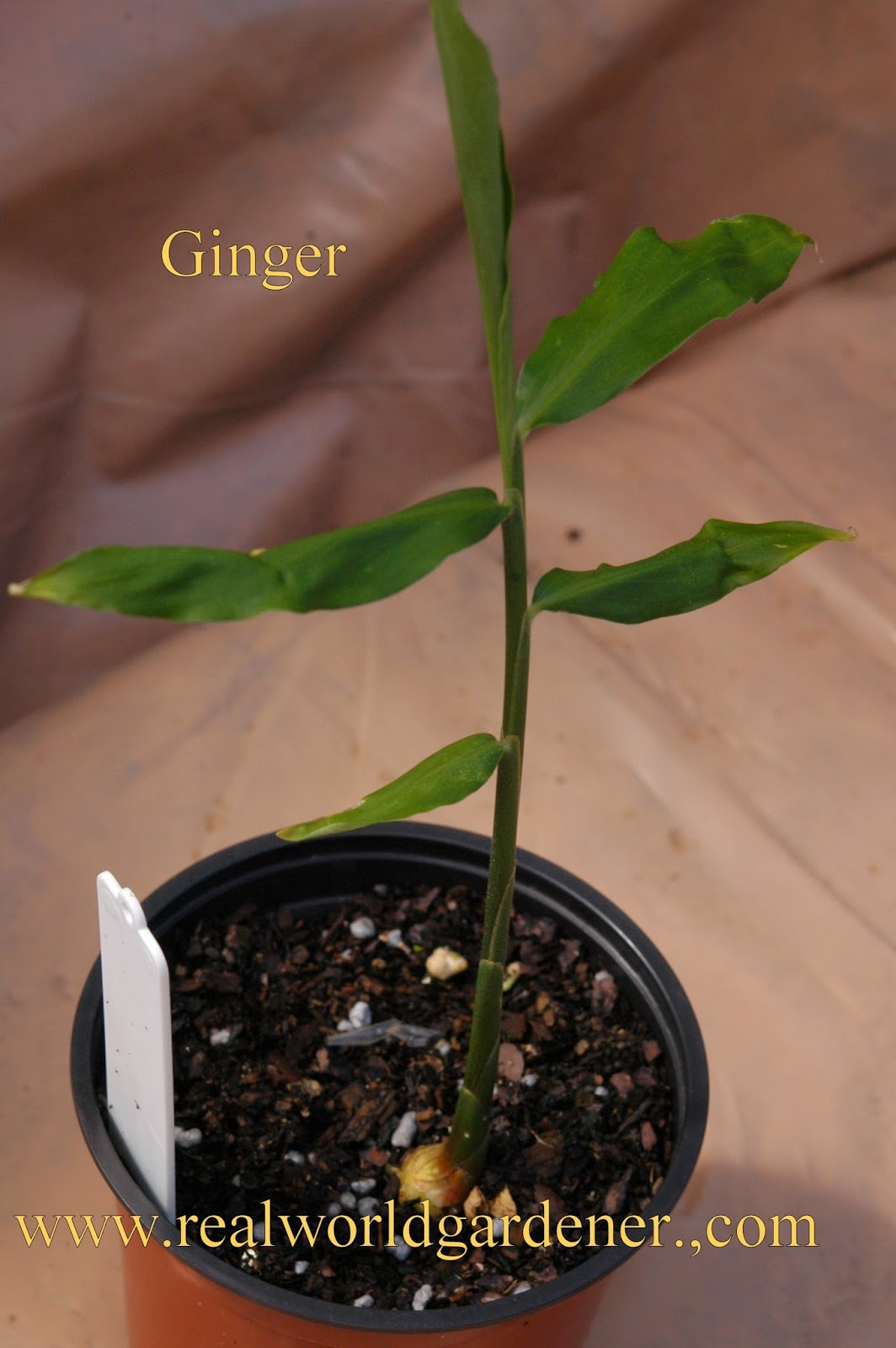
Zingiber officinale or Ginger is in the Zingiberaceae family along with Turmeric, Cardamom and Kenchur.
All of these plants are grown from rhizomes that are harvested.
Ginger was used in Roman times as a food preservative and to help treat tummy upsets.
The Greeks would eat ginger wrapped in bread if they were feeling nauseas.
Eventually  Ginger was added to the bread dough creating that wonderful treat many around the globe love today -gingerbread.
Let’s find out more about ginger.
Talking with herb expert Ian Hemphill from www.herbies.com.au

Fresh ginger can be found in the produce section of most supermarkets and fruit and veg stores.
Look for smooth skin with a fresh, spicy fragrance.
Tubers should be firm and feel heavy.
The biggest rhizomes usually mean they’re getting on a bit and mature rhizomes will be hotter and more fibrous that's because they've been left too long in the ground.
Avoid those with wrinkled flesh, as this is an indication of aged ginger past its prime.
Fresh ginger is sweeter and less fibrous.


Use your fresh ginger by peeling and scraping it first to get rid of the outer skin.
Ginger has a tangy flavour profile and is very versatile in cooking.
You can always have fresh ginger on hand by grating some and putting it in an ice cube tray with some water.
You can also preserve ginger by putting cutting pieces in a jar with some Chinese rice wine.
This will keep for a few months.
You can of course grow your own ginger from one of the rhizomes that have sprouted.

If you have any questions about growing ginger or have some information you’d like to share, why not email realworldgardener@gmail.com or write in to 2RRR P.O. Box 644 Gladesville NSW 1675

VEGETABLE HEROES

Melissa officinalis, known as lemon balm, balm, common balm, or balm mint, is a perennial herbaceous plant in the mint family; Lamiaceae, and is native to south-central Europe, and the Mediterranean region.
You may not be into scientific names but there are two subspecies of Lemon Balm; Melissa officinalis subsp.officinalis, is the common cultivated lemon balm; and Melissa officinalis subsp. altissima, naturalized in New Zealand and known as bush balm.
Apparently the scent of Melissa officinalis. subsp. altissima is sometimes described as fruity, herbal or powdery, but often doesn’t have any scent at all.
Lemon Balm has been used for over 2,000 years, but did you know that because these white flowers attract bees, that’s why the genus name is Melissa which is Greek for 'honey bee'.
In fact the ancient Greeks believed that if you put a few sprigs of lemon balm in an empty hive, it would attract a swarm of bees, or if you planted some lemon balm near a beehive, the bees would never go away.
Officinalis of course means used in medicine and in the 11th century a Persian physician and philosopher named Avicenna recommended the use of lemon balm in treating depression and melancholy.
Fun Facts:Would you believe that according to the London Dispensary (1696) lemon balm in wine could even prevent baldness?
What does it look like?
It’s a fairly low to medium growing herb not growing more than 70 cm tall and being in the mint family, it has square stems.
The leaves have a sweet lemon scent, and because it’s related to mint the leaves look a bit like the leaves of common mint.
During summer, this herb has small white flowers that are full of nectar.


 Interestingly although over 100 chemicals have been identified in Melissa officinalis, the main flavour comes from just two essential oils: oil of citral (neral and geranial), and citronellal.

Why grow lemon Balm?

One reason to grow it is that sachets made with Lemon Balm and put under your pillow or near the bed are supposed to give you a refreshing, relaxing sleep.
Lemon balm seeds are fairly easy to germinate and need light and at least 20°C
Seeds will germinate in 10 – 14 days and are best started off in a punnet.
TIP: The seeds don’t like being overly wet so after the first watering, let them alone but not completely dry out.
Lemon balm is probably one of the easiest herbs to grow and is ideal for beginners.
Lemon balm grows well in both sun and shade, soils of a wide pH, and either dry or damp conditions.
Lemon balm grows in clumps and doesn’t spread vegetatively like mint does, that is putting down roots where the stems touch the ground or through underground rhizomes, but only spreads by seed.
If you don’t want it to spread in your garden, then cut back the clump after flowering so that it doesn’t self-seed.
In mild temperate zones, the stems of the plant die off at the start of the winter, but shoot up again in spring.
Lemon balm doesn’t like temperatures much below 50 C so in cool temperate climates you may lose your plant unless you put some into a pot for replanting next Spring.
You could also just put some protective mulch over the spot when it dies down as long as you remember what you have growing there.
Lemon balm can also be propagated by dividing the rootstock in Spring or Autumn and planting straight into the ground after doing this.

How to use lemon balm?
The best time to pick leaves for drying is before it flowers.
However, you can pick leaves for use lots of ways from flavouring vinegars, teas, especially Early grey or green tea, marinades, dressings, jams and jellies, stuffings and sauces to using it chopped with fish and mushroom dishes or mixed fresh with soft cheeses.
Lemon balm complements many fruits, including honeydew, rockmelon, pineapple, apples and pears.
What about lemon balm with ginger in scones?
That’s the leaves, but the flowers can also be used as a garnish in fruit salads, drinks or with rice .
Did you know that in the commercial food industry, lemon balm oil and extract are used to flavor alcoholic and nonalcoholic drinkgs, confectionary, baked goods, gelatin, and puddings.
Lemon balm is also an ingredient in liqueurs like Benedictine and Chartreuse.
Why is it good for you?
Lemon balm tea is good for relieving mild headaches and possibly the memory as well.
The crushed leaves when rubbed on the skin can be used as an insect repellant.
Lemon balm also has anti-oxidant and calming or mild sedative properties.
There is also some link to memory or attention but further research is needed on that one.
If you have any questions about Lemon Balm, JUST EMAIL ME
AND THAT WAS OUR VEGETABLE HERO SEGMENT FOR TODAY! 

DESIGN ELEMENTS

ROOFTOP GARDENING

Continuing with the series on best fit gardening.
Have you ever thought of using that unused space on a flat roof, if you have a flat roof that is?
You don't have to live in Spain to have a rooftop garden, nor just limit yourself to a line of potted plants.
Why not if you have decent access to your roof and it’s approved for pedestrian traffic (ie, the waterproof membrane is intact, sealed and fully protected).
The only obstacle to using it often comes down to simple lack of shade. Exposed to sun and wind, the area is not going to be inviting unless you can find a way to block out the elements.
Equally, you may have dead space over the top of your garages that could be revamped.
Let’s find out what you can plant up there. I'm talking with Garden Designer Peter Nixon from Paradisus. www.peternixon.com.au

PLAY: Best Fit Gardening_rooftop garden_4th November_2015
This is for a fairly exposed situation so that’s why Peter focused on xerophytic plants.
The planting suggestions were Aechmea recurvata Benrathii or falsa Tillandsia-this is a small growing Bromeliad.
Dykia brevifolia or pineapple dykia.
Alcantarea odorata or giant bromeliad and finally, Tillandsia secunda.
There’s also Crucifix orchids or Epidendrum species and other bromeliads such as Bilbergia pyramidalis and Aechmea recurvata.
If you have any questions about rooftop gardening or have a suggestion why not write in or email me at www.realworldgardener.com

PLANT OF THE WEEK


Delphinium "Guardian"
 These mid-sized plants are the stars of the early summer border.
The plants form a low mound of deeply-cut green leaves, and have these amazing tall spikes of satiny flowers.

The original version have enormous  spikes of up to 2 1/2 metres and needed 'vernalisation."

But not D. Gaurdian which grows to around 1 metre tall with deep-blue petals and strong multi-branching stems that are great for cutting.

Let’s find out about them by listening to the podcast.

I'm talking with Karen Smith from www.hortjournal.com.au and Jeremy Critchley owner of www.thegreengallerycom.au


Special Tips for Delphinium Plants
In the past, the 'old school' Delphiums required their roots to be kept cool, but not these new varieties because their foliage is quite large and as they're usually in the back of the flower border, or where the roots are shaded by other plants.
Removing faded spikes at the base will encourage repeat flowering spikes throughout Summer and into Autumn.
This new branching variety of Delphiums should flavour in your garden beds for at least several months.
When all flowering is finished, remove the last of the dead spikes and water them well after fertilising.

They main thing you have to watch out for in hot, humid
summer regions, is that plants are often attacked by mildew in mid-summer; to fix that just cut back the foliage quite hard to encourage fresh new growth.
In these regions plants don’t usually last more than 2 to 3 years.
Once established, they have low water and maintenance requirements although they will shutdown on days when temperatures are over 30 degrees C in attempt to cool themselves.
 If you have any questions about growing Delphiniums of any variety why not write in to realworldgardener@gmail.com


Sunday, 1 November 2015

Wandering Through Gardens of Time

WHAT'S COOKING


If you could time travel to the early to mid-1800s, what kind of things would you expect to find growing in their produce gardens and what kind food would you expect to eat?
In the What’s Cooking segment, this is exactly what we’re doing; time travelling back to early colonists days in Australia and having a peek at what happened in those kitchens and kitchen gardens.
Let’s find out by listening to the podcast;
I'm talking with Jacqui Newling, Gastronomer from Sydney Living Museums.

Would you have guessed that an alligator pear is an avocado?
Or that eggplants, tomatoes, artichokes and other heritage vegies were grown on a regular basis?
Tomatoes were initially not commonly grown but staples such as beans, potatoes and cabbages were the staples in most kitchen gardens.
Pickling and preserving were high on the cook’s to do list when all the produce comes ripe at once.
Salt and vinegar were the main preserving ingredients back then and unlike today, sugar wasn't used at all, the reason being sugar was expensive.
Pickling was in 100% vinegar, but they also used spices to make condiments like Brinjal pickles and Picalilli.
Fermenting vegies such as cabbage was common practise as was storing root vegetables in sand and keeping them in a cool environment such as a cellar.
Wealthier households that could afford sugar were able to make sweet jams and cordials.
Back then of course there was no global trade so once the tomatoes had finished for the season, the early colonists cook wouldn’t be able to get them unless they had been preserved.
If you have any questions about early colonists kitchen gardens or have some information you’d like to share, why not email realworldgardener@gmail.com or write in to 2RRR P.O. Box 644 Gladesville NSW 1675.

VEGETABLE HEROES

This weeks Vegetable Hero is Roselle plant or botanically-Hibiscus sabdariffa. Being a hibiscus it belongs to the Malvaceae family of plants that mostly originate in tropical Africa. 
Roselle plants some say comes from India but others say Roselle comes from West Africa.
Roselle plant was originally introduced in Malaysia more than three 1,000 years ago.
Did you know that in 1892, there were 2 factories producing roselle jam in Queensland, Australia, and exporting considerable quantities to Europe. This was a short-lived enterprise not going much past 1909.
Roselle grows in a wide variety of climates because it’s very adaptable, possibly weedy even. 
It grows well in dry climates right through to tropical climates. The only drawback is that the growing season is 5 months, so you need to start this weekend.
Why grow Roselle plants?
Well the Roselle plant looks nice with its green leaves that have red stems and red veins and the flowers are deep red hibiscus like; but the fleshy red calyx-the part underneath the flower is excellent in making jams, sauces, cordials, in fact it’s the main ingredient in a herbal tea called Red Zinger.
Roselle seed is a little hard to find unless you look in seed saver networks, organic growers, certainly you’ll find them at organic markets where there is a seed stand.
Nurseries will have seedlings in late spring early summer if they carry unusual plants.
Seeds remain viable for a good long time but soak the small hard triangular seeds in warm water to help speed up germination.
Don’t drown them, just a saucer of water overnight will do.
Roselles need a very warm soil to germinate, preferably over 25°C.
In tropical areas, they sow the Roselle seed in early spring.
In the Northern Territory the seed is sown during the early wet season as Roselle is a short day-length plant and needs 12–12 ½ hours of daylight to flower.
In NSW areas and more southern areas of Australia this would be as late as October early November outside.
Some years the soil might take even longer to warm up.
So gardeners in cooler areas need to start seed indoors using a small bottom-heat unit, or the top of the water heater.
Cover the seed with 12mm of fine soil or seed raising mix.
tip:Roselle plants begin to crop when they’re 3 months old.
I’ve read that 3-4 plants will give you enough fruit to make jam or tea, but I’m not sure how much jam and tea that might be, so you could trial it with just a couple of plants because they take a bit of room.
Too much for the veggie garden so go for the flower bed or flower pot.
Now it grows to 1 ½ metres so a big pot will be good.
There is more than one flush of seed pods, but the trick is to remove the first flush because the second is much bigger and better..
You’ll now the Roselle bud is ready when they easily come away from the bush, usually 3 weeks after the flowers have finished when the pod is 2-3 cms across.

Keep them well watered but it must drain away reasonably quickly because Roselle plants are prone to root rot
Roselle plants are weedy in the Northern Territory and Western Australia-but aren’t a problem anywhere else.
If you are going to go for growing this plant, here’s a tip: When the fruits are about the size of a walnut, about 20 days after flowering, you need to separate the seeds from the inflated and ripened outer fleshy casings or the calyces- or fleshy part.
Roselle fruits are best prepared for use by washing, then making an incision around the tough base of the calyx below the bracts to free and remove it with the seed capsule attached.
The calyces are then ready to be used in jams or teas or whatever.
They may even be chopped and added to fruit salads.
Use an apple corer-from kitchen shops.
By the way the young shoots and leaves can be eaten raw or cooked as a vegetable.
To make Roselle tea-
The dried red calyx is used for tea and it is an important ingredient in the commercial Red Zinger, Hibiscus and Fruit teas.

The tea is very similar in flavour to rose hips and high in vitamin C. To make it, strip off the red calyx (the fleshy cover surrounding the seed pod) and dry it in a solar drier or a slow oven until crisp.
Only two small pieces are needed per cup.

Try mixing it with dried lemongrass or lemon verbena and dried organic orange peel for a wonderful herb tea that is also good chilled.
Why is it good for you? 
Roselle hips contain a very good source of Vitamin C, and is rich in Calcium and Magnesium. vitamin A, and amino acids.
Also Roselle is rich in anthocyanins , essential minerals and vitamins. 

Roselle is very low in Cholesterol and Sodium, and is a good source of Vitamin A, Vitamins B1 and B2, Niacin, Iron and Potassium.
Anthocyanins are water-soluble flavonoid pigments, which are responsible for the red, blue and purple colours in many fruits and vegetables.

AND THAT WAS OUR VEGETABLE HERO SEGMENT FOR TODAY! 

DESIGN ELEMENTS

Continuing with the series on best fit gardening.
Today we’re looking focal points in the garden?
Good garden design has some sort of focal point; something to draw our gaze instead of just randomly looking at a scene but not focussing on anything in particular.
Perhaps a focal point like the fountain in this picture?

Focal points are some plant, whether it’s a tree or a shrub a water feature or a statue, that draws the eye and gives the garden some sense of design.
How do you know what to choose, especially these days when we have smaller gardens?
Let’s find out; I'm talking with garden designer Peter Nixon from www.paradisusgl.peternixon.com.au


The small trees mentioned were Plumeria pudica-the evergreen Frangipani, Synadenium grantii rubra or red south African mild bush; Alberta magna-the Natal Flame Bush for cool temperate to warm temperate regions or don’t go past the double flowering Crabapple-Malus ionensis plena.
If you have any questions about growing small trees for focal points or have a suggestion why not write in or email me at www.realworldgardener.com

PLANT OF THE WEEK

Happy Wanderer: Native Sarsparilla: Hardenbergia violacea cultivars.
Pea flowers are very attractive and gardeners certainly love their sweet peas.
What about other times of the year?
Yes there’s the pea flowers on your vegie plants like peas and beans but they’re all the same and not that showy.
What you need is something that has lots and lots of flowers all over the bush or climber, so spectacular that everyone who visits wants to grow one themselves.
Let’s find out about them and the many different cultivars by listening to the podcast.. I'm talking with Karen Smith, editor www.hortjournal.com.au and Jeremy Critchley owner of www.thegreengallery.com.au


There’s also Hardenbergia violacea Flat White™ and Carpet Royale™ which are fast growing, heavy flowering, shallow rooted plants with long trailing stems forming a dense mat, and unlike most other varieties of Hardenbergia will not climb allowing them to be used in a variety of positions in the garden.

They have large glossy leaves and are available in two different flower colours, white and mauve.


Once established, they have low water and maintenance requirements.Hardenbergia violacea Flat White and Carpet Royale are fast growing, heavy flowering, shallow rooted plants with long trailing stems forming a dense mat, and unlike most other varieties of Hardenbergia will not climb allowing them to be used in a variety of positions in the garden.
They have large glossy leaves and are available in two different flower colours, white and mauve. Once established, they have low water and maintenance requirements.
A full sun to part shade position is preferred in a wide range of soil types including clay or sand however these cultivars will grow best in an enriched well drained acid soil on a raised bed with a pH of 5.5 to 6.0.
They only have a low frost tolerance when young and can get significant leaf damage but will become hardier with age.