Pages

Showing posts with label John Scott. Show all posts

Saturday, 16 November 2019

Bee Keeping part 2 and All Things Lettuce

We start with part 2 of a two part segment on bee-keeping, a veg that helps you sleep in Vegetable Heroes; a new series begins called pruning 101 with landscape designer Jason Cornish, in Design elements and a starry eyed violet flowered small shrub in plant of the week.

KEEPING BEES Part 2

Last week part 1 of this two-part series about bee-keeping went to air, so I’ll revise a little of that in the interview.
If you are considering keeping bees, don’t just get a bee hive and hope for the best.
Don’t be like some people that have put Flow Hives in the backyard and not put any bees in and wondered why they don't get any honey.
Would you be game enough to collect a wild swarm of bees?

Or others that have put just one queen bee in a Flow Hive [without a colony]."
Be informed and do the right thing.
Let’s find out about things you need to know about keeping bees in part 2 of this 2 part segment.
I'm talking with John Scot from www.eezybeez.com.au

Tip: using a smoker calms the bees quite a bit because it gives the bees a cue that something is going to happen.
You will also need to replace you queen bee after 3-4 years because she will have become less productive and your beehive colony will go into decline in as little as 6 - 8 months.
That is because the queen bee is unable to lay sufficient worker bee eggs.
Buying a queen bee can be done online and the best time to buy in Australia is from October until the end of autumn.
For a current list of queen bee producers refer to the Australasian Beekeeper (www.theabk.com.au), or the Australian Honey Bee News.

photo Ulrike Leone from Pixabay
Just remember, one of the most important things you need to do if you want to keep bees is to register with your state’s DPI.
If there's an outbreak of disease in the bee population that could threaten Australia's crops and environment, the department needs to keep beekeepers informed.
Registration allows the DPI to identify owners of beehives and know where the hives are located and communicate with them if there's ever an outbreak of disease outside of Australia,
If you have any questions for me or for John, why not write in to Realworldgardener@gmail.com or write in to 2rrr, PO Box 644 Gladesville NSW 1675.

VEGETABLE HEROES

ALL THINGS LETTUCE.
LETTUCE or Lactuca sativa, is a temperate annual or biennial plant of the daisy family Asteraceae..Lettuce helps you sleep better.
I’ll tell you why a little later on.


  • What to the words Tango, Red Leprechaun, Tennis Ball and Freckles have in common? They’re all lettuce varieties that you can buy.

  • Did you know that Lettuce was considered an aphrodisiac in Egypt?
  • And that the Greeks used lettuce as a medicinal plant to induce sleep?

Lactuca sativa or lettuce is just everywhere and thought to have started in the wild as a prickly lettuce, found as a weed in the Mediterranean.
Why should you grow your own lettuce?
Nothing beats the freshness of home grown lettuce though.
What you mightn’t realise is that the flavour is lost in as little as 24 hours, and there’s no way supermarket lettuce is only 24 hours old.
  • When to plant in Australia

 Lettuce can be planted all year round in all areas of Australia.
Having said that, in Arid districts, it might be a good idea to avoid the hottest months of the year, and in cool temperate districts, you might like to grow your lettuce in a greenhouse or undercover somewhere during winter.
  • Not all kinds of lettuce are created alike however!

For all areas, planting or sowing in the summer months, should only be the loose leaf types of lettuce.

  • Summer is not for sowing hearting types of lettuce.

Now’s not the time to be planting Iceberg and the other hearting lettuce varieties, like Butterhead and Cos Romaine because they prefer being grown in the cooler months of Autumn, and in some districts during winter.
These hearting varieties are OK in the coolest months. (The upper temperature limit to grow heading lettuces is 28°C)
Summer is just too warm for the hearting types.
  • How to Grow Summer Lettuce

If you don’t want bitter lettuce leaves, they you have to grow it
as fast as possible and for that they need plenty of water and plant food.
Ideally your soil should hold lots of water and lots of nitrogen and other nutrients.
Sandy soils need help from your compost bin or worm farm.
If you have clay soils, growing lettuce shouldn’t be a problem, as is growing them in pots.
Remember this, Lettuce has shallow roots, so it dries out easily.
You must keep up a steady supply of water because any set back will at least, make them tough and bitter, at worst it will cause them to bolt to seed straight away without making any leaves for you!
So make sure they never get stressed (e.g. by forgetting to water them).
  • Sowing lettuce 101

To sow lettuce seed, either spread the seed very thinly along a row and ever so lightly, in fact hardly at all, cover the seeds with soil, or sprinkle it over a bed and rake it in.
 For all you balcony gardeners, any largish pot will do for 3 or 4 lettuce seedlings.
Lettuce seed is very fine so just press the seeds into the soil and don’t cover them.
If you’re off to work everyday, sprinkle some vermiculite over the seeds and spray with water.
The vermiculite holds want but lets light through.
  • By the way, lettuce seed doesn’t germinate that well at soil temperatures over 250C. 

So if you are sowing it in a pot, keep the potting mix cool by putting it in light shade until the lettuce seed germinates.
I mentioned before that hearting types of lettuce will go to seed in summer very quickly and not form a heart at all.
For tropical and sub-tropical districts, the most heat tolerant kinds of lettuce are the open leafed varieties (Looseleaf).
All the pretty fancy lettuces you see in the shops, the frilly and curly varieties, they are your lettuce varieties you need to grow.
If your lettuce grows slowly even though you’re giving them plenty of water, then they need more food.
 Did you add organic compost, manures or worm castings to the veggie bed before you sowed the seed?
If you didn’t, then you need to supply extra nutrients, especially nitrogen. Some of the liquid fertilisers will do right now.
Some lettuce varieties for you to try are,
Lettuce Freckles-yep it’s freckly and it’s a butter lettuce as is Lettuce Tennis Ball.
Lettuce Amish Deer Tongue- Amazing two-in-one lettuce that can be cooked like spinach or used like lettuce, so you have a hot or cold vegetable to suit the season. Repeat harvest makes it a highly productive choice for space saving gardens.
Lettuce Crispmint is an outstanding variety with excellent flavour and crisp, minty green leaves. Seed Savers in the US have over 200 varieties of lettuce and rate this as one of their best.
to the elegant deep brown-red leaves that fade to green near the heart.
Lettuce Crispmint photo Diggers Seeds

So why is it good for us?
Lettuce is very good for digestion and promotes good liver function. It can reduce the risk of heart attacks and is good for healthy eyesight. It has good levels of Vitamin C, beta-carotene and fibre.
You won’t put on any weight eating Lettuce  because most varieties have over 90% water and are extremely low in calories.
Lettuce contain the sedative lactucarium (lactoo-caree um) which relaxes the nerves but not upsetting digestion.
As a general rule, the darker green the leaves, the more nutritious the salad green.
For example, romaine or watercress have seven to eight times as much beta-carotene, and two to four times the calcium, and twice the amount of potassium as iceberg lettuce.
By varying the greens in your salads, you can boost the nutritional content as well as vary the tastes and textures.  
AND THAT WAS OUR VEGETABLE HERO SEGMENT

Saturday, 9 November 2019

Bee Keeping and Cucumbers

We start with a two part segment on bee-keeping, being cool as a cucumber in Vegetable Heroes; part 4 of lawn alternatives-plants that create living path edges in Design elements and smaller relative of the giant Angophora in plant of the week.

BEE KEEPING part 1

Thinking about keeping bees but didn’t know where to start?
Is keeping bees a lot of hard work?
Marianne & John Scott
Are you wondering why keep them in the first place?
Well there’s the pollination of flowers, both ornamental and on vegetables in your garden as well as neighbouring gardens, plus the reward of honey by the kilo, not to mention the hive byproduct of beeswax.
Let’s find out about things you need to know about keeping bees in part 1 of this 2 part segment.
I'm talking with John Scot from www.eezybeez.com.au
Langstroth Hive: Image-CSIRO
NOTE:  If you are keen on keeping bees, then you must register with the Department of Primary Industries.
  • A hive is made up of a bottom board, a box and a lid. When you expand a put another box on top, this box is called a 'super.'

    What type of hives are out there?

Flow Hive
Langstroth: the traditional hive with wooden frames.
  • There are two sizes, an 8 or 10 frame box.
  • Each frame has hexagonal wax moulds that the bees can then use to build their own comb on top of. 
Flow HiveThe bees fill the honey cells and cap them off. When you insert the Flow Key and turn it,  the hone cells are split so that honey flows into the trough, through a tube and into your jar.

We all know what honey is but did you know that that bees make it by gathering nectar from plants and processing it in their stomachs?
They keep the honey in cells, adding an enzyme to ripen it.
It's stored as a food reserve for the colony in winter but, since they make more than they need, beekeepers can collect the surplus.
If you have any questions for me or for John, why not write in to Realworldgardener@gmail.com or write in to 2rrr, PO Box 644 Gladesville NSW 1675.

VEGETABLE HEROES

  • Everything you wanted to know about Cucumbers or Cucumis sativus..

Cucumbers just love the hot weather, so they’ll germinate and grow quickly at this time of the year.
Cucumbers are a member of the gourd or cucurbita family and have been grown for 4000 years!
Did cucumber start off in India?
No-one’s really sure although some sources point to somewhere in the lower Himalayas where the ancestor of the cucumber was probably a plant with 7 pairs of chromosomes and small, very bitter fruit.
According to legend, in Ancient Rome during the short reign of Emperor Tiberius (14 – 16 AD) he demanded to eat cucumber on every day of the year.
During summer special gardens were tended just for his vegetables, and in winter cucumber was grown on moveable bed frames that were moved to be exposed to the sun, or illuminated with the mirror-stones.

  • Cucumbers are the fastest and easiest of vegetables to grow so say some gardeners. I would’ve thought radish, but maybe they’re a close second.

When is the best time to grow some cucumbers?
  • Cucumber plants do best in all types of temperate and tropical areas and generally need temperatures between 15°-33°C.but are happiest when the average temperatures are around 21°C
  • Cool temperate districts: sow the seeds of Cucumber in late Spring, say October and early Summer 
  •  Arid and temperate zones: spring and summer 
  • Sub-tropical areas,from August until March in 
  • Only the cooler months for tropical areas-so April until August unless you’re inland.

And where can you grow these delicious cucumbers?
You need to pick a sunny, well-drained spot, because Cucumbers are a subtropical plant, that needs full sun.
Cucumbers also want a decent amount of growing space in your garden.
If you’re short on space, try growing them up vertically on a trellis or even on some netting, perhaps a tomato trellis?
In fact, growing up a trellis would be a great way to avoid all the mildews and moulds that cucumbers are prone to in still humid weather.
So Which Cucumber Should You Grow?
The list is pretty long but you have to decide between regular and burpless varieties to begin with.
Then do you want slicing, or pickling cucumbers?
After that, heirloom or greenhouse varieties.
The burpless varieties don’t need peeling which is an added bonus and would be the way to go if cucumbers repeat on you.
Pickling Cucumbers are shorter, stouter, and have a rougher outer skin, as well as drier flesh that allows them to soak up more of the brine they’re pickled in.
Obviously cucumbers for slicing need to be straight.
The ones you see in the supermarket are regular English cucumbers, usually long thin with a dark green skin.
Cucumbers-probably lemon
Great for slicing, and not suitable for pickling.
Let’s start with cucumber “Sweet and Striped” that can grow to a metre long but it will curl.
Armenian cucumber?
This cucumber is a pale almost limey green, it’s burpless with drier flesh so it can be stored up to one month.
Great for slicing or pickling.
My favourite is Cucumber 'Lemon'
'Lemon' is an apple type, heirloom variety, introduced in 1894.
The fruits are round, sweet and crisp with a thin yellow skin and white flesh.
It can be eaten like an apple and is easy to digest.
This cucumber is a good all-rounder because I can be used for salads, pickling and slicing.
For regular eating there’s Lebanese Cucumber 'Beit Alpha'
A Lebanese style of cucumber is thin-skinned, dark green, tender, and burpless.
This one can grow cucumber, up to 30 cm long.
If you pick it when it’s smaller, it has the best flavour whether pickled or fresh and is never bitter.
Lebanese cucumber vines bear early, are disease resistant and very productive
There’s also a number of dwarf varieties if you’d like to grow your cucumbers in pots.
Try Mini White- one of the most popular.
The 10cm long fruit and is best picked when young.
This one gives you lots of fruit per plant and it’s burpless 
Or you could try Cucumber Little Potato which as the colour or a potato or Kiwi fruit, with a zesty lemon burpless inner flesh.
Then there’s Cucumber 'Spacemaster'
'Spacemaster' is a bush variety, 90 cm across; suitable for growing in containers. Fruit is slender, dark green, 17 - 22 cm long with a crisp, sweet flavour.
It’s supposed to be disease resistant.
Good for salads or pickles, if picked young.
You’ll need to go to a seed mail order place for some of those, or if you’re in Adelaide or Melbourne, go to the shop in the Botanic Gardens.
The best thing is that Cucumbers aren’t picky about soils.
Parthenocarpic Cucumbers What?
  • Did you know that you can grow a seedless variety that doesn’t need pollination?In fact, pollination creates an inferior fruit so these are best grown in a closed environment such as a greenhouse.
  • This type of plant is called parthenocarpic which is just the name of a plant that can produce fruit without pollination.
  • So what’s a cucumber plant that needs pollination called? Gynoecious.
  • Gynoecious varieties have mostly or only female flowers ― the flowers that produce fruit ― and typically are earlier and have higher yields.

And do you get this information from seed packets?
No because most of the seeds you can buy are monoecious cucumbers that have male and female flowers.
  • In a monoecious cucumber ( nongynoecious cucumber) plant, the first 10–20 flowers are male and for every female flower 10–20 male flowers are produced.

I’m not sure if I’ve ever seen that information on the back of a cucumber seed packet?

Why has my cucumbers not got fruit?

  • For most cucurbit family plants, the humidity and temperature has to be within a fairly close range for pollination to occur, even with hand methods.
  • If the humidity is too high, the pollen sticks together, if too low, the pollen will not fertilize.
However, do you find your Cucumber seeds sometimes don’t germinate?
  • They’re big seeds but if you’re raising them in punnets and the seed raising mix dries out, then the seed most like has dried up as well; And if you keep it too wet, then the seed rots.
  • If this keeps happening, try using another type of seed raising mix, or even some good quality potting mix and try again.
  • What cucumbers like is soil that’s well-draining and has a pH of around 6.5.
  • Add in plenty of organic compost and fertilisers like chook poo or cow manure.
When your cucumber has gotten going, water it regularly at the base of the plant, that way the leaves stay dry and you lessen the chances of the leaves getting the white powdery stuff growing on them, powdery mildew disease.
Powdery mildew on cucumber leaf
  • Powdery mildew is a fungal disease that is spread by spores carried by the wind.
  • Look for white to grey fungal deposits on the leaves and stems of your cucumbers. As the mildew spreads, the leaves become brittle then start to die off.
  • There are some types of cucumbers that resist this disease for a time anyway.
  • You can also try a natural fungicide. 1 part whole milk to 10 parts water, and spray in the cool of the day.
Don’t forget to feed your cucumber plants every couple of weeks with a soluble plant food.
There’s so many now on the market, an some come with seaweed added into them as well.
Disease no 2.
  • Sudden wilt is a disease is caused by pythium fungus and causes the entire plant to die and wilt. Look for root rot. This disease usually happens in poor draining soil, so add organic compost to the soil before planting to improve drainage.
  • Growing your cucumbers in pots and raised beds, can help this problem.
Disease No.3 
  • Verticillium wilt, is a fungal disease called by the Verticillium fungus. Symptoms include wilting leaves and brown discoloration of the stems and roots. You’ll typically have to open the stem to see the problem. Eventually, this disease will cause the entire plant to wilt and die. This problem often lingers in the soil where tomatoes, potatoes, chillies, and other members of the nightshade family have been planted.
Crop rotation is important to avoid this disease. There’s no spray of any kind for this problem. Leave the garden bed empty for quite a few months before planting again.
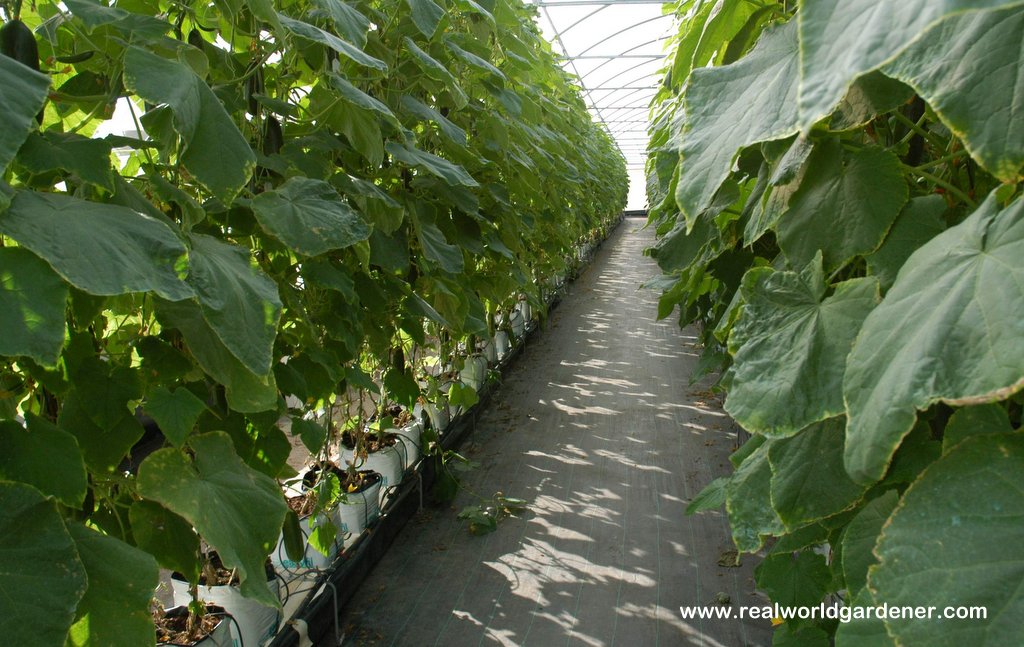
Commercially grown cucumbers avoid diseases with vertical trellising.

Who out there hasn’t tried a cucumber that’s tasted bitter?

I’m sure some time in your life, that’s happened hasn’t it?
One theory is that the bitterness is caused early in the plant’s development by terpenoid compounds that give a bitter flavour to the entire plant.
Usually the bitterness accumulates at the stem and below the surface of the skin of the cucumber.
According to this theory it’s a genetic problem.
Newer cucumber hybrids seem to have fewer problems with bitterness.
  • I’ve always thought it to be the result of Cucurbitacin. Found in most cucumber plants, Cucurbitacin causes fruit to taste bitter.
  • Cucurbitacin levels increase when a plant is under stress, and can make the fruit taste really bitter. 
  • The concentration of these compounds varies from plant to plant, fruit to fruit, and even within the individual fruit itself.
  • Did you know that the ability to taste detect bitterness or cucurbitacins also varies from person to person.
  • Even insects have varying preferences for cucurbitacins- the compounds attract cucumber beetles but repel other insects, such as aphids and spider mites.

Anyway, it proves that you shouldn’t stress out your cucumbers!
  • By the way, if you do get a bitter cucumber, peel it and cut of the ends by about 2.5cm, that’s where the bitterness concentrated.
Just like zucchinis, cucumbers have separate male and female flowers. Male flowers come out at first, but don’t worry too much because the female flowers will arrive soon after. Cucumbers should be ready at about 50-60 days and picking fruit often stimulates more to start growing. Some of you probably have realised that if you pick your cucumbers when they’re quite small, this is when they’re at their sweetest.
Twist the cucumbers off the plant or cut the stalk just above the cucumber tip.
They keep for 7-10 days in the fridge then the start to look like something that came from outer space…green and slimy
Why are they good for you?
Cucumbers have lots of Vitamins C but why you should eat them is because the silica in cucumber is an essential component of healthy connective tissue, you know, like muscles, tendons, ligaments, cartilage, and bone.
Cucumbers have some dietary fibre and Cucumber juice is often recommended as a source of silica to improve the complexion and health of the skin, plus cucumber's high water content makes it naturally hydrating—a must for glowing skin.
So eat them quick in sandwiches, salads or juice them for healthy glowing skin!
Happy CUCUMBER growing everyone!
THAT WAS YOUR VEGETABLE HERO FOR TODAY