Pages

Showing posts with label Tropical gardens. Show all posts

Saturday, 30 September 2017

Gladdies, and Blueberries But Watch Out ForTPP

What’s On The Show Today?

A new pest to watch for in Plant Doctor, berries that are high in antioxidants in Vegetable Heroes; continuing the series on mass planting with Garden Designer Peter Nixon in Design elements, and an flower and Gladioli in Talking Flowers segment.

PLANT DOCTOR

New Pest: Tomato-potato psyllid

A new pest that could be coming to your garden soon is not something we gardeners would be glad to hear about.
But it has been detected in Australia and New Zealand so it’s something we need to be on the lookout for because it seems to combine the damage of a couple of pests.

Worse than that, it attacks plants from the Solanaceae family, like tomatoes, eggplants and potatoes, and even some plants in the Lamiaceae like Catmint.

Let’s find out all about it….
I'm talking with Steve Falcioni, general manager of www.ecoorganicgarden.com.au

This new pest is something to watch out for and possibly a good time to take a hand lens with you out into the garden to have a closer look at the pests. 
The distinctive dame is when you see leaves that have curled up from the edge.
There is other damage as well that is similar to aphid and mite damage combined.
What does it look like?
The adults are 2-3mm in length or aphid size.
The main body is grey with some white markings. Click on the link below to see a photo.
The important distinction is the clear wings which sit at 45 degrees, almost like a mini cicadas wings or the peak of a house.
If you have any questions about this new pest; the tomato-potato psyllid, then why not email us realworldgardener@gmail.com or write in to 2RRR PO Box 644 Gladesville NSW 1675

VEGETABLE HEROES

Blueberries
There are fruit that are at the some ranking as vegetable heroes,.

Would you have thought that the second most popular berry after Strawberries are Blueberries?

Blueberries are the fruit of a shrub that belongs to the heath family includes cranberries, azaleas and rhododendrons.

FACT: Did you know that Blueberries are one of the only natural foods that are really true blue in colour?

They’re sort of a bluey purple colour and have what’s called a waxy ‘bloom’ that protects the surface of the blueberry.
This bloom you can rub off with your finger if you’re curious to see what the true colour of blueberries are.

WE all know what blueberries look like from the punnets that are sold in the supermarket, but what do they look like when they’re growing on the plant?
Blueberries grow in clusters and come in sizes from a pea to a small marble.


FACT
Did you know that blueberries are one of the only fruits native to North America, but it wasn’t until the early 1950’ that blueberries were first brought to Australia.Why’s that?

A couple of guys- Messrs Karel Kroon and Ralph Proctor from the Victorian Department of Agriculture trialled growing them.

But, Australia was out of luck there because these guys couldn’t get past the disease problems.
Twenty years later, the Victorian Department of Agriculture tried again.
This time, a chap called David Jones carefully planted and tended to his blueberry seeds and eventually successfully grew several blueberry plants.
Still, it wasn’t until the 1980’s that Blueberries were commercially available.

Where to Grow? What They Need?

Blueberries need moist soil, good drainage and lots of organic material.
Blueberries are acid loving plants that do best in soils with a pH between 4.5 to 5.5
If you can grow Camellias and Azaleas, you can grow Blueberries.
If you don’t have that ph you will have to add either elemental sulphur (where the pH is too alkaline) or lime / dolomite (where the pH is too acid). If the soil pH is higher the plants may show signs of iron deficiency.
If that sounds too hard, grow you blueberry plant in a pot.

Tip:Very important when growing blueberries. they have a very fine fibrousy root system, just like Azaleas, and this root system needs a porous medium in which to grow, a bit like coarse sand from where they came from.

If you have poor drainage, then grow them in a raised bed or at the very least, on a mound of soil and use lots of mulch.

So, a little bit fussy there.

Which to Grow

Not all blueberry plants are alike, so choose the variety for your region carefully.
For temperate areas which don’t get too cold in winter, we need to grow a variety which is low chill.
Gardeners in the know about chill factor will now know, that means a certain amount of hours below 7°  C. 
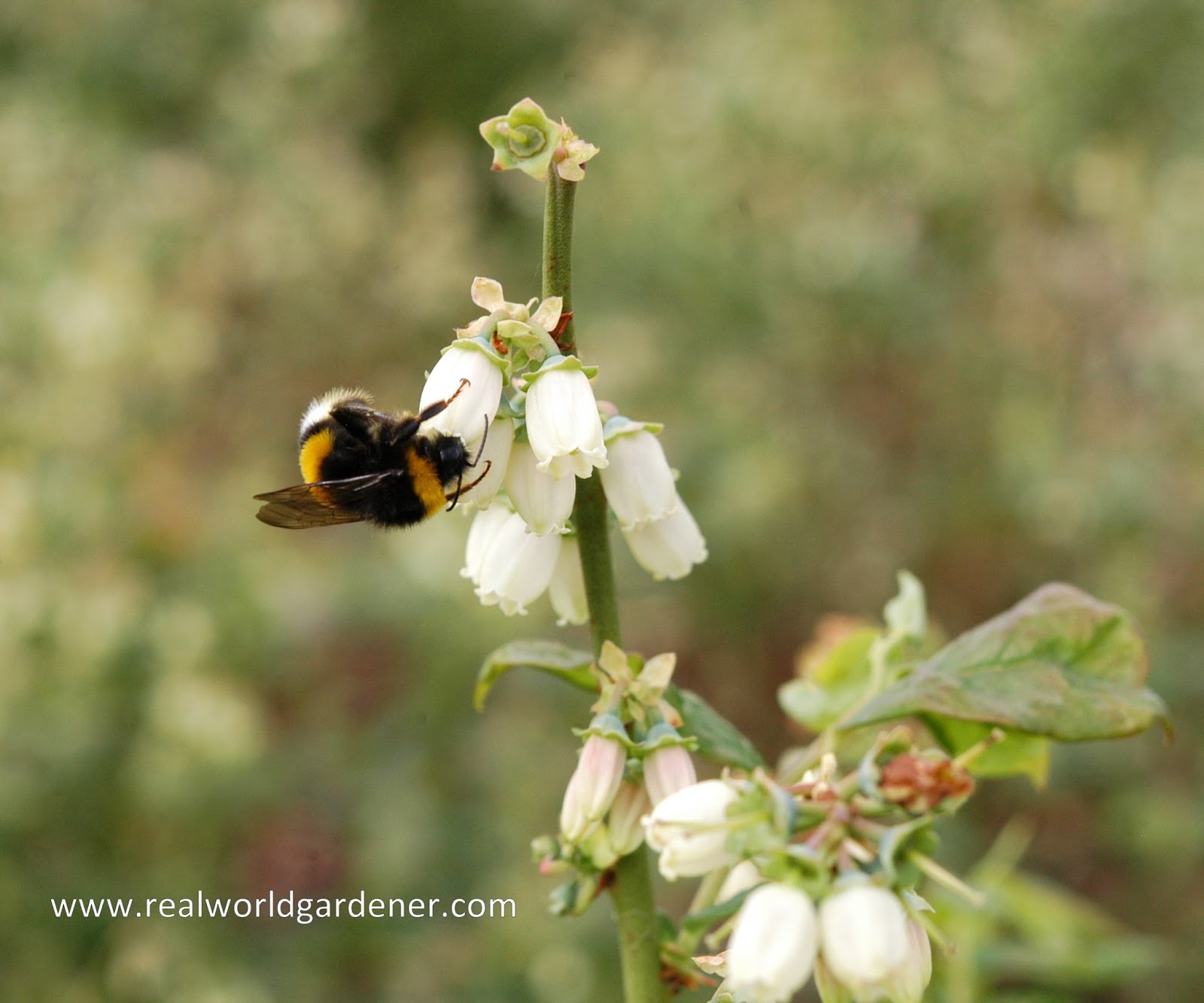
Blueberry flowers being pollinated
Gardeners in cool temperate areas can grow the low bush variety
Low bush variety-is a dwarf shrub that only grows to around 30-60 cm.
Low bush varieties love colder climates and need very low temperatures for the fertilised flowers to “set” and form berries.

They’re not grown in commercial quantities here.

The highbush variety, grows to 1.5–3 metres, has many different cultivars that are well suited to the Australian climate.
In Victoria, Tasmania and Southern New South Wales, you are more likely to find the Northern Highbush, high chill variety for sale in your nursery.

Winter chilling is quite high -(over 1000 hours below 2°C) but they can still able tolerate high summer temperatures.
The fruit of the Northern Highbush is harvested later in the season, from December to April.

For Northern NSW and Queensland, you need to grow a variety called Rabbiteye
The rabbiteye is a low chill, late season variety that’s best at coping with warm and humid summers
Rabiiteyes can also cope with dry conditions, making it right at home in Arid climates too.

PRUNING YOUR BLUEBERRY BUSH

IMPORTANT TIP: Blueberries fruit on the tips of the previous season’s growth.
I spoke to a blueberry grower last year and was told to let the shrub establish first.
That means, you must pluck off the flowers in spring so it doesn't set fruit, but the 3rd year you can let it flower.
If you let them establish for the first two years apparently the plants will last a lifetime!

Once your Blueberry shrub is established new stems will come up and fruit for up to four years initially from the tip to down the whole branch.
From the third winter onwards, cut back old, dry stems every winter.
Cut them back either down to ground level or to a vigorous new shoot near the ground.

They first produce sideshoots from the base of the plant soon after flowering in spring. Then in early to midsummer, vigorous growths push up from the base of the bush.

Hard pruning in winter will encourage this renewed growth and result in larger, earlier fruit.

SHARPE BLUE
Generally a tough bush that needs constant picking of the ripe fruit or they’ll get too soft.
MISTY another tough evergreen variety.. It is an early fruiting variety, with light blue, medium to large fruit of excellent flavour.
GULF COAST: The bush is vigorous and upright, with moderate toughness. The fruit is medium to large blue with a medium colour. The fruit has a problem in that it holds the stems on many of the berries at harvest. The flavour of the fruit is medium. 

BLUEBERRY BURST Good all rounder with super-sized fruits but best in pots.

Blueberries are pest free apart from caterpillars and birds, and if you prune the shrub so its open in the middle it reduces fungal disease.
Selecting and Storing Blueberries –
Pick or buy blueberries that are firm and have an even colour with a whitish bloom. Blueberries are another fruit that don’t ripen off the bush.
Blueberries should be eaten within a few days of picking or buying.
I tend to eat mine straight of the bush.
Ripe berries should be stored in a covered container in the fridge where they will keep for about 1 week.
Don't wash blueberries until right before eating as you will remove the bloom that protects the berries' skin from going bad.
If kept a room temperature for more than an hour, the berries will start to spoil.
Blueberries can be frozen.

Why are they good for you? 
Blueberries have large amounts of anthocyanins,- antioxidant compounds that give blue, purple and red colour to fruit and vegetables.
Not sure what all the fuss is about? Antioxidants are very well known for their health benefits, especially their ability to reduce damage to our cells and Blueberries contain more antioxidants than most other fruits or vegetables

Blueberries are also a good source of Vitamin C, Vitamin E, manganese and both soluble and insoluble fibre like pectin.
Plus they’re low in calories.
If you think they’re too fussy to grow, for the same price as a cup of coffee, treat yourself to a punnet of Blueberries, eat them straight out of the punnet (wash them of course) and enjoy the health benefits.

THAT WAS YOUR VEGETABLE HERO FOR TODAY

DESIGN ELEMENTS

Mass Planting for Tropical Gardens part 2

Tropical gardens have a different regime of wet and dry compared to other climate zones in Australia.
The advantage is plants grow outside as if they’re in some huge greenhouse with perfect temperatures and irrigation or rainfall to make them grow like blazes.
But is the planting really all that different in tropical climates, and can we gardeners further south still grow these plants?

Let’s find out about in part 2 of mass planting in the tropics.
I'm talking with Peter Nixon, landscape designer and Director of Paradisus garden design.


Peter mentioned the following plants.
Flowering shrubs to 3m 
Heliconia pendula - Waxy Red
Crinum augustum
Hakea bucculenta - large blood red flowers
Small trees to 5m
Malus ioensis plena - Double Crabapple
Plumaria obtusa  - Frangi pani
Xanthostemon chrysanthus - Golden Penda 

If you have any questions about mass planting for tropical climates, why not email us realworldgardener@gmail.com

TALKING FLOWERS

GLADIOLI
1.      Gladiolus bulbs are not true bulbs. Gladiolus bulbs, in botanical terminology, are referred to as corms.

2.      A corm is a shortened and thickened section of the stem that appears at the base of the plant. On the corm are buds for each layer of leaves. Except for production of new varieties, Gladioli are not cultivated from seed.
3.      Gladiolus plants are outstanding perennial herbs being semi hardy in temperate climates. 
     They grow from rounded, symmetrical corms that are enveloped in several layers of brownish, fibrous tunics.

Best time is to plant Gladioli bulbs or corms now for Summer flowering.

Rain is usually not enough especially after the plant has grown around 5 sets of leaves.
That’s the time you need to start giving it lots of water.
The new corm and the new roots are formed on top of the old one during the growing season.

FOR THE VASE.
Mercedes recommends cut the stalks straight across the stem for vases.
Remember: Burped water which is Merecedes' way of saying, NO TAP WATER, but filtered water or water from the kettle for your vase.
Gladioli only like to sit in a small amount of vase water.
I'm talking with Mercedes Sarmini about how to get the most vase life from your Gladioli.


Saturday, 23 April 2016

Create an Oasis in Your Garden with Autumn Flowers

WILDLIFE IN FOCUS

Did you know that Australia provides habitat for millions of migratory birds each year?
Some of these birds fly amazing distances when they migrate.
Grey Plover photo www.birdlife.org
Today’s bird in Wildlife in focus is the Grey Plover which is a special and unusual migratory shorebird that we know very little about.
It’s the largest plover we have in Australia of its type and we know that they migrate an amazing  12,000km to breed in northern Siberia and Alaska during the northern summer and return to spend our summer in Australia.
Let’s find out more about this bird. I'm talking with Dr Holly Parsons, Manager of Birds in Backyards. www.birdsinbackyards.net

So the grey Plover can be described as having a strongly barred tail.
We can see them all around the coastline of Australia at inlets, estuaries lagoons, and tidal salt marshes.
Oddly enough, the majority of Grey Plovers that migrate to Australia are female. No-one knows why.
Grey Plover, photo Birds in Backyards
They spend their summer here and from March to April, head north, stopping to re-fuel in Korea, and China's Yellow Sea.
Grey Plovers mostly eat crustaceans, polychete works and other invertebrates.
Because shore birds like the Grey Plover are along the coastline if you notice that there’s a flock of shore birds, not just you’re common seagull, but birds like the grey plover, then you can help by not disturbing them and keeping your dog on a lead.
Threats to migratory birds have grown with habitat destruction especially of stopover and wintering sites, as well as structures such as power lines and wind farms.
The conservation of important sites both within Australia and along their migration routes is really important to their survival.
If you have any questions about Grey Plovers or any birds or have some information to share, drop us a line to realworldgardener@gmail.com or write in to 2RRR PO Box 644 Gladesville NSW 1675

VEGETABLE HEROES

 Spinach  or Spinacia oleracea.
Spinacia comes from the Latin word for spine and refers to the prickly seed coat.
  The species name, oleracea, simply means that the plant is edible.
Did you try growing Spinach in Summer?
It was alright for a while then when the humidity got turned up the stalks went a funny grey colour, then the leaves turned a sort of greeny-brown.
English Spinach
Not that attractive or edible.
I had to pull them out, not a great experiment.
Spinach originates from the Middle East, most likely Persia or modern-day Iran.
It was brought to Spain via the Moors somewhere between 800 AD and 1200 AD.
Did you also know that Medieval artists extracted green pigment from spinach to use as an ink or paint?
Spinach seed was sent out from England in 1787 with the First Fleet but in the new colony they found it difficult to grow.
They found growing silverbeet much easier, which is why Silverbeet is sometimes called spinach in Australia, but true spinach has smaller leaves and a much sweeter, milder flavour.
When to Sow
In Cool temperate zones, you can plant spinach from April until September.
In temperate zones you have from February until the end of May, and in sub-tropical zones, from April until the end of July.
In Arid zones, you’ve hit the jackpot because you can plant Spinach all year round.
Spinach seeds have a prickly seed coat
These times are only a guide, and personally, I plant some vegetables and see how they go even though it might be a month or two out of their supposed best planting time. So, I have some Spinach seedlings coming up in my garden right now, even though I’m in a temperate district.

Growing from seed is the cheapest way of growing any vegetable and even herb in your garden.
Saved seed is even better but if it’s not that easy to remember where you last put the seeds or if you’re not that good at recording how old the seed is, there’s plenty of packet seeds around in market stalls as well as supermarkets.
Germination of spinach seeds can take anything between a week and 2 weeks.
Plant your seedlings / seeds around 7cm apart in rows about 30 cm apart.
For once a vegetable that grows well in partial to full sun.
Spinach likes a moist but not waterlogged soil.
Using a mulch of straw or grass clippings can help to keep moisture and warmth in the soil.
Plenty of compost and the usual organic matter to so that your spinach will grow well.
Having a worm farm or compost bin really does help your veggie bed no end!
Spinach doesn't like acidic soils, a good PH is around 6.3 -6.8.
Add lime to the soil if you need to a few weeks before you put the seeds in.
Spinach like all leafy vegetables is what’s called a heavy feeder –ie, needs lots of Nitrogen to grow well.
If you haven’t already applied Blood and Bone or cow manures to the soil a month or two ago, your soil will run out of nutrients.
During the cooler months of winter, organic matter doesn’t break down that much and to get the needed Nitrogen, applying liquid fertilisers such as compost tea or fish emulsion often will be the best way to go
Another thing to remember is that Spinach grows on shallow roots, so don't dig vigorously around it.
If you get weeds because you didn’t mulch, carefully hand remove them.
Water frequently to keep up with the fast growth of the plants.
In about 6-7 weeks, your Spinach plant has put on enough big leaves so you can pick them one by one like you might lettuce.
The leaves will keep regrowing for quite a while.
Otherwise pick the whole plant for Spinach pie etc.
Make sure you wash spinach leaves well - soil is not tasty!
Big Tip: When you want to store Spinach in the fridge a tip to remember is that
Spinach is highly ethylene sensitive.
To stop leaf yellowing don’t refrigerate with apples, or tomatoes.
Why should you grow your own Spinach?
 Because Spinach is best eaten fresh and because it loses nutritional properties every day.
Putting it in the fridge slows the deterioration, but half of the major nutrients are lost by the eighth day after harvest.
Why is Spinach good for you.?
The amount of iron in spinach comes way down the list after vitamins A and C, thiamin, potassium and folic acid (one of the B complex vitamins).
Dark green leafy vegetables, like spinach, contain carotenoids. Studies show carotenoids help your eyes stay healthy as you age by preventing macular degeneration and the formation of cataracts.
Also good for the immune system
 If you have any questions about growing spinach or any other vegetable write in or email me.
Plant lots and pick them young:
AND THAT WAS YOUR VEGETABLE HERO FOR TODAY?

DESIGN ELEMENTS

Tropical gardens for everyone series part 1
What do you think of when the word Tropical garden is said?
Swaying palms, coloured cocktail drinks with umbrellas in them, lying in a hammock swaying gently in the breeze? Dipping you toes into a pool?
Perhaps you did all these things on your last holiday to a tropical isle, but wait, you can have it at home as well.
But aren’t tropical gardens definitely for the tropics right? Wrong.
Maybe not all of it, but at least some of the features.
Over the next five weeks, Design Elements will be talking about Tropical Gardens to suit any climate in Australia. Today, you’re going tropical around the pool in part 1 of this series.
I'm talking with Landscape Designer Louise McDaid

The whole garden doesn’t have to be tropical.
If you live in a cooler or arid area, you might have a tropical theme within your garden style. Somewhere there is a microclimate that suits those plants that were mentioned. You get the idea.

PLANT OF THE WEEK

What’s your Autumn garden looking like right now?


Are there plenty of flowers, perhaps roses, are there autumn colours of trees that are starting to lose their leaves.
Heuceheras photo M Cannon
If there’s a few spots that you can add a little something, autumn is the best time to plant, so the plant panel got our heads together and picked out 3 plants that are true winners.
Let’s find out which ones are so good. I'm talking with Karen Smith www.hortjournal.com.au and Jeremy Critchley, plant nursery owner, www.thegreengallery.com.au

I'm talking with the plant panel were Karen Smith, editor of Hort Journal and Jeremy Critchley, The Green Gallery wholesale nursery owner.
One of the stars of the Autumn garden is definitely the Japanese windflower, and they’re so easy to grow and fit well planted amongst Camellias.

Primula

Heucheras on the other hand have many different types of leaf colour making a bold statement in any garden, even in vertical gardens.


Primulas (Primula obconica) fit well into any garden and if you look for the "Libra" range of Primul,s these are NEW and have been bred without PRIMIN.


Japanese wind flowers


Thursday, 15 November 2012

Hedging with Rosemary and Entertaining Tropically

REAL WORLD GARDENER Wed. 5pm 2RRR 88.5fm Sydney and Across Australia on the Community Radio Network. www.realworldgardener.com
The complete CRN edition of RWG is available on http://www.cpod.org.au/ , just click on 2RRR to find this week’s edition.
STREAMING LIVE ON 2rrr at http://www.2rrr.org.au/ Wed. 5pm

Design Elements

with Louise McDaid
In a lot of places in Australia, the days have begun to be quite warm, so thinking of tropical plants for an area in the garden suddenly has become quite appealing. Even if you live in an arid zone or cool temperate area, you can still achieve that tropical look with plants that grow well in your local district. Knowing how to arrange them is the key to achieving that tropical look, and around the entertainment area, it might be de rigour. Listen here to find out....

The whole garden doesn’t have to be tropical. If you live in a cooler  or arid area, you might have a tropical theme within your garden style. Somewhere in your garden where you like to sit and read or think, you can add a tropical touch here and there, with plants that are suited to the climate you live in. There is a microclimate that suits those plants that were mentioned. You get the idea.

Vegetable Heroes:    

  •      Pumpkins !. After Ian complained last week that his pumpkin vine only had male flowers, I decided to do a whole segment about growing them.
  •   Pumpkins (Cucubita spp.)  (could be Cucurbita pepo, or C maxima and son on)are members of the Cucurbitaceae family along with zucchini, gourd, squash, melons and cucumber.
  • Honestly., for those of us who have a compost heap, one of the most often things to grow out of the heap is the pumpkin. Usually a Butternut or Queensland Blue.
  • Just as well that Pumpkins like compost heaps because the vines need fertile, compost-rich, well-drained soil in full sun and are most easily grown as ground-cover plants. There is a bush variety called Golden Nugget, that can be grown in a pot but all the rest grow way too big for pots.
  • Vines can be trained over frames provided they can support the weight of the heavy fruit.
  • In temperate zones, plant your pumpkin seeds from September until the end of December.
  • Arid zones have from September until February, sub-tropical regions have between August and February, Cool temperate districts have between October and December, and once again, like Zucchinis, Tropical areas have to wait until it cools down, so between April and July is the time for you to plant your pumpkin seeds.
  • There are as many different varieties of pumpkins as there are of tomatoes, almost.
  • Golden Nugget is best for small gardens, for a medium sized pumpkin, try Hybrid Grey Crown or Queensland Blue.
  • Turk’s Turban is an exotic-looking pumpkin (although its flavour is a little dry).
  • You might prefer the stronger taste of Jarrahdale, from Western Australia.
  • Pumpkin seed needs a soil temperature of 20˚C for germination. You can either sow them individually in 10cm pots and plant them out when the pots are filled with roots.
  • Or, sow seed or plant seedlings into mounds of rich compost, with lots and lots of chook poo, made over loosened soil.
  • Plants take 70–120 days to mature. That’s 10 17 weeks!
  • Pumpkins are shallow-rooted they need regular watering in dry or windy weather. Even moisture helps prevent fruit splitting.
  • Pinch out growing tips, otherwise they may take over you whole backyard!
  • When I worked at Yates, getting those pumpkins to fertilise was the bane of quite a number of people’s veggie growing.
  • The complaint was lots of leaves and few flowers or that the embryo fruits and flowers fall off.
  • Pumpkins produce short-lived male and female flowers that can close by mid-morning.
  • Female flowers open above the swollen, distinctive embryo fruit and male flowers produce pollen. If the embryo fruit falls off, that usually means it didn’t get pollinated.
  • Native and honey bees are normally able to complete pollination, but sometimes ants harvest pollen before this occurs.
  • High temperatures can affect fruit formation – over 30˚C, hand pollination is useful for improving fruit set.
  • To hand pollinate, pick male flowers, remove petals then dab pollen on the stigma of female flowers. Squeezing female flowers aids pollination in wet weather.
  • If you remember, last week I advised Ian that sometimes female flowers take two weeks or longer before they start appearing.
  • This is because the pumpkin vine has to grow to a decent size-one where it can support fruit, before the female flowers appear.
For some online shopping -          www.newgipps.com.au-
If you don’t have a computer or like shopping on line there’s also a free call number. 1800 887 73

Plant of the Week:

  • Have you been avoiding growing hedges because it’ll mean that you have to prune it? Maybe you’d prefer a less formal look? If so, these new plants will help create either of these looks with a lot less effort. A plant that’s self shaping is always useful in any garden because it looks after itself.
  • Have you ever wanted a drought tolerant hedge of a native plant that looks like those evergreen hedges that you’ve seen in your travels to England, or Europe?
  • Not that Buxus species aren’t drought tolerant because they are, but what about native species, that might also be more likely to attract small native birds, lizards and other beneficials to your garden.
  • Westringia species   The Native Rosemary or Coastal Rosemary as it is also known is an extremely hardy plant that will tolerate almost any situation.
  • It has beautiful small white flowers to lavender flowers for most of the year and grows to around 2 metres high and wide. It’s salt tolerant, frost resistant down to about -7oC and is often mass planted and used very effectively as a clipped hedge. It also makes a great small screening plant that will accept full sun or part shade and can be pruned to shape.
  • The flowers are tubular or funnel form with orange landing spots for native bees. In fact native bees are the main pollinators because they are able to do what’s called buzz pollination.
  • In Westringias, the pollen is firmly attached to the anther, so the bees, grab the anthers with their hind legs and give it a shake. They can do this because they can vibrate their thorax. Something that European bees can’t do and apart from that, European bees being too large to fit into these tubular flowers.
  • In a lot of cases European bees bit the bottom of the flower to get at the nectar, destroying the reproductive parts of the flower in the process.
  • Ozbreed Aussie Box® It is much more drought tolerant than exotic box plants, but it will need slightly more pruning to keep in a box shape. Aussie Box grows to approximately 60cm x 60cm unpruned.
  • Position-Ozbreed Aussie Box® requires full sun to light shade. It is suited to most soil types.
  • Grey Box™ is the perfect grey colour contrast for Ozbreed Aussie Box®. It is an even more compact form than Aussie Box, growing 30-40cm high and wide unpruned. It can be pruned down to 20-30cm.
  • This tough drought and frost tolerant Westringia looks great when pruned to shape or left in its natural ball shape.
  • Position-Grey Box™ requires full sun to light shade. It is suited to most soil types and has been found to work well in sandy and heavy clay soils.
  • Grey Box is similar to the new Aussie Box, but with great grey foliage colour contrast and white flowers instead of mauve. It is a much more compact form than Aussie Box and grows to 30-40cm high and wide unpruned.
  • It can be kept pruned down to 20-30cm in size.
  • Propagation:soft tip cuttings in spring and semi-hardwood cuttings in autumn.