DESIGN ELEMENTS
Vegetable Garden Series part 3-the planting stage.Living in a particular place in Australia means that you have a particular climate and also means that if you’re into gardening that you need to know which climatatic zone you are in.
Some books suggest different zones to what you think you are in and in can be a bit confusing .
But it’s important to newbie gardeners to know what climate zone they’re in because it determines the type of garden you’ll have and the plants that you’ll grow.
We’re going through a few basics in this next segments so let’s find out.
 |
| Private vegetable garden of Lyn Woods in Ulverston Tasmania |
I'm talking with Glenice Buck, landscape designer and consulting arborist.
If you’re new to gardening then concentrate on what does well in your area.
Check the Bureau of Meteorology, local gardening groups and local newspapers to build a better picture of your local area.
If you’re new to gardening then concentrate on what does well in your area.
Check the Bureau of Meteorology, local gardening groups and local newspapers to build a better picture of your local area.
In
Australia we have 4 very broad climatic zones …
Hot tropics/subntropics
Cool Temperate
Arid areas
Hot Temperate
Very broad zones and then within these zones
there are microclimates dependent on elevation and proximity to the coast.
The
higher you are the cooler the temperatures and the coast will keep temps more
moderate – not as extreme.
These do get broken down into semi
arid/arid climates, dry temperate and so on .
Of course every garden has its own microclimate depending if you live in a valley or on a hilltop.
How
are vegetable classified or divided up?
Vegetables are basically divided into warm
season and cool season
Warm season crops grow best when average
temperatures 20 degrees
Cool season crops – best grown below 20
degrees
What
are some examples?
Warm season
Tomatoes, sweet corn, French and runner
beans capsicum, eggplant, cucumber,
Cool season
Cabbage broccoli fennel cauliflower,
asparagus, Brussels sprouts spinach, and peas.
If you have any questions about designing a veggie garden, write in to realworldgardener@gmail.comVEGETABLE HEROES
Aubergines or Eggplants
This weeks Vegetable Hero is eggplants, aubergines to some and Solanum melongena to botanists.
Did you think that eggplant was a vegetable or a Fruit?
Yes, the eggplant is botanically a fruit, although the plant is used almost exclusively as a vegetable.
The eggplant is, or Solanum melongena, a member of the nightshade family closely related to the tomato and potato.
When you hear the words the night shade family you often think of “deadly”, and the reason for this is that the leaves and flowers of plants in the nightshade family are often poisonous.
So don’t forget that you can only use the “fruit” from this plant, which is the eggplant.
Did you know that the first eggplants to reach Europe during the Middle Ages were actually a rare white species, with oval fruits that closely resemble a hen’s egg?
No surprise that they began calling it eggplant even when other colours became popular.
 The eggplant was once known as the “love apple” in England because it was thought to possess aphrodisiac properties.
“The happiest omen for a New Year is first Mount Fuji, then the falcon, and lastly eggplant.”
A Basic Guide for Growing Eggplants
Eggplant is a short lived perennial plant that is usually grown as an annual. Eggplants grow best when the temperatures are at least 250C or above.
Eggplants or aubergines particularly resent frost and so far my plants from previous years never survive the cold and I have to start all over again.
Eggplant seeds/seedlings can be planted in Spring to Autumn in tropical areas, Spring to early Summer in temperate zones, October to January in arid areas and September through to December in cool climates.
Tip for cool temperate zones: A bit late for this year but next year but next year plan to start your seeds 8 to 10 weeks before your last frost date.
That will allow your plants enough time to become sturdy.
Eggplants have to have full sunlight or they simply won’t grow well.
Any spot that gets about six to eight hours of full sun (meaning no shady plants or structures nearby to block the sun) would do well.
Give your eggplants a reasonable amount of space-each eggplant seedling should be spaced a minimum of 40cms apart from one another.
You’ll probably have only room for a couple to see how you go.
Mix some pelleted chicken manure, or blood’n bone and compost in with the soil before planting your eggplants.
After the seedlings have been transplanted, give them a little water and leave them to grow.
TIP:Don’t overwater your eggplants as they are susceptible to root rot.
Research the different types of eggplant before choosing the species you want to plant, as some of the larger varieties will require a stake to help lend support as they fruit.
Make sure to add a little mulch to the top of the soil to help keep moisture in the soil.
Good idea for areas that get quite warm or are prone to drought.
Ready for picking in about sixty days, you should notice the fruit popping up on your eggplants.
As eggplants are the tastiest when they are young, most people prefer to pick them when they are about one third of their potential size.
When you pick your eggplant fruit is really up to you. As soon as the “skin” of the fruit is glossy, it is typically ready to be picked.
If the skin has turned brown then you’ve waited too long to pick the fruit.
They come in many colours besides the purple variety, there are white and yellow varieties, and a dwarf species whose fruits grow only three or four inches long.

Why not try ROSA BIANCA?
Did you think that eggplant was a vegetable or a Fruit?
Yes, the eggplant is botanically a fruit, although the plant is used almost exclusively as a vegetable.
The eggplant is, or Solanum melongena, a member of the nightshade family closely related to the tomato and potato.
When you hear the words the night shade family you often think of “deadly”, and the reason for this is that the leaves and flowers of plants in the nightshade family are often poisonous.
So don’t forget that you can only use the “fruit” from this plant, which is the eggplant.
Did you know that the first eggplants to reach Europe during the Middle Ages were actually a rare white species, with oval fruits that closely resemble a hen’s egg?
No surprise that they began calling it eggplant even when other colours became popular.
 The eggplant was once known as the “love apple” in England because it was thought to possess aphrodisiac properties.
Without fail, everytime I hear that, I think that most vegetables and herbs were at one time considered an aphrodisiac at some point in history!
The eggplant is native to India and eastern Asia, and has been around for ages.
.Japan even has a proverb about eggplant:“The happiest omen for a New Year is first Mount Fuji, then the falcon, and lastly eggplant.”
A Basic Guide for Growing Eggplants
Eggplant is a short lived perennial plant that is usually grown as an annual. Eggplants grow best when the temperatures are at least 250C or above.
Eggplants or aubergines particularly resent frost and so far my plants from previous years never survive the cold and I have to start all over again.
Eggplant seeds/seedlings can be planted in Spring to Autumn in tropical areas, Spring to early Summer in temperate zones, October to January in arid areas and September through to December in cool climates.
Tip for cool temperate zones: A bit late for this year but next year but next year plan to start your seeds 8 to 10 weeks before your last frost date.
That will allow your plants enough time to become sturdy.
Eggplants have to have full sunlight or they simply won’t grow well.
Any spot that gets about six to eight hours of full sun (meaning no shady plants or structures nearby to block the sun) would do well.
Give your eggplants a reasonable amount of space-each eggplant seedling should be spaced a minimum of 40cms apart from one another.
You’ll probably have only room for a couple to see how you go.
Mix some pelleted chicken manure, or blood’n bone and compost in with the soil before planting your eggplants.
 |
| Eggplant flower |
The seedlings don’t need to be planted too far into the ground. Just enough so that the soil covers the roots is fine.
After the seedlings have been transplanted, give them a little water and leave them to grow.
TIP:Don’t overwater your eggplants as they are susceptible to root rot.
Research the different types of eggplant before choosing the species you want to plant, as some of the larger varieties will require a stake to help lend support as they fruit.
Make sure to add a little mulch to the top of the soil to help keep moisture in the soil.
Good idea for areas that get quite warm or are prone to drought.
Ready for picking in about sixty days, you should notice the fruit popping up on your eggplants.
As eggplants are the tastiest when they are young, most people prefer to pick them when they are about one third of their potential size.
When you pick your eggplant fruit is really up to you. As soon as the “skin” of the fruit is glossy, it is typically ready to be picked.
If the skin has turned brown then you’ve waited too long to pick the fruit.
They come in many colours besides the purple variety, there are white and yellow varieties, and a dwarf species whose fruits grow only three or four inches long.

Why not try ROSA BIANCA?
Vigorous Italian heirloom variety, heaps of fruit that are rosy lavender and white heavy teardrop shaped fruit with a mild flavour.
How about TURKISH ORANGE?
Beautiful red-orange fruit, round to 7.5cm, lots of fruit in 65-85 days.
For cooler districts, why not try the funny soundying UDUMALAPET
Yellow-green teardrop shaped fruit with vibrant lavender stripes, best eaten small at 8cm.
A peculiar variety called the snake eggplant produces narrow, elongated fruits up to a foot in length with their ends curled up like a serpent’s tongue.
Why is it good for you?
Eggplant is a very good source of dietary fibre, potassium, manganese, copper and thiamin (vitamin B1). It is also a good source of vitamin B6, folate, magnesium and niacin. Eggplant also contains phytonutrients such as nasunin and chlorogenic acid.
They are an excellent food to aid in weight loss, being low in calories and fat. Eggplant is a nutrient dense food, which will help you feel full, and there are only 20 calories in one cup in eggplants.
,. Go the eggplant.
AND THAT WAS OUR VEGETABLE HERO SEGMENT FOR TODAY!
How about TURKISH ORANGE?
Beautiful red-orange fruit, round to 7.5cm, lots of fruit in 65-85 days.
For cooler districts, why not try the funny soundying UDUMALAPET
Yellow-green teardrop shaped fruit with vibrant lavender stripes, best eaten small at 8cm.
A peculiar variety called the snake eggplant produces narrow, elongated fruits up to a foot in length with their ends curled up like a serpent’s tongue.
Why is it good for you?
Eggplant is a very good source of dietary fibre, potassium, manganese, copper and thiamin (vitamin B1). It is also a good source of vitamin B6, folate, magnesium and niacin. Eggplant also contains phytonutrients such as nasunin and chlorogenic acid.
They are an excellent food to aid in weight loss, being low in calories and fat. Eggplant is a nutrient dense food, which will help you feel full, and there are only 20 calories in one cup in eggplants.
,. Go the eggplant.
AND THAT WAS OUR VEGETABLE HERO SEGMENT FOR TODAY!
FEATURE INTERVIEW
Autumn in a Japanese Garden and Ephemeral Plants
In Australia, only some parts of the country have defined seasons.
In other parts, sometimes it feels like there are only two season, slipping from winter to summer, cold to hot, wet to dry.
In Japan, there are definite seasons, and they are celebrated not by just visiting the spectacular parks and gardens, but by the food that is consumed by the Japanese.
Every thought of eating a fried maple leaf?
 |
| Chantelle Leenstra in Japan (Own photo) |
I'm talking with Chantelle Leenstra, Prinicpla of Garden Atelier, Garden Designer and Public Speaker about her recent trip to see Autumn in Japan.
Not all areas of Australia have defined seasons.
However, if you want to celebrate a change of seasons you can grow plants which only flower in specific times here are some of our suggestions.
For cool temperate districts, Japanese Maples and Cherry Blossoms, Nerines, Oriental Lilies, and Tree Dahlias.
 |
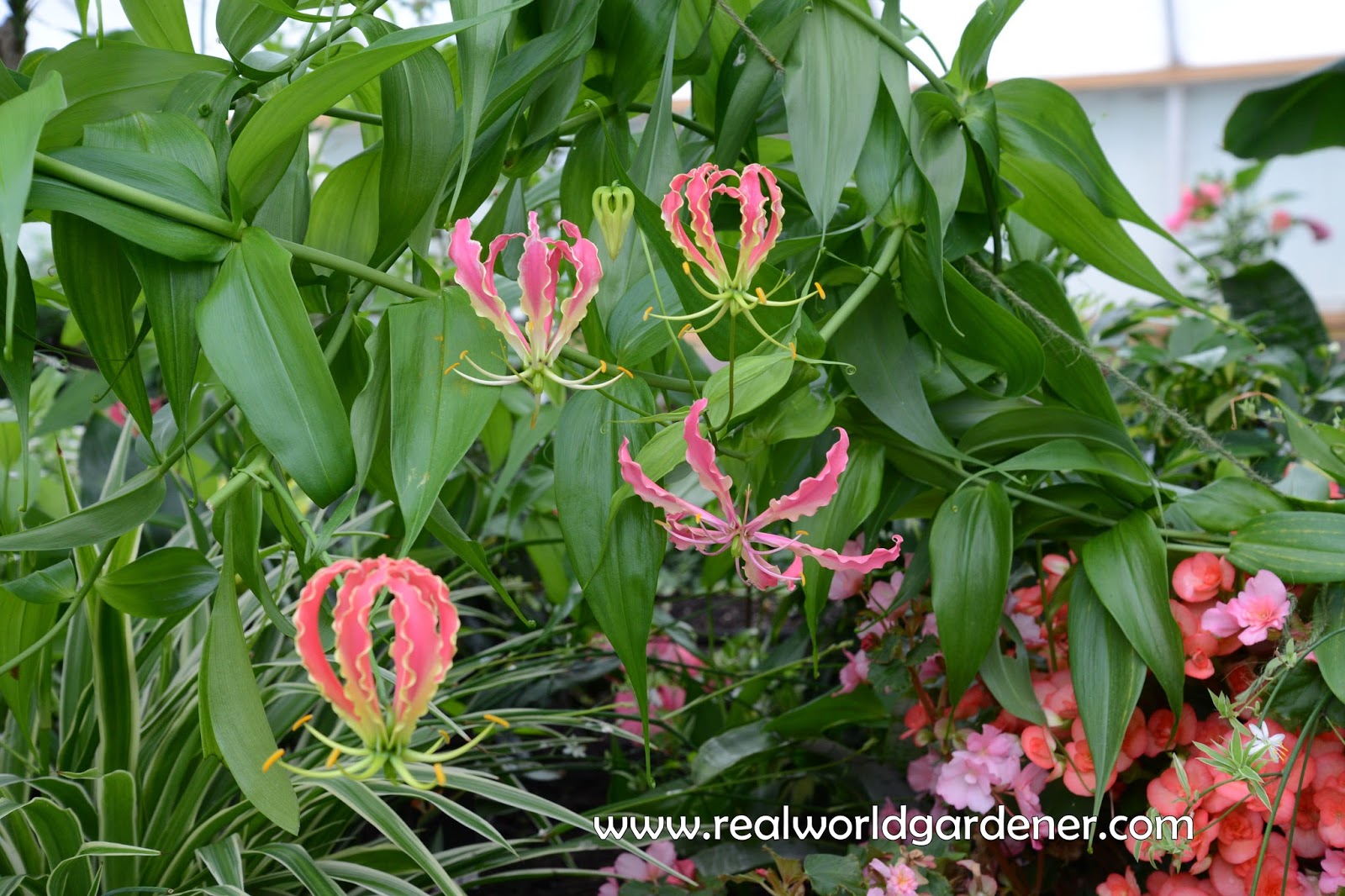
| Golden chalice vine |
Tropical zones: Poinciana tree, and Frangipanis. Check out the facebook page of the Frangipani Society of Australia.
PLANT OF THE WEEK
Poinsettias PrincettiaThis next plant’s leaves was used by the Aztecs to make red dye and the plants’ milky white sap was also used to treat fevers.
 |
| Poinsettia Princettia Soft Pink |
The bloke that this plant was named after also founded the Smithsonian Institute in America.
What is it? Let’s find out..
I'm talking with the plant panel: Karen Smith, editor of Hort Journal www.hortjournal.com.au and Jeremy Critchley, The Green Gallery wholesale nursery owner. www.thegreengallery.com.au
The ponsettias that you see for sale have been tricked into flowering in the summer months when they would prefer to flower when nights are long and days are short.
In America they're cheap as chips with plants selling for $US1 on 'Black Friday."
Here in Australia, plant growers have to provide a greenhouse with thick block out curtains to provide that 12 hours of darkness Poinsettias need to initiate flowering.
Then for the 'old school" varieties, they need to be sprayed with a dwarfing compound which is quite toxic, requiring the nurseryman/woman to suit up in protective clothing.
With all that extra effort, Poinsettias are that much more expensive to buy here.

Did you know that also in America Congress honor red Joel Poinsett by declaring December 12th as National Poinsettia Day which commemorates the date of his death in 1851.
Poinsettias can be grown south of Brisbane right down to Coff's Harbour, and north of Brisbane they will grow as far as the land extends, although they can be difficult to grow in frost prone areas west of the coast.
They can also be grown in warm parts of South Australia and in Western Australia's coastal regions, particularly in the north.
If you have any questions about growing Poinsettias, why not write in to realworldgardener@gmail.com
Poinsettias can be grown south of Brisbane right down to Coff's Harbour, and north of Brisbane they will grow as far as the land extends, although they can be difficult to grow in frost prone areas west of the coast.
They can also be grown in warm parts of South Australia and in Western Australia's coastal regions, particularly in the north.
If you have any questions about growing Poinsettias, why not write in to realworldgardener@gmail.com